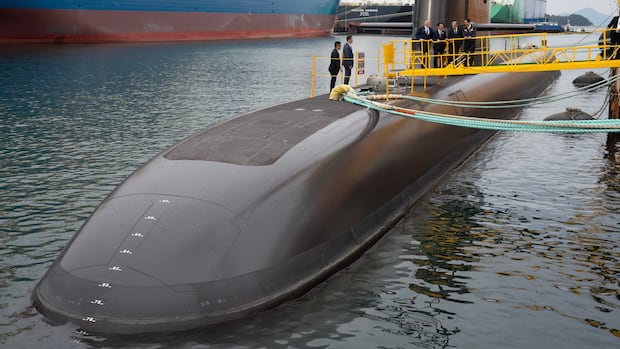
South Korea put political weight behind its bold, high-stakes bid to sell submarines to Canada on Thursday as Prime Minister Mark Carney got a look at one of the country’s new boats and toured the shipyard that would do the construction.
South Korea Prime Minister Kim Min-seok accompanied Carney during the visit to the Hanwha Ocean Ltd. facility in Geoje, 96 kilometres from Gyeongju, where the Asia Pacific Co-operation (APEC) summit is being held. Earlier in the day, Carney also met with South Korea’s new president, Lee Jae Myung.
Hanwha Ocean and its partner Hyundai Heavy Industries have been fairly aggressive in pitching the KSS-III (Batch 2) submarine to Canada, delivering an unsolicited, detailed proposal to the federal government last winter — just ahead of the last election.
The submarine Carney got to see was only recently launched and built for the South Korean navy. Yet, in a bold marketing move, it flew a Canadian flag from its mast, while a second boat under construction nearby had Korean and Canadian banners draped across it.
Aging subs to retire by 2035
Showing the prime minister the boat under construction was a not-so-subtle demonstration by the Koreans that their production lines are active and they can live up to the pledge to deliver four submarines to Canada by 2035 — the navy’s deadline to begin retiring the four, old Victoria-class boats.
Defence Minister David McGuinty and Vice-Admiral Angus Topshee, commander of the Royal Canadian Navy, also took the tour.
“It’s a beautiful submarine,” Topshee told journalists on Thursday. “Really impressed with the size of the submarine, the quality of the crew accommodations, the layout of the combat information center, where the submarine is controlled from. It’s an impressive boat.”
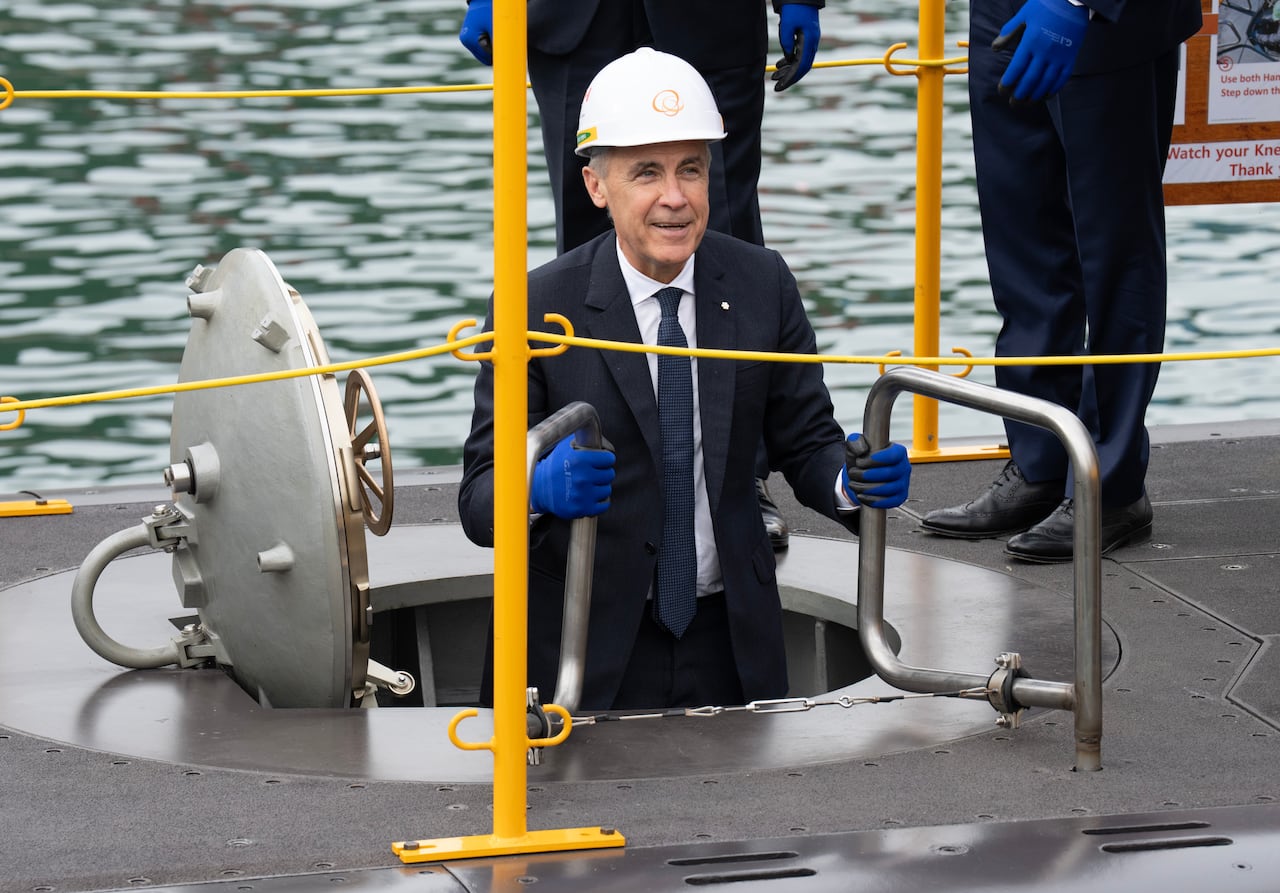 Carney smiles as he climbs down a ladder into a submarine during the tour. (Adrian Wyld/The Canadian Press)
Carney didn’t offer any remarks after the tour and a meeting with the company’s top executives.
Hanwha Ocean executive, Steve Jeong, a former vice-admiral in the Korean navy, said Carney had a lot of specific questions and seemed impressed with what he saw.
The visit was significant because it’s a sign the federal government is prepared to move swiftly toward a decision, perhaps as soon as next year.
While in Berlin in August, Carney announced the hunt for a few submarine builders had been narrowed down to two companies, Hanwha Ocean and ThyssenKrupp Marine Systems (TKMS) of Kiel, Germany, which the prime minister visited.
South Korea’s competition: Germany
One of the weaknesses in the German bid is that Canada likely wouldn’t see the first TKMS-built submarine until 2032, and it would be later in the decade when the other boats arrive.
The submarine replacement program will be managed out of the newly created Defence Investment Agency (DIA).
The cabinet secretary in charge of it, Stephen Fuhr, said a few weeks ago that Ottawa will favour the submarine pitch that creates the most Canadian jobs when it decides whether to award a contract.
Canada’s shipyards don’t have the capacity or technical know-how to build submarines. But the CEO of TKMS and Germany’s procurement minister have suggested that building some of the boat in Canada could be a possibility.
However, McGuinty appeared to pour cold water on the notion Thursday.
“We’re well on the way right now in terms of conducting this procurement with two established manufacturers, one in Germany and one here in Korea,” said McGuinty. “And having visited both of their facilities, I can say this: setting up a manufacturing site for submarines is not an uncomplicated thing. “
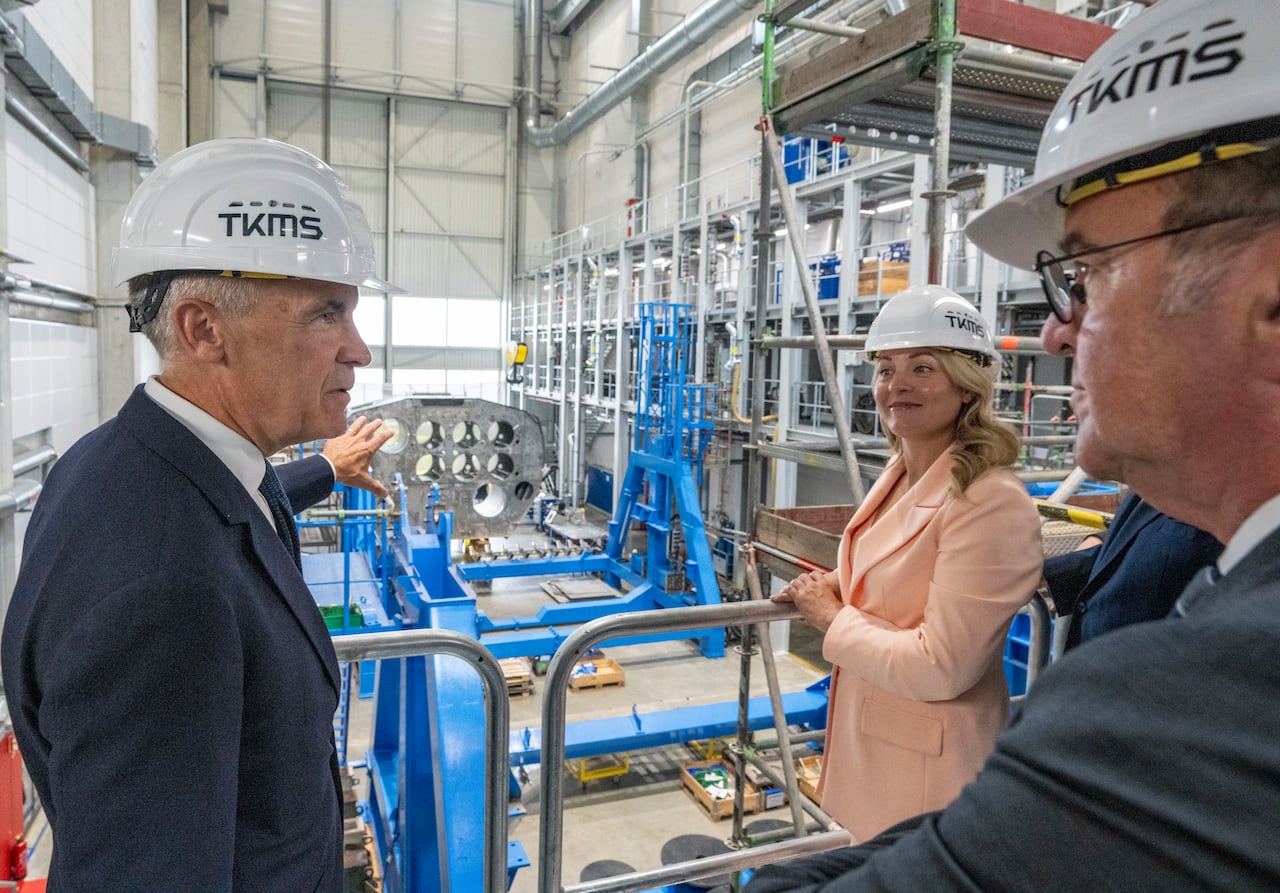 Here, Carney, left, can be seen on his tour of ThyssenKrupp Marine Systems, a submarine-building facility in Kiel, Germany. He’s accompanied by Minister of Industry Melanie Joly, second from right, and Germany’s Federal Minister of Defence Boris Pistorius on Aug. 26. (Christinne Muschi/The Canadian Press)
Topshee was more blunt, saying he needs the boats now.
“We’re not looking for either of the submarines to be built in Canada, to be honest, because Canada right now does not have any capacity to build submarines,” Topshee said, referring to both the Korean and German proposals. “Ultimately, how the government decides it would like to proceed is a decision for government. “
WATCH | It’s been a long time since Canada bought new subs:
Both the Korean and the German submarines meet the navy’s requirements, but Topshee acknowledged the replacement project doesn’t yet have an approved budget.
The numbers are still being refined by defence planners, he said.
“I’m not sure when the government will make a decision about the full funding,” Topshee said. “I would expect that this does fit in within the government’s commitment to get to the NATO target at five per cent,” he continued, referring to Canada’s promise to increase defence spending.
McGuinty acknowledged the budget has yet to be established and wouldn’t say when it would happen. He echoed Topshee in saying that the submarine replacement would be included in that NATO target.
“Canada is committed to meeting its two per cent GDP [NATO] target by March 31st,” the minister said. “We’re well underway.”
The cost of underspending
The tour came one day after the Parliamentary Budget Office released a report that quantified how much the Trudeau government underspent on equipment over seven years.
Between the fiscal years of 2017-18 to 2023-24, actual capital defence spending fell short of planned amounts by $18.5 billion, said the analysis, released Wednesday.
WATCH | Germany, South Korea show off their shipbuilding: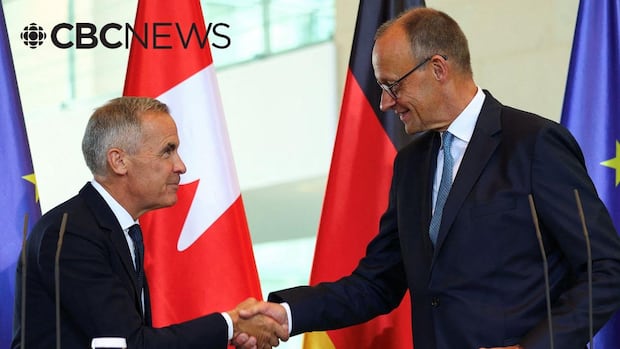
Canada narrows choice for new submarines to German, South Korean bidders
Prime Minister Mark Carney has announced that the field of contenders for Canada’s new submarines is down to two bidders, Germany’s TKMS and South Korea’s Hanwha Ocean.
The assessment does not look at the Carney government’s recent commitment to reach the NATO benchmark defence spending target of five per cent of GDP.
But it questions the ability to get there.
“The scale of the planned increase raises questions about the government’s capacity to manage a higher volume of procurement activity and the domestic defence industry’s ability to support it,” said the report.