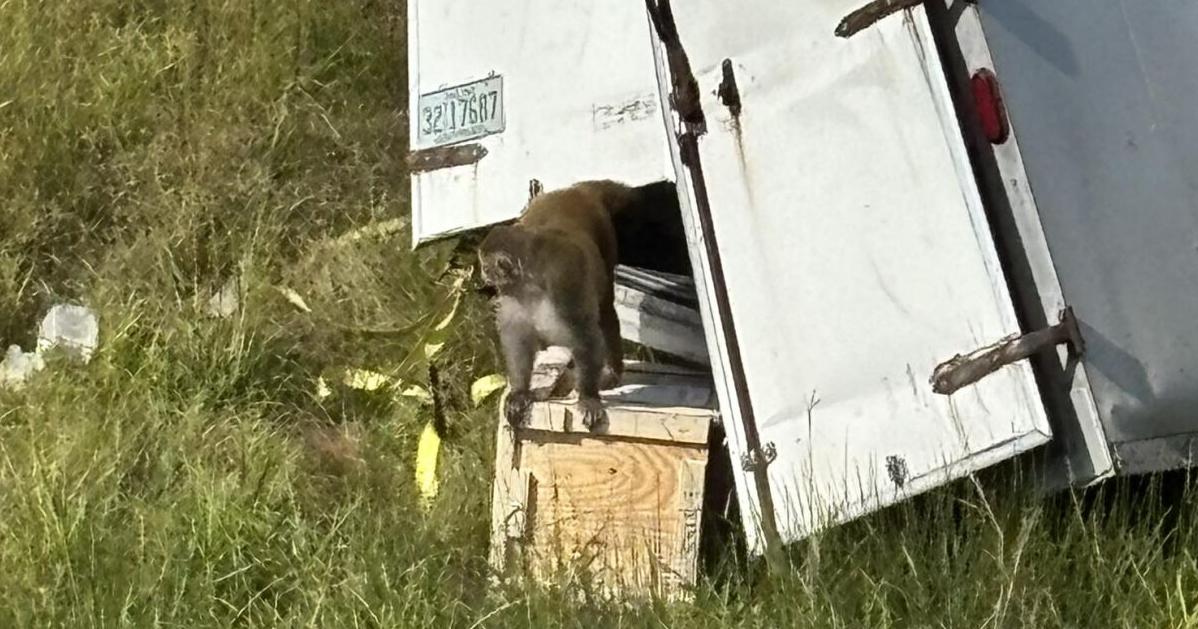
Mississippi authorities have captured an escaped monkey that had been on the lam since Tuesday after the truck carrying it flipped over a highway median, the Jasper County Sheriff’s Department said.
A homeowner found the monkey on his property near Heidelberg, Mississippi, according to a social media statement posted early Sunday. The Mississippi Department of Wildlife and Fisheries responded, and the rhesus macaque is now in the department’s possession. Two other monkeys remain on the loose.
The apprehended monkey was being transported along with 20 other macaques from Tulane University’s National Biomedical Research Center on the northshore when the truck carrying them crashed. Initial reports from the scene claimed the monkeys were “aggressive” and may have been infected with herpes, COVID-19 and hepatitis C.
Tulane officials quickly clarified that the monkeys were not infectious, but not before Mississippi authorities killed five of them.
In the days since, officials have left questions about the crash unanswered. It isn’t clear where the monkeys were headed or why some had to be killed. The Jasper County Sheriff’s Office said in a social media post Tuesday evening that the truck’s driver warned authorities the monkeys were dangerous and that anyone handling them should be wearing personal protective equipment.
“We took the appropriate actions after being given that information from the person transporting the monkey,” the sheriff’s office said.
On Sunday morning, the sheriff’s office declined to provide any comment beyond what was in Sunday’s social media statement.
Tulane spokesperson Michael Strecker previously said that the university was not involved in the monkeys’ transportation, but confirmed that they had left Tulane’s research center shortly before the “tragic incident” took place. He said the university often provides primates to other organizations to “advance scientific discovery.”
The incident has sparked outrage from animal-rights organizations, which have long called attention to the practices at Tulane’s northshore research facility, where medical research is conducted on monkeys.
“Terrified monkeys running for their lives into unprotected, populated areas is exactly the spark that could ignite the next pandemic,” said People for the Ethical Treatment of Animals (PETA) Senior Vice President Kathy Guillermo.

People wearing protective clothing search along a highway in Heidelberg, Miss., on Wednesday, Oct. 29, 2025, near the site of a truck which overturned Tuesday, that was carrying research monkeys. (AP Photo/Sophie Bates)
Sophie Bates
Though it may be alarming to have monkeys running around rural Mississippi, Tony Goldberg, a professor at the University of Wisconsin School of Veterinary Medicine who specializes in cross-species disease transmission, stressed that the monkeys aren’t likely to set off the next pandemic. Rhesus macaques often live near populated areas in Asia, where they can interact with people without spreading infections.
“So three monkeys on the run in Mississippi, I wouldn’t be alarmist about it,” he said.
Still, officials with the wildlife department have urged residents to avoid contact with the monkeys and to report sightings by calling (800) BE-SMART.