U.S. President Donald Trump with Treasury Secretary Scott Bessent at the Gyeongju National Museum in Gyeongju, South Korea on Oct. 29, 2025. On CNN on Sunday, Bessent refuses to rule out additional tariffs on Canada.Mark Schiefelbein/The Associated Press
U.S. Treasury Secretary Scott Bessent signalled on Sunday that the Trump administration is still considering imposing an additional tariff on Canadian imports, creating more uncertainty in a trade war that is wreaking havoc on Canada’s steel, aluminum, automobile and lumber sectors.
In an appearance on CNN on Sunday, Mr. Bessent was asked whether U.S. President Donald Trump was going to follow through on his threat to bring in an additional 10-per-cent tariff in retaliation for an anti-tariff TV ad commissioned by the Ontario government.
“We’ll see,” he responded.
“I do think it was a big setback for the Canadian government and the Premier of Ontario should be ashamed.”
Mr. Trump broke off trade talks with Canada on Oct. 23, citing the ad, and later threatened to impose the new tariff.
Explainer: What you need to know about Ontario’s anti-tariff ad
The Government of Ontario released this TV ad that uses a recording of Ronald Reagan to argue against tariffs.
Government of Ontario
Mr. Trump has not yet issued any executive order to enforce the threatened 10-per-cent hike. It’s not clear if this new levy would apply to all Canadian imports or a selection of them. And he has announced no date for this increase.
Ontario’s television ad campaign in the U.S. featured 1987 footage of then-president Ronald Reagan, a Republican, criticizing trade wars as making little business sense.
Mr. Bessent called the Ontario-funded ad campaign “unacceptable,” and he accused Ontario Premier Doug Ford of “sending propaganda across the U.S. border via our own airwaves.” He compared it with interfering with an election.
“Nobody likes foreign election interference, he said. ”Nobody likes foreign governments trying to sway public opinion for their own good.”
Mr. Trump, in cancelling trade talks, accused Ontario of misleading the American people by leaving out parts of Mr. Reagan’s address in which he justified imposing tariffs on Japan.
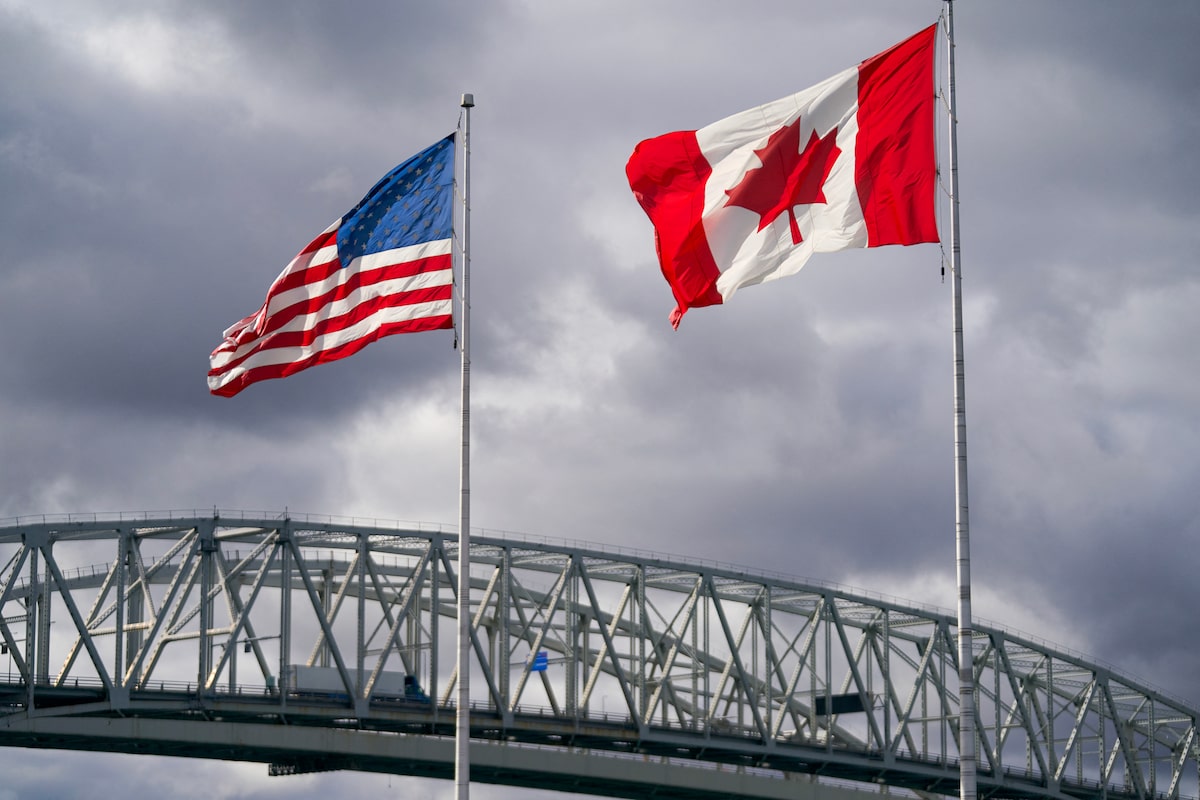
The U.S. and Canada flags at the border crossing in Point Edward, Ont. Trump said he will imposed an extra 10-per-cent tariff on Canadian imports because of an anti-tariff advertisement form Ontario.GEOFF ROBINS/AFP/Getty Images
Prime Minister Mark Carney said on Saturday that he had advised Mr. Ford not to run the TV ad.
Speaking to reporters at the Asia-Pacific Economic Cooperation summit, Mr. Carney also confirmed he had apologized to Mr. Trump for the advertisement.
He said the apology was conveyed to the U.S. President Wednesday evening when the pair and other leaders attended a dinner hosted by South Korean President Lee Jae Myung. The meal was in Mr. Trump’s honour.
Before the ad ran, there was hope that a deal between Canada and the U.S. on tariffs might be unveiled at the APEC summit.
In Detroit, where sympathy for Canada runs high, residents are divided on Reagan anti-tariff ad
Canada’s steel and aluminum sectors are currently dealing with the worst of Mr. Trump’s tariffs, with a 50-per-cent levy that came into effect in June, up from the original 25 per cent imposed in March. A large swath of Canada’s auto sector is subject to 25-per-cent U.S. tariffs, while softwood producers are facing levies of more than 45 per cent.
If Mr. Trump raises tariffs on the steel sector, Jim Ritchie, owner of Vancouver-based metals distribution company Cascadia Metals Ltd., said it would be “very bad news” for any Canadian mill still sending metal to the U.S.
Last week, Algoma Steel Group Inc. ASTL-T, Canada’s last remaining independent steelmaker, reported a $485.1-million loss in the third quarter, incurring almost $90-million in tariff costs and taking a writedown of more than $500-million.
Mr. Ritchie isn’t convinced Mr. Trump will actually increase tariffs on Canada, pointing out that while some of the President’s threats have come into fruition, many have not.
Tony Keller: Is Doug Ford’s TV ad to blame for Donald Trump’s tariff tantrum? Be serious
“The on-again, off-again punishment of Canada, I don’t want to just brush it off,” Mr. Ritchie said. “But I think that we’re kind of used to it now.”
Giles Gherson, chief executive officer of the Toronto Region Board of Trade, said the continuing uncertainty of an unresolved trade war is causing many Canadian businesses to delay making new investments in plants, machinery and equipment.
“This is actually a time when we want to see Canadian companies expanding, modernizing, investing in the most up-to-date production technologies, so they can be competitive both in Canada and globally,” he said. “But who’s going to invest in new equipment and technology if their market is shrinking in front of them?”
With a report from Steven Chase in Gyeongju, South Korea