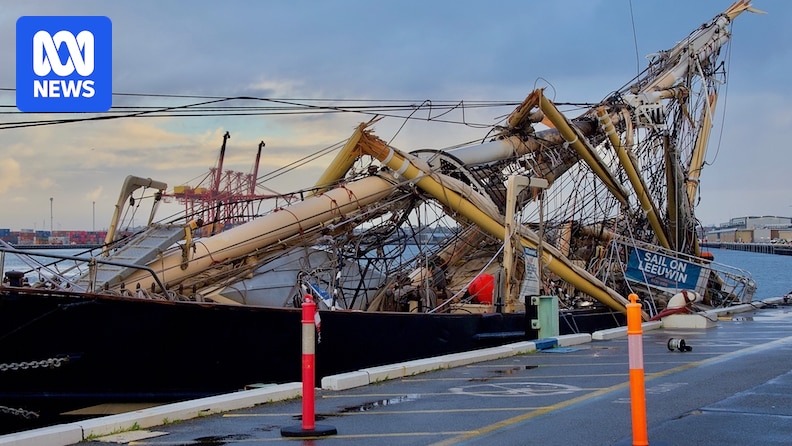
A lack of effective communication contributed to a collision between the sail training ship Leeuwin II and a container ship in Fremantle Harbour last year that injured two crew members, a new report has found.
The investigation by the Australian Transport Safety Bureau (ATSB) found one of the harbour pilots helping navigate the 333-metre long Maersk Shekou into the port failed to issue a crucial instruction as the giant vessel battled through rough seas and stormy weather, escorted by four tugboats.
Loading…
A secondary pilot, who was meant to be monitoring the ship’s arrival, was distracted by taking a non-essential phone call.
The container ship, which was laden with more than 4,000 shipping containers, struck the Leeuwin, which was berthed at the quay, causing the vessel’s wooden masts to collapse.
The two crew members on the Leeuwin sustained minor injuries trying to flee the ship via the gangway as the collision occurred.
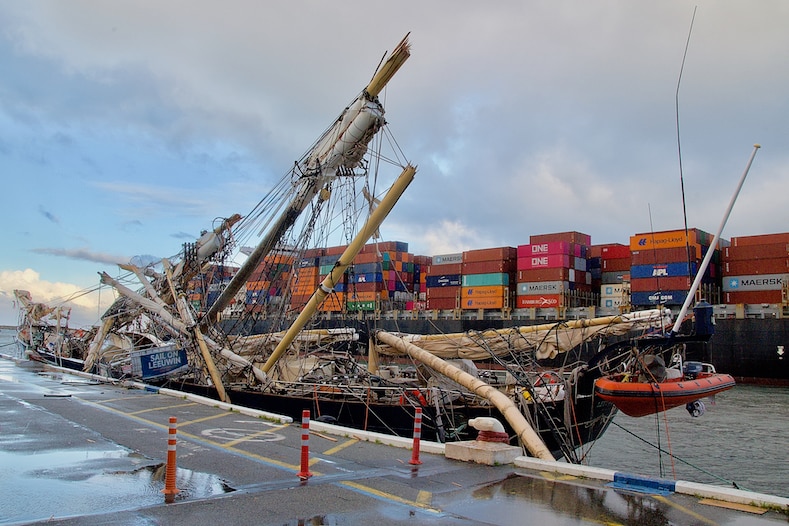
The Leeuwin was struck by a container ship. (Supplied: Roel Loopers )
Meanwhile, the Maersk Shekou’s stern struck the roof of the nearby WA Maritime Museum, damaging the facade.
The report found crew on the container ship’s bridge “failed to adequately monitor, or challenge, the ship’s turn and position in the channel”.
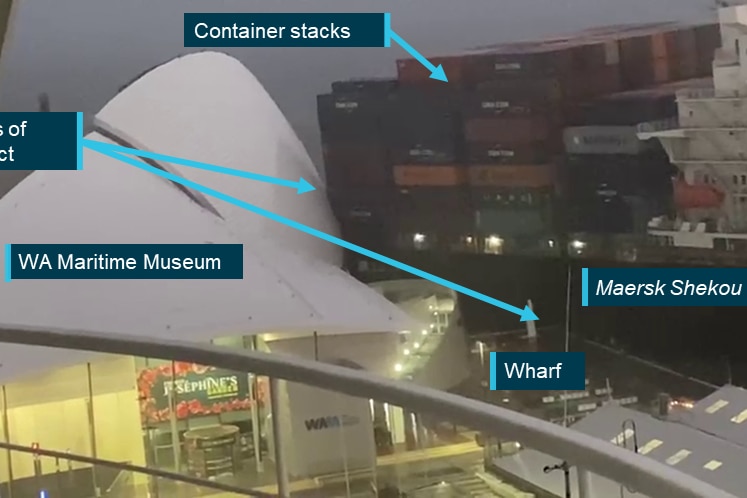
The moment the ship comes into contact with the roof of the WA Maritime Museum. (Supplied: Fremantle Ports Authority)
As it swung away, the hull of the Maersk Shekou scraped against the wharf, gouging a 1.8 metre long hole in its side and collecting concrete and timber debris from the damaged wharf along the way.
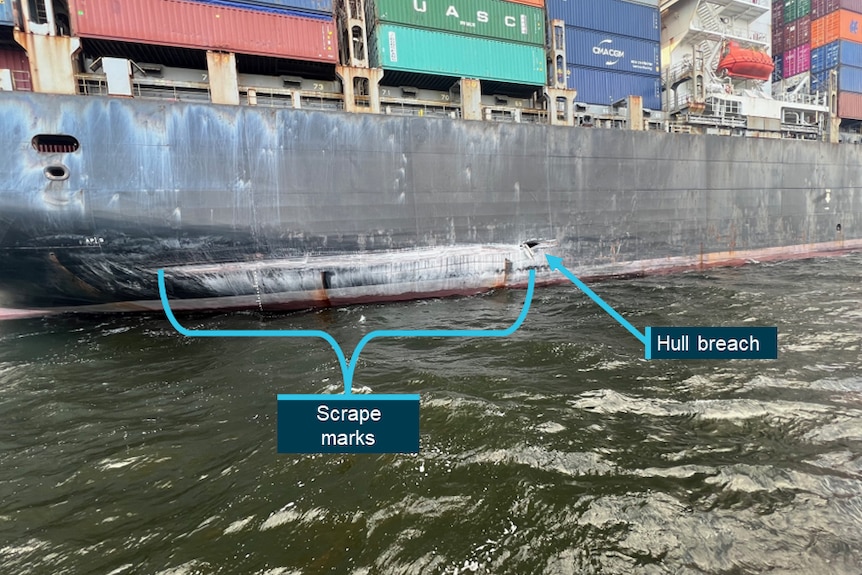
Scrape marks left on the ship from its contact with the Leeuwin. (Supplied: Maersk Shekou’s P&I representative)
Secondary pilot ‘on phone’
The report was scathing about the actions of many of the personnel involved in trying to get the ship into the harbour.
Much of the report’s focus was on the operations of the pilots tasked with navigating the ship into the harbour.
Repairs begin on iconic Leeuwin sailing ship
Day and night, whenever a ship arrives in the waters off Fremantle Port, a local team boards the vessel and takes control.
Battling wind gusts of up to 54 knots as the container ship approached the port, the report said the pilot failed to tell the helmsman to turn into the inner harbour, meaning the ship continued to barrel towards the Leeuwin.
And the secondary pilot did not realise the lead pilot had changed course because they were on their mobile phone.
Weather conditions were more severe than had been forecast, with squalls and high winds — but the unusual conditions were not mentioned when the pilot discussed the ship’s entry into the harbour with the harbour’s vessel traffic services operator.
The Maersk Shekou entered the port while it was still dark — contrary to harbour rules for ships of that size — and while weather conditions were too severe for them to safely enter, according to the rules.
Ineffective risk controls
As part of their probe, investigators conducted four separate simulations of the Maersk Shekou’s arrival into the harbour using tugboats under similar weather conditions — and in each case, pilots were able to successfully guide the ship into the port.
Investigators also highlighted ineffective risk controls by Fremantle Port, which “likely increased” safety incidents.
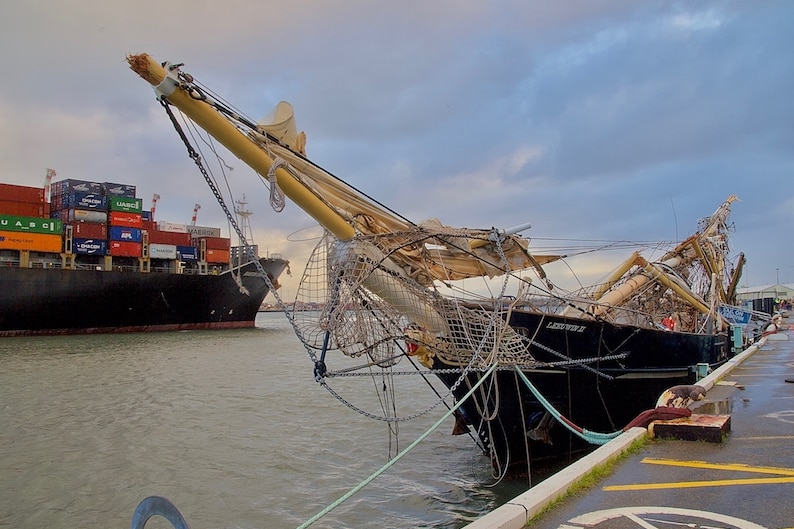
Fremantle Port has improved its safety procedures since the Leeuwin accident. (Supplied: Roel Loopers )
Both the port and the pilot company Fremantle Pilots have since committed to improving their safety and weather monitoring protocols.
Last week the Leeuwin sailed back into the harbour for the first time since the accident, having undergone extensive repairs, with its sail training program expected to resume early next year.
Loading