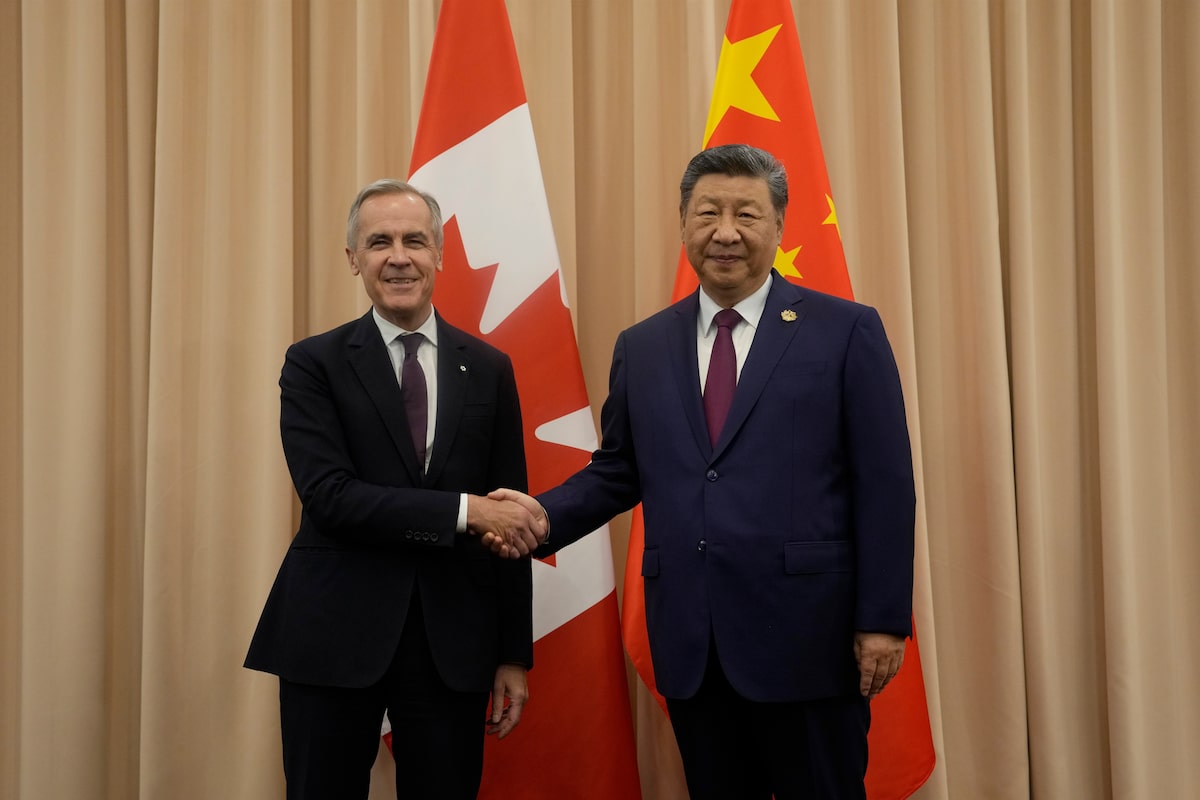
Prime Minister Mark Carney shakes hands with Chinese President Xi Jinping at the start of a meeting in Gyeongju, South Korea, on Oct. 31.Adrian Wyld/The Canadian Press
The Chinese government has allowed the country’s group tour operators to resume travel to Canada, a potential boon for tourism that follows Prime Minister Mark Carney‘s efforts to repair relations with Beijing.
Mr. Carney and Xi Jinping met Oct. 31 in South Korea for the first sit-down meeting between a Canadian prime minister and the Chinese President in eight years.
Canada was left off the list in 2023 when China loosened restrictions on group travel for its citizens that had been imposed during the COVID-19 pandemic. That year, Canada was embroiled in a debate over Chinese foreign interference. Then-prime minister Justin Trudeau announced a public inquiry into the matter.
Chinese foreign ministry spokesperson Mao Ning announced the change in Beijing Monday, saying her government believes it will “promote people-to-people exchanges between the two countries and deepen mutual understanding and friendship between the two peoples.”
“We stand ready to work with Canada to make cross-border travel easier and hope that Canada will work with China and provide a safe and enjoyable environment for Chinese tourists,” she added.
Carney says he raised foreign interference with Xi
Mr. Carney and Mr. Xi met on the sidelines of the Asia-Pacific Economic Cooperation summit in Gyeongju, South Korea, as the Prime Minister seeks new markets for Canada to offset the economic damage wrought by U.S. President Donald Trump’s tariffs.
Sébastien Benedict, president of the Tourism Industry Association of Canada, said his group is pleased to see approved destination status restored for travellers from China.
“Chinese visitors are among our highest‑value travellers, staying longer and spending more, and this decision jumpstarts the return of group tours, helps rebuild air links and supports jobs and businesses in every region,” Mr. Benedict said.
In 2019, before pandemic travel restrictions, Canada saw more than 700,000 visitors from China. In 2025, according to TIAC, visits from China are down to less than 60 per cent of 2019 levels.
Goldy Hyder, president of the Business Council of Canada, said permission to resume group travel from China was “the signal that the Canadian government had hoped to see.”
He said it’s evidence the Carney-Xi meeting went as well as the government had described.
Foreign Affairs Minister Anita Anand said the granting of approved destination status for Canada by China “marks another important step in the recalibrated bilateral relationship.”
Doug Saunders: Carney wants a China ‘reset.’ May he avoid the mistakes of the previous four
Canada and China, however, have yet to make progress on a punishing trade war that is hurting Canadian farmers and fishermen.
Canada imposed a 100-per-cent tariff on Chinese electric vehicles last year in tandem with the former Biden administration, as well as a 25-per-cent levy on steel and aluminum from China. China retaliated with tariffs on Canadian canola oil, canola meal, peas and Canadian seafood and pork products. It ratcheted up the pressure in August by imposing a duty of more than 75 per cent on Canadian canola seed, a major crop in Alberta, Saskatchewan and Manitoba.
Mr. Carney’s courting of Mr. Xi is an abrupt change of course in Ottawa’s approach to China, a country Ottawa publicly characterized less than three years ago as an “increasingly disruptive” global power.
Mr. Trump’s protectionism is driving U.S. allies to look far and wide for new markets, including in countries Canada has often criticized for human-rights abuses.
During the same Monday press conference in Beijing where the resumption of tours was announced, the Chinese foreign ministry spokesperson signalled disapproval of Canada signing a joint military pact with the Philippines on Nov. 2, an agreement that Manila’s defence minister said would help counter China’s expansionist ambitions in the region.
“To flex muscle and stoke confrontation is not conducive to regional peace and stability,” Ms. Mao said.