
Federal public sector unions say they’re preparing for deep cuts to come out of Tuesday’s federal budget.
Since the federal election earlier this year, the Mark Carney government has aimed to “spend less, invest more” by reining in spending on day-to-day government work to funnel money into other priorities.
Some of Canada’s nearly 360,000 federal public service employees — more than 40 per cent of them in the Ottawa-Gatineau area — are hearing that phrase as a warning.
“I have grave concerns with the things I’ve been seeing over the last couple of weeks about the cuts of the public service and what effects that will have on Canadians,” said Sean O’Reilly, president of the Professional Institute of the Public Service of Canada (PIPSC), which represents 75,000 federal public servants.
O’Reilly told CBC News he’s worried the government is looking too heavily at outsourcing and workforce adjustment, “which for us means cuts.”
WATCH | Government will make ‘workforce adjustments’ in a ‘smart way’: finance minister: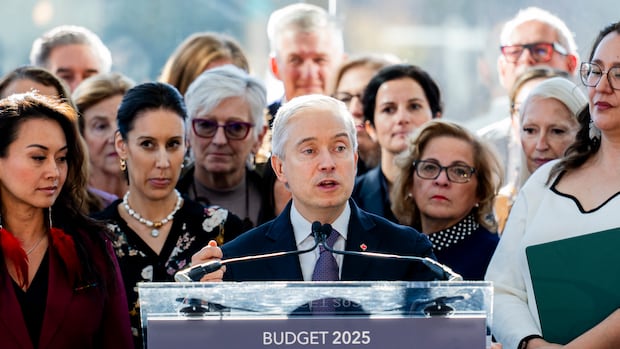
Government will make ‘workforce adjustments’ in a ‘smart way’: finance minister
Ahead of next week’s federal budget, Finance Minister François-Philippe Champagne says the government has been fair and balanced in making ‘tough choices’ around cuts to civil service.
Scaling back public service spending was promised in the last two budgets of the previous Justin Trudeau government.
In April 2024, it promised to cut 5,000 public service jobs over five years. The government then shed 10,000 in just one year for about a three per cent reduction.
Carney and Finance Minister Francois-Philippe Champagne asked cabinet this summer to reduce program spending by 7.5 per cent in the fiscal year that begins this coming April, followed by 10 per cent the year after and 15 per cent in 2028-29.
Champagne described the budget as a “generational investment” that will focus on national priorities.
“Canadians have asked us to build big bold things,” he told reporters Monday. “We’re going to do the kind of things that will make this country stronger and everyone will see themselves in that budget.”
In Prime Minister Mark Carney’s budget speech at the University of Ottawa late last month, he said his government will balance the deficit by “reducing wasteful government spending and doing more with less.”
O’Reilly said he’s concerned doing more with less will directly impact the quality of services Canadians depend on.
The contractor question
The president of the Canadian Association of Professional Employees, which represents 25,000 federal public service workers, told CBC News that “Canadians have been lied to over and over again that the public service is bloated.”
Nathan Prier said the opposite is true.
“If there’s a big deficit right now, it’s because big program promises get made to Canadians without squaring how they’re going to pay for it,” said Prier.
“[It’s] not because of the money that they’re spending on the people working to deliver those programs.”
Prier said he’s concerned the government will outsource public sector work to private contractors — something he said the federal government did earlier this year.
CBC News chief political correspondent Rosemary Barton hosts special coverage of Prime Minister Mark Carney’s first federal budget, on CBC-TV and CBC News Network at 3 p.m. ET. Power & Politics will provide further analysis on CBC News Network at 5 p.m. ET.
On radio, Your World Tonight‘s Susan Bonner and Catherine Cullen of The House host special coverage beginning at 4 p.m. ET on CBC Radio and the CBC Listen app.
Coverage will also stream live on CBC Gem, the CBC News App and on the CBC News YouTube (3 to 7 p.m. ET) and TikTok (3 to 5 p.m. ET) channels.
Geneviève Tellier, a political science professor at the University of Ottawa, said the government has been trying to sell two messages at once.
“On the one hand, they’re talking about sacrifices … people working in the public sector and the federal government, some may lose their job,” she said.
“But on the other hand, [the government] is talking about a transformational budget, heavy investment in different key areas.”
“This country desperately needs a strong federal government making crisp decisions based on evidence. And that’s what our members do, they deliver evidence based decision making options to decision makers,” said Prier.
Until the budget is made public after 4 p.m., it is not known what sorts of cuts or investments will be coming, but both unions say savings are possible — just not where politicians are looking for them.
Prier says the government could look to reduce “management bloat,” “reliance on contractors,” and to “downsize our real estate footprint and let workers that really don’t need to be in an office work from home.”
“This is a terrible time to lose a skilled, knowledgeable workforce,” he said.