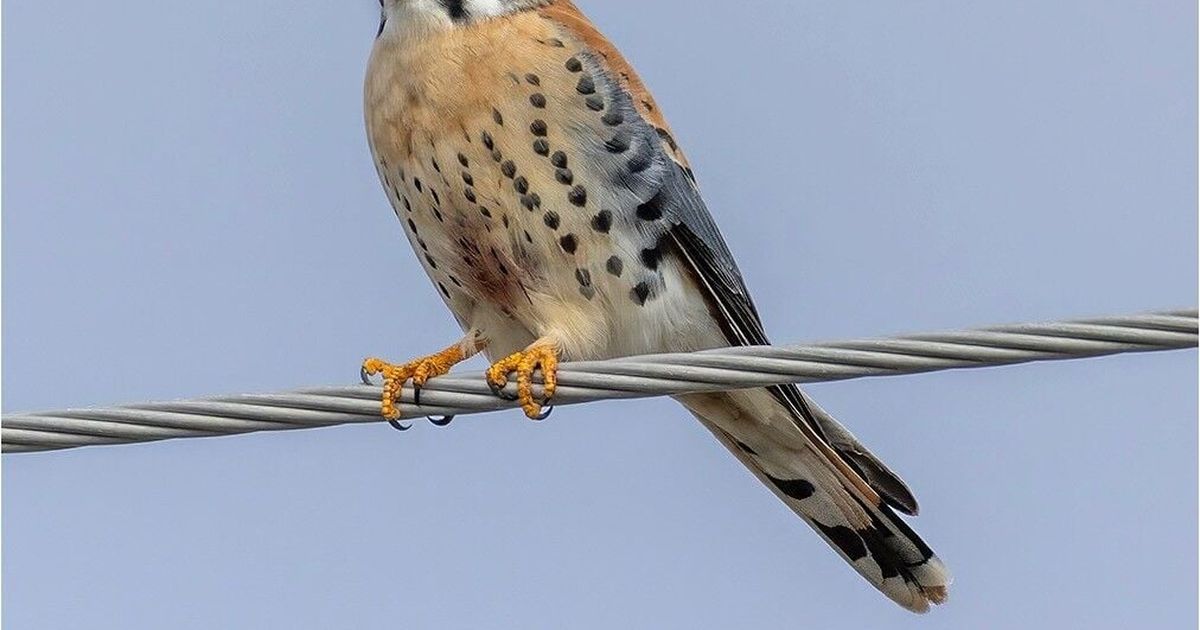
Chihuahuas of the avian world, the American kestrel is small, territorial and feisty.
About the size of a blue jay and weighing little more than a handful of nickels, the kestrel is North America’s tiniest falcon. Even so, you don’t need to be hawk-eyed to spot one.
And judging by the many photographs being posted on social media these days, autumn is a good time to see them in our region. Instead of migrating south for winter, many stick around.
Perhaps you have seen a kestrel perched on a pole, treetop or wire above meadows, fields and semi-open urban environments. As a miniature bird of prey, they are scanning for large insects, rodents and snakes to ambush.
Because many bird species like to perch, how can you tell if you are seeing a kestrel, particularly from the distance? Note the bird’s movements. If it occasionally bobs its head and flicks its long tail, it is likely a kestrel.
Or, you might spot a kestrel hover-hunting to get food when there are no perches around. They will hover in midair, hummingbird style, above a food source located on the ground directly below them. To execute this specialized flight behavior, “they catch the wind, flap their wings, and work their long tails to stay perfectly steady as they home in on their prey,” according to the Cornell Lab of Ornithology.
Just as chihuahuas are known to bark loudly and charge off perceived trespassers, kestrels often defend their hunting grounds and nesting sites by dive-bombing red-tailed hawks, northern harriers and other large raptors, Cornell explains on its website. All the while, they will blare out a loud, rapid series of “Klee! Klee! Klee!” get-out-of-here alarm calls.
A small rodent seized by a kestrel’s sharp talons would certainly disagree, but this bird is beautiful. Its intricate tapestry of rusty-red, slate-blue and warmish brown feathers make it one of the world’s most colorful raptors, according to the Cornell Lab. The kestrel also sports two black vertical streaks under each eye. Besides being stylish, scientists believe the dark stripes evolved to reduce glare from the sun to help the birds hunt, like baseball athletes using eye black to help them see the ball.
These bold facial markings, along with their colorful plumage and distinctive hunting behaviors make the American kestrel easy to spot. But that doesn’t mean it is thriving.
Scientists estimate that since 1970, the kestrel population has been cut by half across the country , according to the National Audubon Society. Multiple factors are suspected, including habitat loss, less prey due to pesticides and fewer nesting spots.
“It’s definitely a worrisome decline,” said Mike Borysewicz, board member with the Spokane Audubon Society.
Borysewicz is among the kestrel’s legions of admirers trying to boost the bird’s numbers. He helped launch Spokane Audubon’s Kestrel Nest Box Project, a volunteer-led venture that partners with private landowners and government entities to build and monitor nest boxes in areas of Spokane County where kestrels breed.
The project is modeled after a successful kestrel nest box program run by the North Central Washington Audubon chapter. Most of the boxes are installed in the Waterville Plateau area located about 30 miles northeast of East Wenatchee.
“Kestrels are cavity nesters that will readily use human-made wooden boxes to raise their young,” Borysewicz explained. Even so, recovery is gradual, with progress measured in small steps, he added.
One nest box at a time.