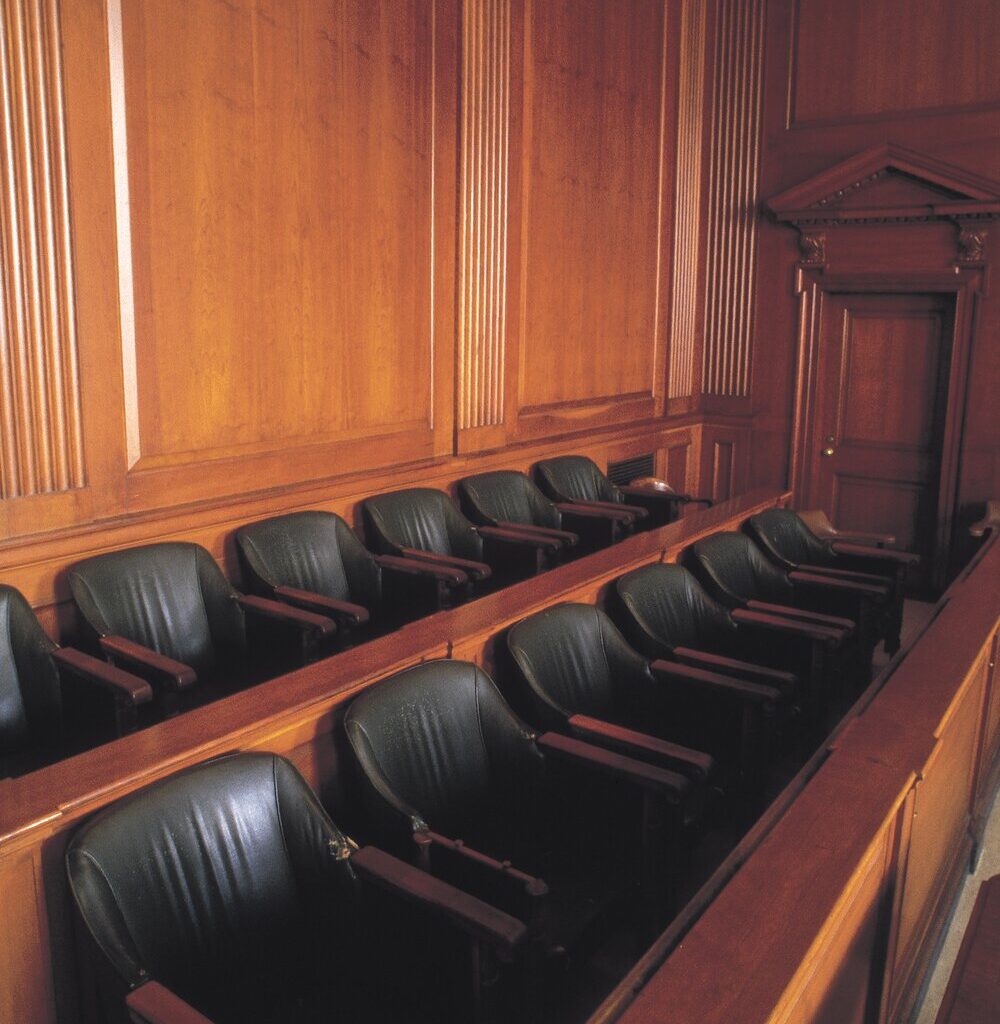
PHOENIX – The Arizona Supreme Court will decide how absolute the constitutional right of trial by jury is.
In a brief order, the justices agreed to hear arguments by attorneys for EFG America LLC of Mesa that claims of securities fraud against it by the Arizona Corporation Commission cannot be decided by the commission itself.
Instead, attorney Aditya Dynar of Pacific Legal Foundations, which is representing the company, contends his client is entitled to have its case decided by jurors.
The company lost the first round in the legal battle at the Court of Appeals.
Judges acknowledged there is a right to a trial by jury in the Arizona Constitution. But they concluded that it was overridden by another section which grants specific authority to handle such cases to the commission.
In deciding to hear the case, the justices rebuffed Elizabeth Schmitt, the commission’s attorney, who told them there was no reason for them to get involved. She said the legal fight “applies to only a single category of matters before a single agency and does not have the immense impact claimed by petitioners.”
But Dynar told Capitol Media Services that what the high court decides ultimately could set new precedents. And that most specifically involves the rights of anyone who has a dispute with a state agency, like individuals whose right to practice is governed by a regulatory board and businesses that find themselves in a dispute over whether they are complying with rules and regulations.
All that goes to the system used not only by the Corporation Commission but most state agencies who review claims of violations or laws or reguations.
These are generally referred to a hearing officer – called an “administrative law judge” – who takes evidence and decides if the rules have been violated. But in all cases, that becomes little more than a recommendation, with the agency itself having the final say.
Dynar said that’s not due process.
This case involves EFG, which recycles rubber.
Pacific Legal, which is defending the company for free, says EFG developed what it believed to be a proprietary chemical process to do the job more efficiently than competitors. It says that founder Douglas Fimrite, needing capital for the new business, sold securities to investors.
But the commission, in its complaint, says EFG made material misrepresentations and omissions to investors in connection with the sale of more than $26 million in unregistered securities. The allegations include that the company provided investors with baseless financial projections and failed to disclose prior lawsuits, judgments and bankruptcies.
Following normal procedures, the commission referred the case to its own in-house administrative law judge. And that person rejected the company’s request to instead transfer the case to an actual court where there could be a jury trial.
That sent Dynar to the Court of Appeals.
Appellate Judge James Morse Jr. acknowledged there is a provision in the Arizona Constitution that says “the right of trial by jury shall remain inviolate.”
But Morse, writing for the unanimous three-judge panel also pointed out that the commission itself was constitutionally created and has “the power and authority to enforce its rules, regulations and orders by the imposition of such fines as it may deem just.” In fact, he said the only constitutional limit is that any fines can be no more than $5,000 for each violation.
“If our constitutional framers had intended to confer a jury-trial right for commission enforcement actions, they would have done so,” Morse wrote. “Given the framers’ omission of such a right, and the absence of a statutory grant, we conclude that Arizona law does not grant a jury-trial right for commission enforcement actions.”
Dynar, however, is telling the Supreme Court it’s not that simple. He contends that state constitutional right to a trial by jury is supreme and pretty much absolute – and cannot be overridden by other provisions.
It comes down to how he interprets the Arizona Constitution.
He said after the constitution says that the right to a jury trial “shall remain inviolate,” it then spells out things like the requirement for a 12-person jury in serious criminal cases and that the verdict must be unanimous.
“It then states in no uncertain words: ‘In all other cases, the number of jurors, not less than six, and the number required to render a verdict, shall be specified by law,” Dynar told the justices.
“That last sentence means the legislature can set the number of jurors and decide whether jury unanimity is necessary ‘in all other cases,”’ he said. “But neither the legislature nor the commission has the power to declare the right to jury trial is unavailable in some categories of civil cases.”
Dynar said even if the justices say the state constitutional provisions don’t apply, there’s also language in the Seventh Amendment of the U.S. Constitution.
It guarantees a right to a jury trial in any suit “at common law” where the value exceeds $20. And Dynar said what’s at issue here comes down to a claim of fraud which fits that “common law” description.
All those arguments ultimately come down to claims by Pacific Legal that the process at issue is legally wrong.
“This unjust system puts defendants at the mercy of the very agency seeking to punish them by acting as a prosecutor, judge, and punisher rolled into one court-like apparatus within the agency’s own walls and without a jury trial,” the organization stated in a press release.
And Dynar said that only after going through the time and expense of a hearing and the agency does the accused individual or company facing a fine or other penalty finally get a day in an actual court.
And that, in turn, goes to how far-reaching a ruling in EFG’s favor might be – beyond whether the company gets the jury trial it seeks.
“I think it definitely could set a precedent for future cases,” Dynar said.
Howard Fischer
Mr. Fischer, a longtime award-winning Arizona journalist, is founder and operator of Capitol Media Services.