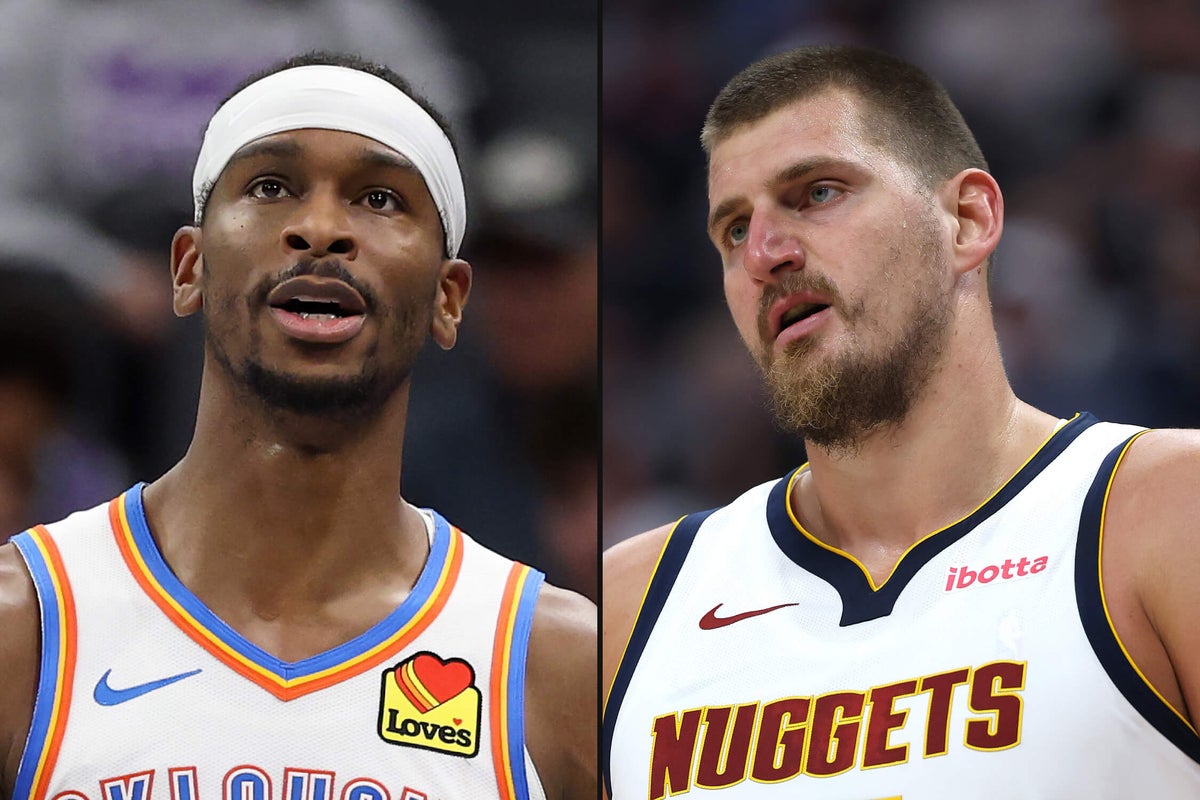
Luka. SGA. Joker. Giannis.
Whatever name you use, they are the four best players in the NBA. That seemed clear enough as the season was about to begin, but the events of the first three weeks have only furthered the idea that these four guys are on one level and everyone else is on another.
To wit: Shai Gilgeous-Alexander, Nikola Jokić and Giannis Antetokounmpo have won six of the past seven MVP awards, and the odds seem extremely strong that one of them will make it seven of eight this season. The only potential rival, thus far, is the 26-year-old Dončić, the youngest of the bunch and the seeming heir (along with the San Antonio Spurs’ absurd Victor Wembanyama) to their throne at some point.
All four of them have been awesome for most of the last half-decade and have the team success to back it up, with Dončić dragging the Dallas Mavericks to the 2024 NBA Finals and the other three leading their teams to championships. And all four only seem set to deliver even more this season.
That’s possibly understating things, actually. Here’s an amazing fact, given all they’ve accomplished: Each is having the best year of his career so far.
Antetokounmpo broke the PER record (31.9) in 2019-20 and Jokić nudged past it in 2021-22 (32.8); but both of them would smash the mark if they keep up their level of play this year. Meanwhile, Gilgeous-Alexander and Dončić are having seasons that would be historic in their own right if it weren’t for Giannis and the Joker; they are on pace to become the seventh and eighth players in NBA history to post a PER of greater than 31 for a full season while playing at least 1,000 minutes. The others are Jokić, Antetokounmpo, Michael Jordan, LeBron James, Joel Embiid and Stephen Curry.
(If you’re wondering about Wilt Chamberlain and Bill Russell, PER only works back to 1974, when the NBA started tracking everything that goes into the formula; before then, a lack of data on turnovers in particular makes it impossible to compare apples to apples.)
Combined, the four players’ teams are 32-10 through Monday’s games, and they are so far ahead of the rest of the pack in the advanced stats that it’s laughable.
For instance, here’s the PER leaderboard through Sunday’s games:
- Giannis Antetokounmpo, Milwaukee: 37.8
- Nikola Jokić, Denver: 35.4
- Luke Dončić, L.A. Lakers: 31.8
- Shai Gilgeous-Alexander, Oklahoma City: 31.3
* (a giant, yawning chasm) *
- Jalen Duren, Detroit 27.9
And here’s what the top five looks like for BPM:
- Nikola Jokić, Denver: 18.5
- Giannis Antetokounmpo, Milwaukee: 12.7
- Luka Dončić, L.A. Lakers 11.6
- Shai Gilgeous Alexander, Oklahoma City: 11.1
*(a vast, empty void encompassing multiple solar systems)*
- Donovan Mitchell, Cleveland: 8.2
Let’s start with the Joker, who somehow is still finding new ways to reinvent the game. He’s leading the league in assists from the center position and is somehow on pace to achieve the impossible feat of leading the NBA in both rebounds and dimes in the same season.
It’s easier when you get both on the same play. Watch him chasing the rebound with his back to the play but still knowing, while the ball is still in the air, that he’s going to turn and whip a TD pass to Christian Braun as soon as he catches it. His anticipation and court sense remain on another level:
Want to see it again? Let’s see Patrick Mahomes stand in against this kind of rush and still airmail a dime to Peyton Watson like this:
Jokić has actually dialed back his shot volume considerably, only taking 21.2 field goals per 100 possessions compared to 25.5 and 25.6 the past two seasons. Of course, the only other time his shooting rate was this low was Denver’s championship season in 2022-23, so maybe he’s on to something.
Also, he’s adopted a new life hack called “never missing.” He’s shooting impossible 76.8 percent on 2s, including 65.3 percent in the floater death zone between 3 and 10 feet. The video clips here aren’t breathtaking; it’s just a bunch of contested jump hooks that just go in the basket, time after time. His shot making turns normal defense on its head, because this is normally a shot you want the other team to take, but he’s automatic at it.
Once again, his impact stats are off the charts. The Nuggets once again are getting outscored in the non-Jokić minutes, but that hardly matters when they carry an absurd plus-19.7 net rating when he is on the court.
Also … Water polo, anyone? Here’s the moment Tim Hardaway Jr. realized his life was about to change:
Meanwhile, Antetokounmpo has been so good that he’s becoming his own paradox: The biggest reason the Bucks aren’t under pressure to trade Giannis is because Giannis is making them so competitive all by himself. The Bucks are 7-4 and have the underlying stats of a certain playoff team.
Impact-wise, they are getting smacked in the non-Giannis minutes, although that’s partly because Doc Rivers has leaned into five-man bench units to keep the starters together. They just make it up with interest when Giannis is on the court.
Does he not know he’s supposed to be getting old? At 31, whatever he’s lost athletically has been more than offset by increasing awareness of how to take advantage of driving lanes and increased willingness to brute force his way there. Once at the cup, he’s still an overpowering force, even against opposing centers. Like, what are the poor Rockets supposed to do about this? They had four guys on him!
Antetokounmpo’s stats indicate that he’s doubled down on the physically imposing parts of this game, an atypical adjustment for a player in his 30s. Thirteen of his 14 field goals against Houston came inside the charge circle. He’s nearly doubled his offensive rebound rate from a year ago, he’s leading the league in free-throw attempts for a fourth straight season, and his 48 dunks through nine games had him on pace to blow away his previous career high of 279 of 2018-19. Always an elite at-rim finisher, he’s taken nearly two-thirds of his shots in the basket area but has done it while making fewer turnovers than ever.
And when he’s needed to move farther away from the hoop, his shaky jumper has proven more reliable, as the Indiana Pacers can attest. Aaron Nesmith is a big, mobile defender, and Isaiah Jackson is a bouncy center making a strong late contest, but neither had any chance of affecting this buzzer-beating shot.
In Oklahoma City, the defending champ and MVP Gilgeous-Alexander has had to drag his squad through a sluggish start during which injuries have forced him to take on a huge minutes and usage role. As a result, the Thunder are only 10-1.
Gilgeous-Alexander’s slow, steady refinement of his craft is hard to appreciate unless you start looking across multiple seasons. For instance, he’s slowly but steadily tightened his handle to the point that it’s a news alert when he turns it over; he’s gone from miscues on 13.7 percent of his possessions in his first season as the Thunder’s leading man in 2020-21 to a meager 6.3 percent this season. That makes his 64.3 percent true shooting on high volume even more devastating, as it has come with virtually no cost in turnovers.
Despite his skinny frame, Gilgeous-Alexander’s ability to play with physicality but stay under control is a cheat code. He’s a master of getting his shoulder into a defender and creating space without using his off arm to push off. In a related story, he’s taken 238 shots this season and committed one offensive foul.
He’s also devastatingly consistent. The Thunder needed all 55 of his points to beat Indiana in double overtime in the second game of the season (part of a series of efforts that make him an early favorite for the Clutch Player of the Year Award), but otherwise, he’s been a scoring metronome: He enters Tuesday with seven straight games between 30 and 35 points.
As with Jokić, his being a killer from midrange has turned the logic of the game on its head; he’s shooting 58.7 percent on 2s despite hardly ever getting all the way to the rim and earns heaps of free throws along the way. Unlike Giannis, he also makes all of them, converting 90.4 percent from the stripe so far.
Finally, there’s Dončić, who’s been so good in the early going that it might get his former GM fired. “Skinny Luka” entered the year on a mission and has delivered, averaging nearly a triple-double (37.0 points, 10 rebounds, 9.5 assists) despite an early-season shooting slump.
“It’s just fun to watch him, see him have that joy on the court,” said Maxi Kleber, his longtime teammate in Dallas and L.A., before Sunday’s game in Atlanta. “I don’t want to put any fire in this narrative because, if a player comes out and gets a 30-10-10, it’s kind of hard to argue about conditioning.
“You can’t guard him one-on-one, so if it’s a one-on-one matchup, he’s going to score very high and efficiently, and that forces his team to double, and he has the ability to find open people and make the right decision every time. So if you put him in a pick-and-roll, if it is a trap, if it’s a regular coverage, he will make the right decision 99 percent of the time, so that just makes basketball a lot easier.”
What’s scary about Dončić’s performance so far is how much money he’s left on the table as a scorer while still raining buckets at such a prolific rate. He’s only made 32.1 percent of his 3s and 79.3 percent of his free throws thus far; while those two areas have never been strengths for him, he shot 36.8 percent and 38.2 percent from 3 the past two seasons on similar volume.
It’s possible his scoring will decline as the Lakers become less heliocentric once LeBron James returns. On the other hand, the heliocentrism suits Dončić, who has a 37.8 percent usage rate; nobody is better at orchestrating an attack and picking apart a set defense. And the work that “Skinny Luka” has put in has already yielded one benefit: his first dunk as a Laker! (Sort of.)
He had another Monday night in Charlotte. Dončić only had three jams in his previous two seasons; could this be the year of Dunking Dončić? More notable and realistic, perhaps, is that he felt good enough to sprint the floor like this in the fourth quarter in the first place.
Look, it’s early, and sample sizes are small and blah blah blah. Other players might emerge to join the MVP chase, notably Wembanyama (whose stats aren’t quite as electrifying as these guys’ but not too far away) and a torrid Mitchell.
For now, however, let’s slow clap and appreciate the Fab Four. They’ve been running circles around the league for the last half-decade, and early returns indicate they might be better than ever. Enjoy the show, everyone.
Cup Geekery: Raptors take charge
NBA Cup enthusiasts, take note: The Raptors have all but ensured themselves a spot in the Eastern Conference’s final four already.
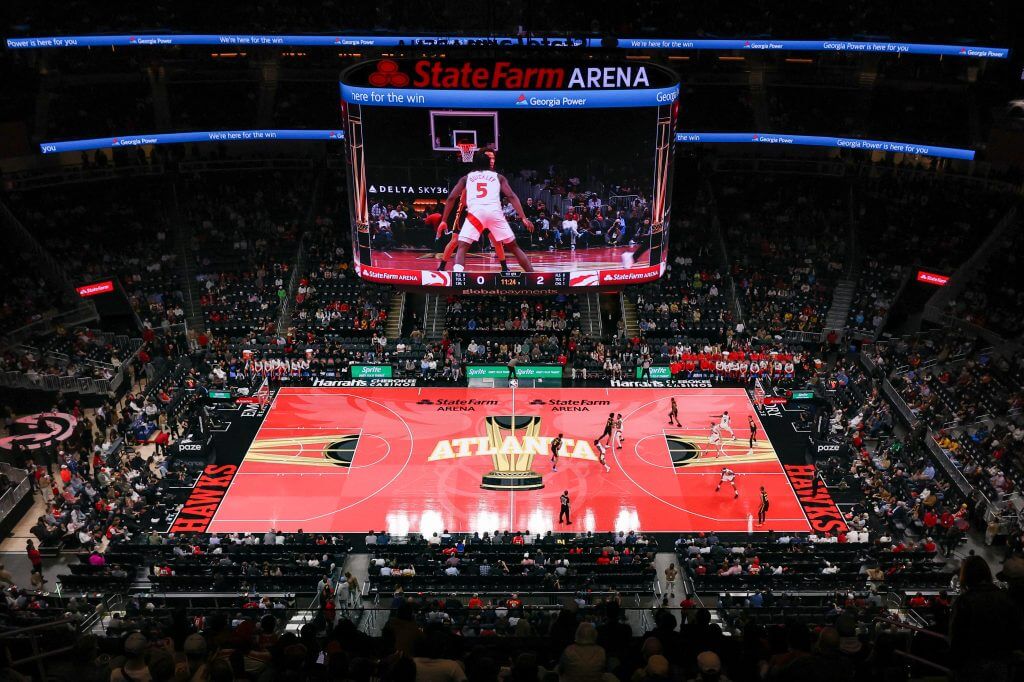
Toronto’s win in Atlanta on Friday, combined with an earlier win at Cleveland, means the Raptors will win Group A if they beat either Indiana or Washington. Both games are at home, and the Pacers and Wizards have the two worst records in the league. The Raptors at this point are playing for home-court advantage in that semifinal, which likely requires them to win both games and perhaps run up the score on their hapless opponents as well.
Meanwhile, the winner of the Atlanta-Cleveland game on Nov. 28 should be very much alive for the wild card, assuming each takes care of business in upcoming games against Washington and Indiana, respectively. If so, the Cavs-Hawks winner will be 3-1 and should have a strong point differential.
A look at State Farm Arena during a Hawks-Raptors NBA Cup game. (Brett Davis / Imagn Images)
The rest of the East is much less settled, with this week’s games likely being more about weeding out the riff-raff than establishing control of a group. Late November games between Detroit and Orlando in Group B and Milwaukee and Miami in Group C could end up deciding the fate of each.
In the West, Utah unsurprisingly became the first team to excuse itself from contention, dropping its first two games by a combined 62 points. The Jazz’s foes in Group A benefit from their struggles, as the second-place finisher in the group (likely Oklahoma City, Phoenix or Minnesota) should have a strong point differential for the wild card.
In Group B, the Lakers-Clippers meeting on Nov. 25 seems to be for control at the top, but we have to wait two more weeks for that one; first, they must take care of business on Friday against the Pelicans and Mavericks, respectively.
The most interesting situation, by far, is in Group C. San Antonio and Portland are in position to deliver shocking early knockout blows to Golden State and Houston, respectively, after both the Warriors and Rockets lost their openers this past week. On the other hand, if Golden State and Houston win, it’s the maximum-chaos scenario: All five teams would be tied at 1-1.
Finally, nine teams face a must-win in this week’s NBA Cup games on Friday, as a second loss is basically curtains in this tournament. In addition to the two above, Charlotte, New York, Philadelphia, Brooklyn, Dallas, New Orleans and Sacramento will be effectively eliminated with a loss. Of those, New York, which has a tough game against visiting Miami, would be the most shocking besides the Rockets and Warriors.
Cap Geekery: Pistons’ clever waiver claim
The Sacramento Kings waived big man Isaac Jones last week to create a roster spot to sign Precious Achiuwa; the Kings probably had better candidates to cut but desperately needed a mobile power forward and had to waive Jones’ non-guaranteed contract to ensure they would stay under the luxury-tax line.
The interesting part, though, is what happened next. I’ve often felt that teams underutilize waiver claims as a resource, especially when it comes to players with lightly guaranteed contracts. Well, enter the Pistons. They were toward the back half of the league in the waiver-claim line, but were still able to grab Jones and his non-guaranteed $1.96 million salary for this season.
Obviously, this move will matter more if Jones gives them some decent minutes, but I like the process regardless. In fact, Jones might help even if he never plays. Detroit is miles from the luxury tax but does have a concern with having enough tradeable salary to put into potential deals for another impact player. Jones can be traded 30 days after he was claimed, meaning Detroit has roughly a one-month window before his contract guarantees on Jan. 10, where they could potentially add his salary as ballast to a larger deal.
On the court, if Jones makes an impression, he’ll be a restricted free agent with a minimum cap hold after the season. If not, Detroit can cut bait on or before Jan. 9 with little obligation and move on to another target with its last roster spot.