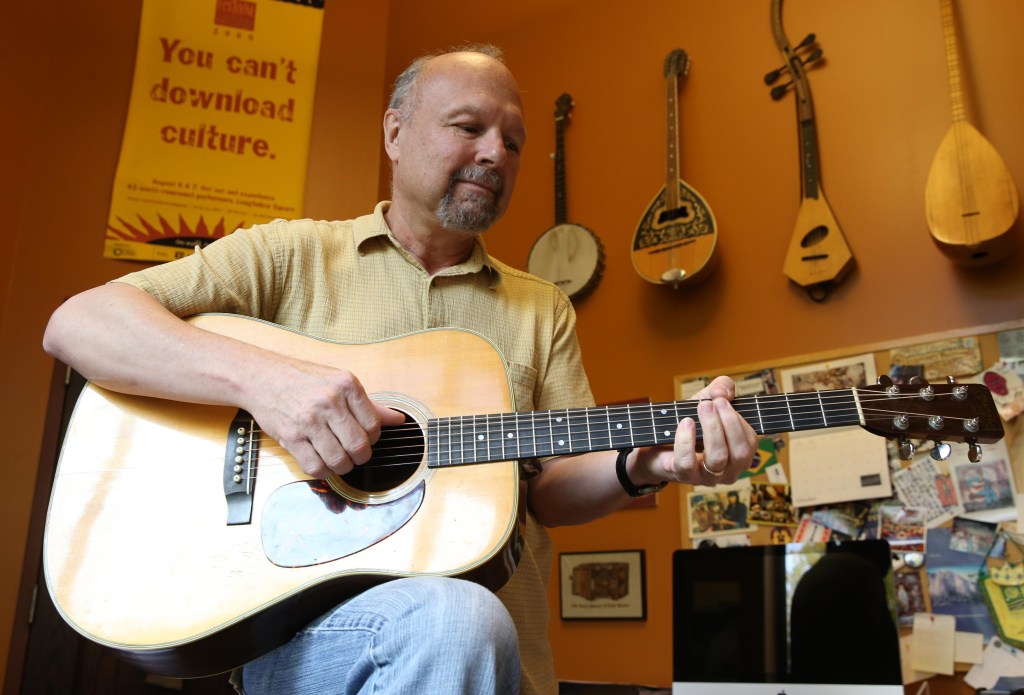
James “Bau” Graves was the executive director of Chicago’s Old Town School of Folk Music for more than 11 years, steering the venerable institution in the North Side’s Lincoln Square neighborhood through a major expansion.
“Bau lived a vibrant life and was a champion for the power of music and cultural traditions,” said Kish Khemani, who chaired the school’s board during Graves’ time as executive director. “He inspired us to be bold by having the audacity to believe that we, as the Old Town School, have not only the capability but also the responsibility to help address inequities and injustices within our society.”
Graves, 73, died of heart failure on Sept. 26 at his home in Harpswell, Maine, said his wife, Phyllis O’Neill. He had lived in the Rogers Park neighborhood before moving to Maine in 2019.
Born in Swindon, England, in 1952, Graves moved with his family as a child to Grosse Pointe, Michigan, the Detroit suburb where he grew up. He took on the nickname “Bau” as an early teenager while on a camping trip with his family, when he and his two siblings all adopted unusual nicknames, his wife said.
Interested in playing music from early childhood, Graves earned an undergraduate degree from Thomas Jefferson College, a part of Grand Valley State University in Michigan, where he designed his own courses in guitar making, music appreciation, piano improvisation and boat building. Later, in 1991, he earned a master’s degree in ethnomusicology from Tufts University.
After college, Graves lived in Grand Haven, Michigan, with his first wife before moving in 1976 to Maine, where they opened Welcome Home, a store in Brunswick that sold instruments and provided a space for musicians to gather. Graves also performed with several traditional folk music ensembles.
Graves also became the artistic director of the three-day annual Maine Festival, which O’Neill led as executive director. The couple moved to Portland, Maine, to launch the annual, multivenue New Year’s Portland celebration in 1983. In the mid-1980s, Graves and O’Neill co-founded the year-round concert series Big Sounds From All Over in the Portland Performing Arts Center, presenting dozens of eclectic performances, including traditional folk, jazz, well-known and experimental music, and they launched a number of national tours, including “Accordions That Shook the World.”
In 1997, the couple, with the support of a nonprofit board of directors, purchased and renovated a building in Portland, renaming it the Center for Cultural Exchange when it opened in 1999. The center was devoted to presenting and commissioning artists from all over the world and providing educational programs throughout Portland’s schools.
Graves played many instruments himself, including the guitar, the bass, the button-up accordion, the ukulele, the mandolin and the piano, O’Neill said.
“If you asked him what instruments he played, he’d say, ‘I play a lot of instruments but I don’t play any of them well,’ but that wasn’t true,” she said. “He was very, very modest and a master of many instruments and musical traditions.”
In addition, Graves built a reputation while in Maine for being effective at fundraising, and also championed both traditional and experimental performers in Portland. He also drew famous artists, including Ray Charles and Tony Bennett.
In 2006, Graves left Maine to move to Roanoke, Virginia, to become executive director of the Jefferson Center Foundation, a cultural arts group that managed a theater and presented various series of artistic and cultural events. Graves told the Tribune in 2007 that he helped stabilize what had been a financially troubled group during his short time leading that organization.
In 2007, Graves moved to Chicago to lead the Old Town School of Music, which bills itself as the largest nonprofit community arts school in the nation.
“He wanted to do something different and be someplace different,” O’Neill said. “He loved it and loved so many things. The first thing he had to do was to raise money. He really liked the staff and put a lot of the concerts together.”
Graves arrived when the Old Town School of Folk Music, which was founded in 1957, was in transition. Upon his hiring, the school was preparing to expand into a three-story, 27,100-square-foot performance and education annex that it would soon construct across the street from its principal site at 4544 N. Lincoln Ave. in Lincoln Square. The school also had continued to operate a longtime location at 909 W. Armitage Ave. in Lincoln Park.
“Old Town has a history of being in borrowed spaces; it started out in a living room, and has been in a former bank, a former library,” Graves told the Tribune’s Greg Kot in 2010. “None were specifically designed as schools of music and dance. So to move into a space that we design with great acoustical properties for music and sprung floors for dancing is going to be a luxury. It will improve the experience for everyone taking classes in the new building, of course, but in the old one too. Now the mandolin class won’t be distracted by the Irish step dancing class a floor above. It’s going to be a great leap forward for us.”
Known as the Old Town School East building, the $16.5 million building, at 4545 N. Lincoln Ave., opened in January 2012 with 16 music classrooms, three dance studios and concert space.
“When the school moved here in 1998, there was a lot of consternation in the (school) community whether we could fill this building,” Graves told Kot in 2011. “It ended up that within a couple years we had classes running in prime time in every room. There has been a lot more demand for Old Town participation from various communities (musical and ethnic) than we can accommodate. We end up saying ‘no’ a lot. There’s a sense that we’ve hit our heads on a very real ceiling in the current facility and can’t grow anymore, even though there is a demand for it.”
Gail Tyler, the school’s retired marketing director, called Graves “a remarkable and generous musician and bandmate, a truly visionary leader and a sincere friend.”
“He was one of the most enthusiastically can-do individuals I have ever met, and fearless,” she said. “Bau always thought the best of people, thought anything was possible and had an amazing ability to will much of his vision, large and small things, into existence.”
One of the school’s annual events, “Songs of Good Cheer,” is a winter caroling party, with former Tribune columnists Eric Zorn and Mary Schmich playing the guitar and piano, respectively, each December. Other musicians teaching at the school joined them, including Graves, with other instruments played, including banjo, clarinet, washboard and accordion.
“I found him to be supremely talented and delightfully generous and collaborative,” Zorn said.
Graves’ tenure was not without controversy. In 2018, he proposed selling the longtime location at 909 W. Armitage to seed an endowment fund with a short-term target of $10 million, which would be put toward general operations, aimed at helping the school, which the Tribune that year labeled a “struggling nonprofit.” Graves noted at the time that the school was facing a tough financial picture, in part due to the increase and ease of online music instruction.
Many teachers, students and their families objected to the idea of selling the Armitage location, which the school’s board had unanimously approved. Some suggested that the Old Town School East building was more likely the root of the school’s financial woes. Others pointed to a roughly 25% decline in class registrations between 2010 and 2017 and said selling the Armitage building would place the school in a “death spiral.”
Amid this controversy, Graves took a medical leave of absence after being hospitalized due to blockages in three coronary arteries. Soon after going on that leave, Graves announced in January 2019 that he would retire.
“It has been my honor and great privilege to serve Old Town School and its extended community for 11 years,” Graves wrote in a letter to the school’s staff announcing his departure. “They have been, by far, the most challenging — and deeply rewarding — years of my professional life. Being director of Old Town School is a total immersion experience, and it was my good fortune to have been immersed in a collective that is the most warm, welcoming, creative and, to me, loving community that I have ever experienced.”
The school’s board ultimately reversed its decision to sell the Armitage location.
After retiring, Graves and O’Neill relocated to Maine, where, for a time, he worked full-time as a development officer for the Greater Portland Immigrant Welcome Center.
“He loved it and … raised a ton of money from federal grants and foundations,” O’Neill said.
In 2004, the University of Illinois Press published Graves’ first book, “Cultural Democracy: The Arts, Community, and the Public Purpose,” which explored risks to national cultural vitality, particularly due to corporations and the wealthy elite.
A first marriage ended in divorce. In addition to his wife, Graves is survived by a daughter, Hannah Kailer; a son, Guthrie Graves; three grandchildren; a sister, Christina Southgate; and a brother, Nick Graves.
A celebration of life event is being held in late November in Portland, Maine.
Bob Goldsborough is a freelance reporter.