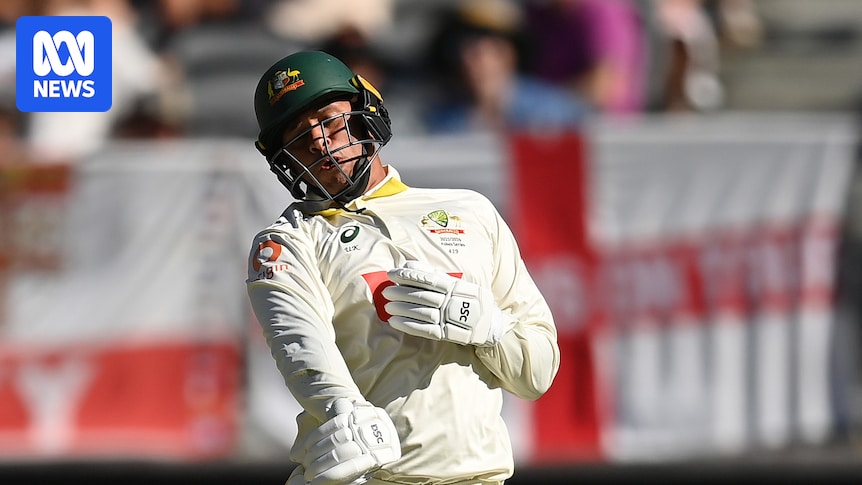
Usman Khawaja has attracted criticism for missing the start of Australia’s batting innings due to spending time off the field.
Khawaja came off the field at the end of the 29th over of England’s innings and returned during the 33rd over, spending a total of 19 minutes off the field — a period where England lost three wickets to be bowled out for 172.
After initially stating that Khawaja’s absence was due to “toilet breaks and stretching”, Cricket Australia later revealed the 38-year-old had been dealing with back stiffness throughout England’s batting innings. When he had come off the field at the end of England’s innings, a back spasm meant he spent an extended period in the changerooms.
- LIVE BLOG: Wickets tumble on opening day of first Ashes Test in Perth
- How Starc’s career-bet dismantled England’s ‘unacceptable’ batting style
Due to spending more than eight minutes off the field, Khawaja was not permitted to bat until the same amount of time had elapsed in Australia’s batting innings, per law 24.2.3.2 which states in part: “The player shall not be permitted to bat in the match until his team’s batting innings has been in progress for the length of playing time that is equal to the unexpired Penalty time carried forward from the previous innings.”
The law meant Test debutant Jake Weatherald was forced to take the first ball of the innings, with Marnus Labuschagne — who was listed to come in at number three — opening alongside him in Khawaja’s absence.
Weatherald was dismissed just two balls into Australia’s innings, and with the innings not yet eight minutes old, Steve Smith was forced to come in at number three.
Former Australian Test players Tom Moody and Darren Lehmann were both critical of Khawaja’s decision to spend time off the field at the back end of England’s innings.
“I’m stunned. Absolutely poor management,” Moody told ABC Sport.
“At the end of the day, to gamble on the fact that he could come back on the field when England is eight down [is a big risk].
“That is beyond a joke. He is our most experienced top-order player. We needed Khawaja at the front to lead the batting unit into this series.
“For that to take more than 20 minutes, unless we’re not getting the right information … it’s beyond belief.
“You do not take the risk knowing you’re right on the cusp of bowling England out.”
Lehmann recalled a similar incident occurring when he was Australia’s coach where Khawaja was forced to partner Matt Renshaw at the top of the order in a 2016 Test match against South Africa in Adelaide, after David Warner had spent time off the field and wasn’t allowed to open the innings, noting that Khawaja stepped in to make 145 on that occasion.
“That was disappointing,” he told ABC Sport of Khawaja’s absence at the top of the order.
“Bill Lawry batted for Australia in a very uncomfortable way. We wanted Mitchell Starc to lead [with the ball] and we wanted Usman Khawaja to lead with the bat.
“The timing is wrong. That there, with especially how important that hour of batting was, we needed him out there facing the first ball.”
Australian captain Pat Cummins — who is sidelined for this Test match — told ABC Sport that Khawaja simply “got on the wrong side of the timings”, stressing that Khawaja did not carry an injury into the match.
“A few quick ones [wickets] at the end kind of meant that he couldn’t bat, missed it by a few minutes,” he said.
Khawaja eventually came to the crease at the number four position at the dismissal of Marnus Labuschagne, but managed just two runs before he became Australia’s fourth wicket to fall.