Sign up for the Slatest to get the most insightful analysis, criticism, and advice out there, delivered to your inbox daily.
Earlier this month, Google researchers released a paper about “Project Suncatcher,” the company’s research “moonshot” to build data centers in space. The paper’s authors don’t mince words when it comes to the challenges the tech giant is facing from A.I.’s energy demands, and their planned solution is to launch “fleets of satellites” into space and harvest energy from the sun.
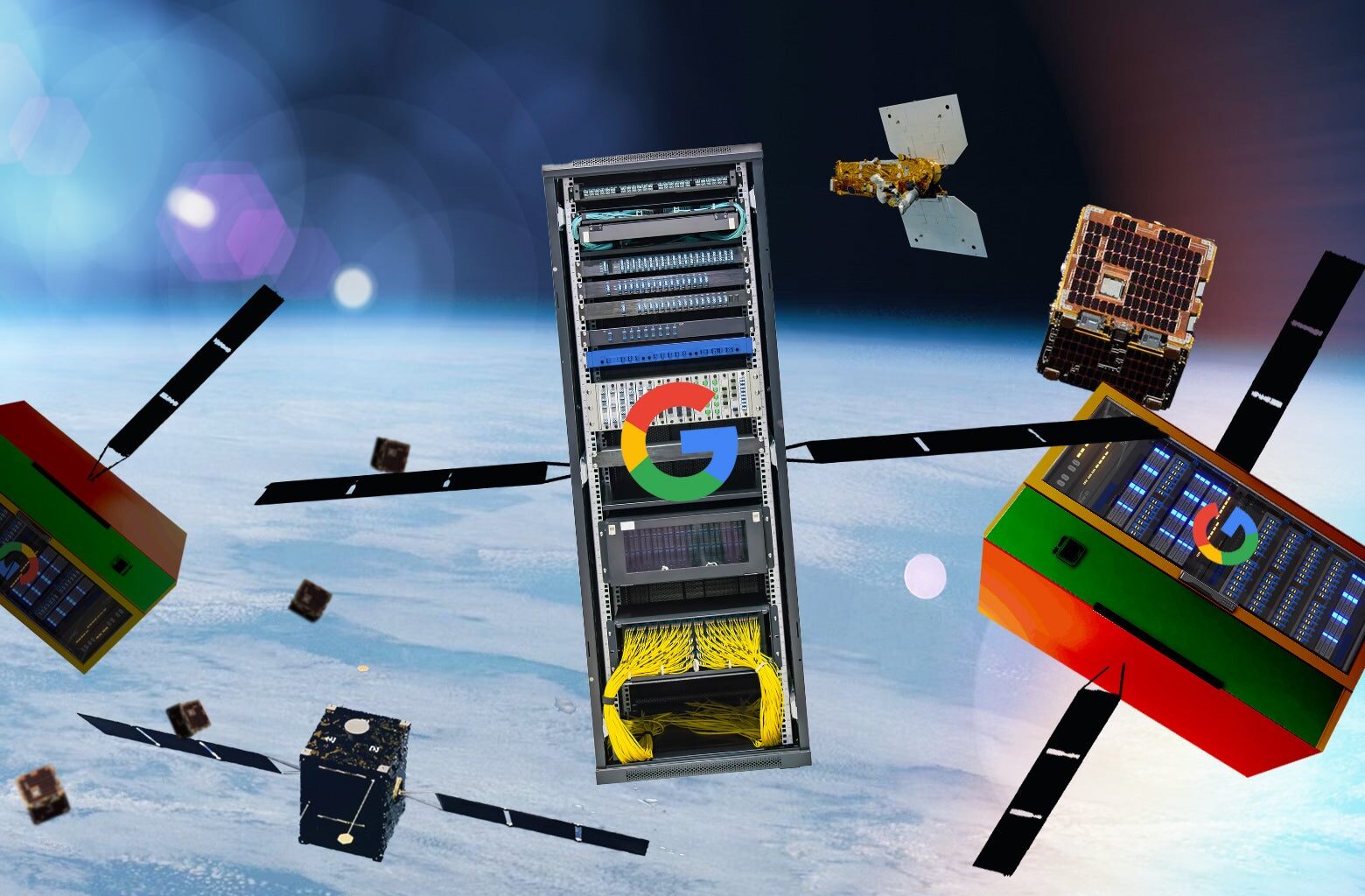
Google’s space-based data centers won’t be gigantic monolithic buildings like the data centers we have on Earth, but a “constellation of solar-powered satellites” carrying tensor processing units (the processors used to power Google’s A.I. systems). The paper boasts that the company’s data center fleet “will be significantly larger … than any previous or current satellite constellations” in orbit.
Reading the paper, I was struck by a sense of déjà vu. It was all too familiar: the rapidly increasing energy demands of A.I., the need for alternative energy sources, and launching data centers into the sky to harvest energy from the sun. Sure enough, Google is going to have some stiff competition, including from its own former CEO Eric Schmidt (who took over control of Relativity Space and is also planning to launch data centers into space), Jeff Bezos, Elon Musk, Red Hat (owned by IBM), China, startups like Starcloud, and others.
It’s not hard to see where this is going, or to predict just how bad this is going to be.
Having drained the Earth of its natural resources and energy, the billionaires, tech giants, and warring nations of the world will launch their satellite data centers into space, littering our atmosphere and the solar system with satellite debris, contributing to light pollution, and making it difficult for astronomers and astrophysicists to conduct any research. Without any significant regulations that prevent them from launching thousands (or even millions) of these satellite-based data centers, it will be a competition for control over space itself. The winner will be the one who can put the most satellites into orbit, at the lowest cost, for the longest time and successfully exclude others from doing the same.
We already know what happens when these oligarchs, corporations, and countries compete against one another. It’s ugly, it leads to power consolidation, and it almost always leaves us— the people, the users, the citizens—worse off. After the social media wars, the algorithm and machine learning wars, and the A.I. wars, we’re headed toward the space data-center wars, in which the battle for control will fill the very skies above us.
And I suspect “fill” is an understatement. As the authors of the Suncatcher paper point out, they won’t be able to service any broken space-based data centers by hand the way they do on Earth. Their solution for this is redundancy: They’re going to put more and extra processors and satellites into orbit for when the others inevitably break down.
Google has many millions of TPUs in its terrestrial data centers; if they’re going to win the space data-center wars, they’re going to need millions of them in the sky, too. Multiply that by the number of competitors, and what results will be a nightmarish swarm of metal debris surrounding our planet. It’s almost like they saw the cluttered graveyard of dead satellites clustered around the Earth in Wall-E and thought to themselves, “That! Let’s do that!”
All of this, they’re doing in the name of A.I. Or, at least, that’s what they’re telling us.

Mary Harris
Elon Musk Has His Own Encyclopedia Now. Well, We Read Some of the Entries …
Read More
-
Americans Don’t Take Climate Change Seriously. Might I Suggest One Simple Fix?
-
Google Wants to Power Their Chatbots By Filling Our Skies With Garbage
-
Elon Musk Has His Own Encyclopedia Now. Well, We Read Some of the Entries …
-
Podcast Episode
Crypto Keeps Criming
The Project Suncatcher team claims that A.I. is “a foundational general-purpose technology—akin to electricity or the steam engine,” a comparison that’s quite a stretch. I have yet to see any implementation of A.I. that I could consider either general-purpose or foundational, and I think it’s absurd to look at the hallucinating chatbots and inaccurate A.I. Google search summaries and claim that this technology is fundamental to human progress. Google’s own CEO, Sundar Pichai, even told the BBC that people shouldn’t “blindly trust” A.I.
I suspect the real reason they’re doing this has nothing to do with A.I. itself or their belief in its value (or lack of value) to humanity. At the heart of it, I believe this is a simple, straightforward, cold-blooded quest for power. Having already dominated and ravaged our world, they’ve set their sights on the sky.
It would be easy to put a stop to this. We need an international agreement like the Antarctic Treaty that prevents countries and corporations from launching satellites into low Earth orbit for nonscientific purposes and prohibits commercial resource extraction of any kind. Maybe then we could protect the sky, and prevent the Earth’s atmosphere from becoming a graveyard of broken satellites, space debris, and redundant TPUs.

Sign up for Slate’s evening newsletter.