For the past year and a half, legendary singer and actress Lea Salonga (Miss Saigon, Mulan, Aladdin) has been traveling the world on her ongoing tour, “Stage, Screen, & Everything In Between” — a showcase of the roles, songs, and eras that have defined her four-decade career. It’s a tour only she could pull off: a collection of Broadway canon, iconic Disney songs, and pop classics all showcased through her unmistakable belt and fierce vibrato.
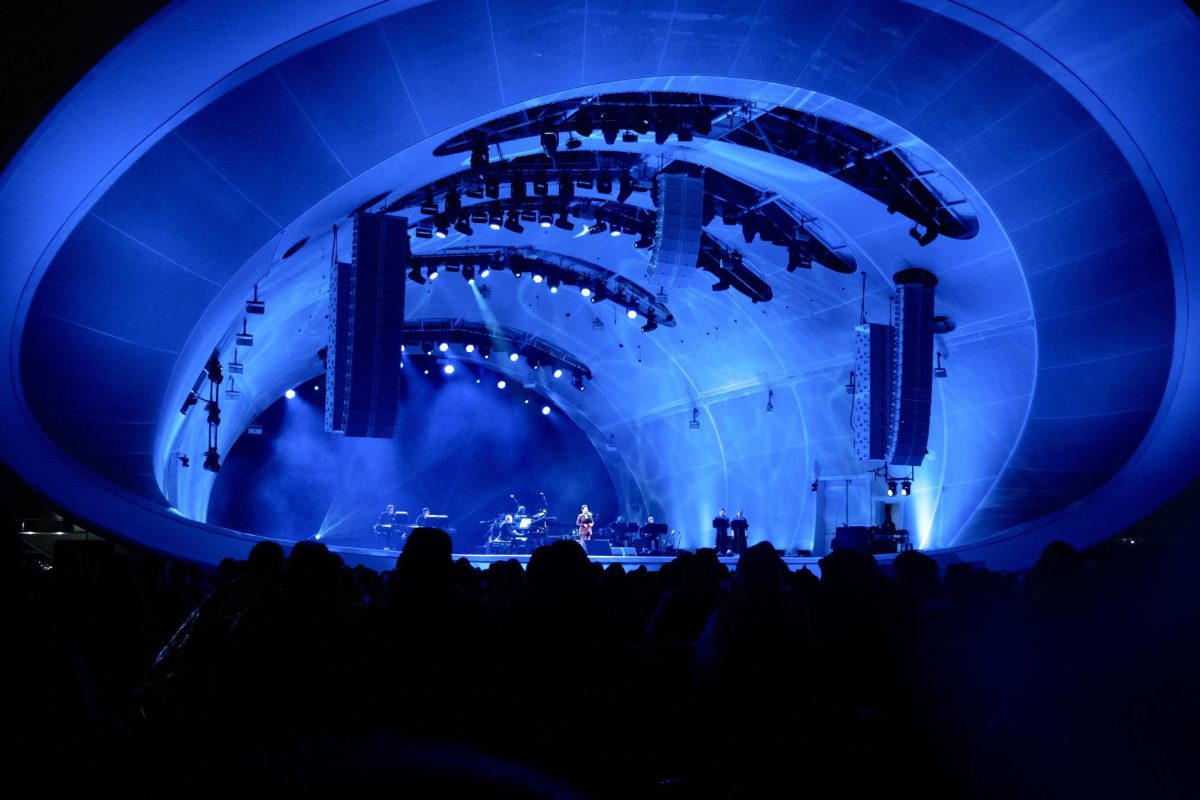
I was fortunate enough to catch the North American leg of the tour on Saturday, Nov. 15, at the Rady Shell at Jacobs Park. The rain, the cold, and the Shell’s total lack of overhead covering made me question whether any voice was worth shivering for. I’ll admit, I almost didn’t go. But whether out of obligation to The UCSD Guardian or the quiet desire to witness an icon in real life, I surrendered my complaints and went — and thank god I did.
Lea Salonga is a name I have only come to consciously appreciate in the past few years, mostly because my partner is Filipino. But the truth is that she has been a presence in my life for far longer than I initially realized. As the original singing voice of Mulan, Salonga embodied one of the few forms of ethnic representation I had growing up. Like so many other Asian girls, Mulan was my favorite Disney princess. This wasn’t necessarily because I was drawn to her storyline or connected with her persistence — I certainly don’t have the selflessness or dedication to risk my life for a country that sees me as less than equal. Rather, she was the closest thing I had to seeing myself on the screen. Mulan’s character offered a kind of promise: proof that Asian women could be powerful, triumphant, and celebrated.
So, when I later learned that Mulan’s singing voice belonged to a Filipino woman, I was stunned, and more significantly, I was moved. It’s one thing to love a character; it’s another thing to understand her background. To know that an Asian woman had carved out a space for herself in an industry that still struggles to make room for us — and that she had been doing it long before I was even born — was quietly revolutionary and still inspires me to this day.
Seated in the Marina Right, a high-rent stretch of the Shell that sits comfortably outside my budget, I paused to look around. For as far as I could see, I was surrounded by Filipino people of all ages, huddling under rain jackets and brightly colored plastic ponchos in the cold rain, waiting to see the “Pride of the Philippines” herself. It was a heartwarming sight; I was witnessing a homecoming I wasn’t technically a part of, but still grateful to be included in.
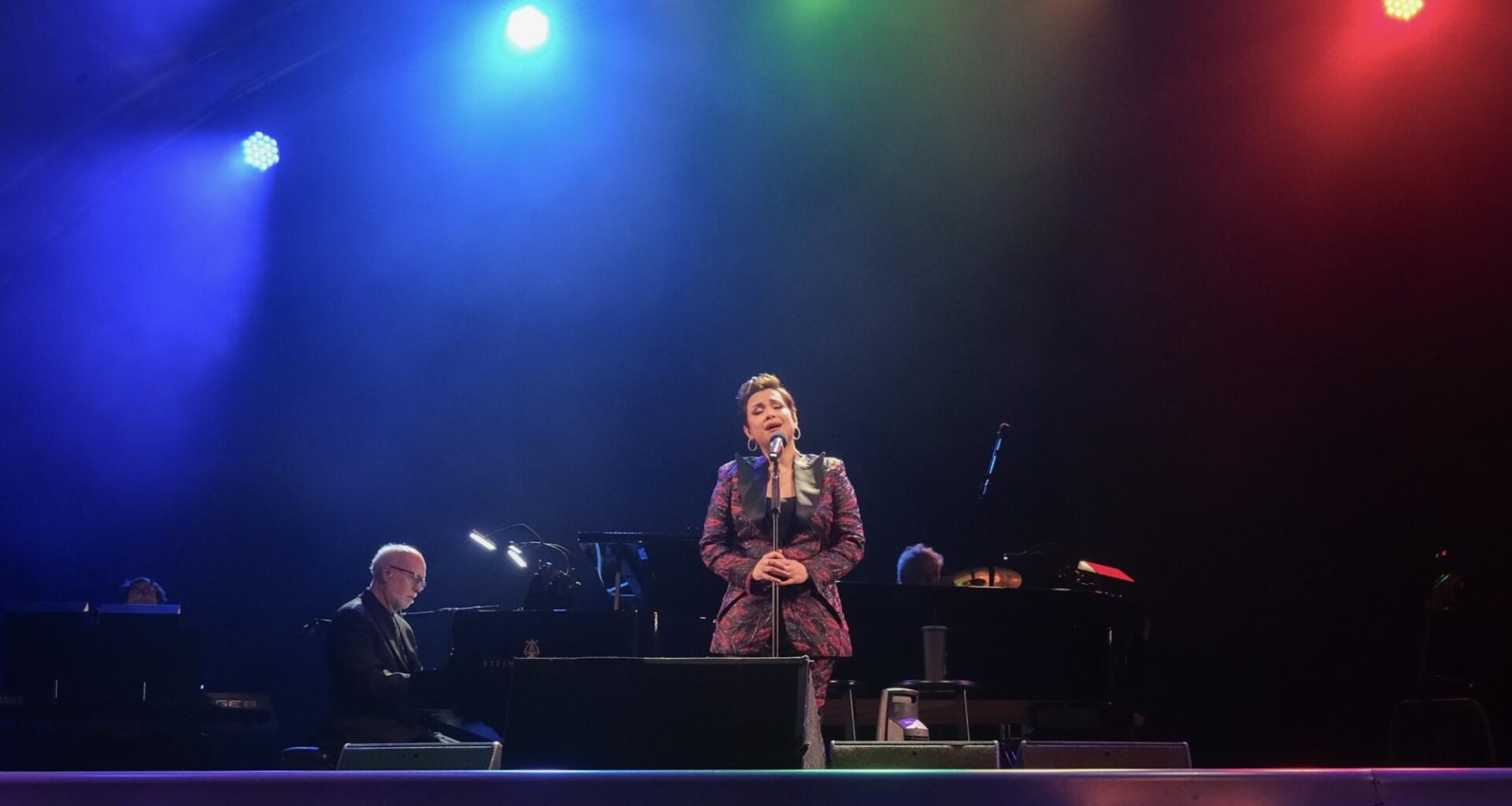
Then, Salonga took the stage. In my mind, she’d existed at a mythic scale, larger than life by sheer reputation alone. Instead, standing at only 5-foot-2, she occupied just the tiniest sliver of the Shell’s massive platform. The moment she opened her mouth, however, that mythic scale snapped back into place. Her voice — bright, controlled, and impossibly clear — filled the entire venue with an authority that made her small stature a non-factor. She didn’t need to take up space physically to command it.
Salonga opened with the iconic “Pure Imagination” from “Charlie and the Chocolate Factory,” a choice so on the nose that it bordered on clever self-commentary. As she eased into the opening lines, it became clear that this concert wasn’t just a career retrospective: It was a portal transporting us into the worlds that Salonga has shaped over the years. Her powerful vocals, combined with an upbeat, peppy composition, transformed “Pure Imagination” from its original dreamlike haziness into something more electric — a bright, intentional invitation. Even amid the cold evening rain, her music brought warmth to the Shell. Salonga affirmed this feeling with a smile: “There’s sunshine in all the faces I can actually see.” It was the perfect beginning to a night stitched together by nostalgia, story, and unreal vocal precision.
What struck me the most was Salonga’s insistence on naming the people behind the industry standard. After the opening number, she took a moment to introduce each of her fellow vocalists and band members, pausing after every name so that each person received a deserved swell of applause. Salonga has always used her platform to uplift emerging or overlooked artists, and that dedication was on full display here. Even on a night centered around her career and legacy, she shared the spotlight with purpose. Representation, for Salonga, is not a talking point but a practice.
Her dedication to the Filipino community also came through. After some sharp banter about the sheer number of Filipino nurses in the audience — and the hypothetical healthcare crisis their absence might cause — Salonga shifted into a rendition of one of the few Tagalog songs I actually know: the classic love ballad “Kailangan Kita.”
During the song, her vocals remained as steady and crystalline as ever, but something in her tone softened. In her mother tongue, her voice carried a gentler, more introspective sound. It resonated as though she was turning inward, acknowledging not just the diasporic audience before her, but the cultural lineage that shaped her and the power in her Filipino audience’s support. For a moment, the vastness of the Shell felt smaller, as if the space had folded inward to hold her, her history, and her people, all at once.
Quite predictably, however, my favorites of the night were “Mulan’s” “Reflection” and “Aladdin’s” “A Whole New World,” moments when Salonga stepped back into the roles she once portrayed as the voices of Fa Mulan and Princess Jasmine. Hearing her sing these songs live more than 25 years after the original recordings was uncanny: Her voice was identical, as if time had perfectly preserved it. The melodies triggered an overwhelming sense of nostalgia, resurfacing my childhood imaginings of who I wanted to be and re-emerging the emotional imprint of these songs that have steadily shaped me.
Salonga’s encore, and the official end to this magical night, was “Somewhere Over the Rainbow” from “The Wizard of Oz,” a film that she describes as “inspiring all of the things.” Her performance was intimate, stripped down to only Salonga and her pianist and musical director, Lawrence Yurman. It stood in stark contrast to the theatrics and production that had painted the night, but its rawness was a change welcomed by the audience — a moment of simplicity after an evening of vibrant production. Every note hung in the air, delicate yet precise, giving the audience space to linger on the song’s emotional weight and the journey we had just shared over the course of the evening.
For me, the concert was an homage to history, identity, and community. In the cold rain at the Rady Shell, Salonga’s voice had warmed the audience in a way that felt almost physical, cultivating a shared intimacy I will treasure forever. I walked out of the Shell soaked, shivering, but impossibly happy, and I realized that the soundtrack of my awkward formative years does in fact still own me.