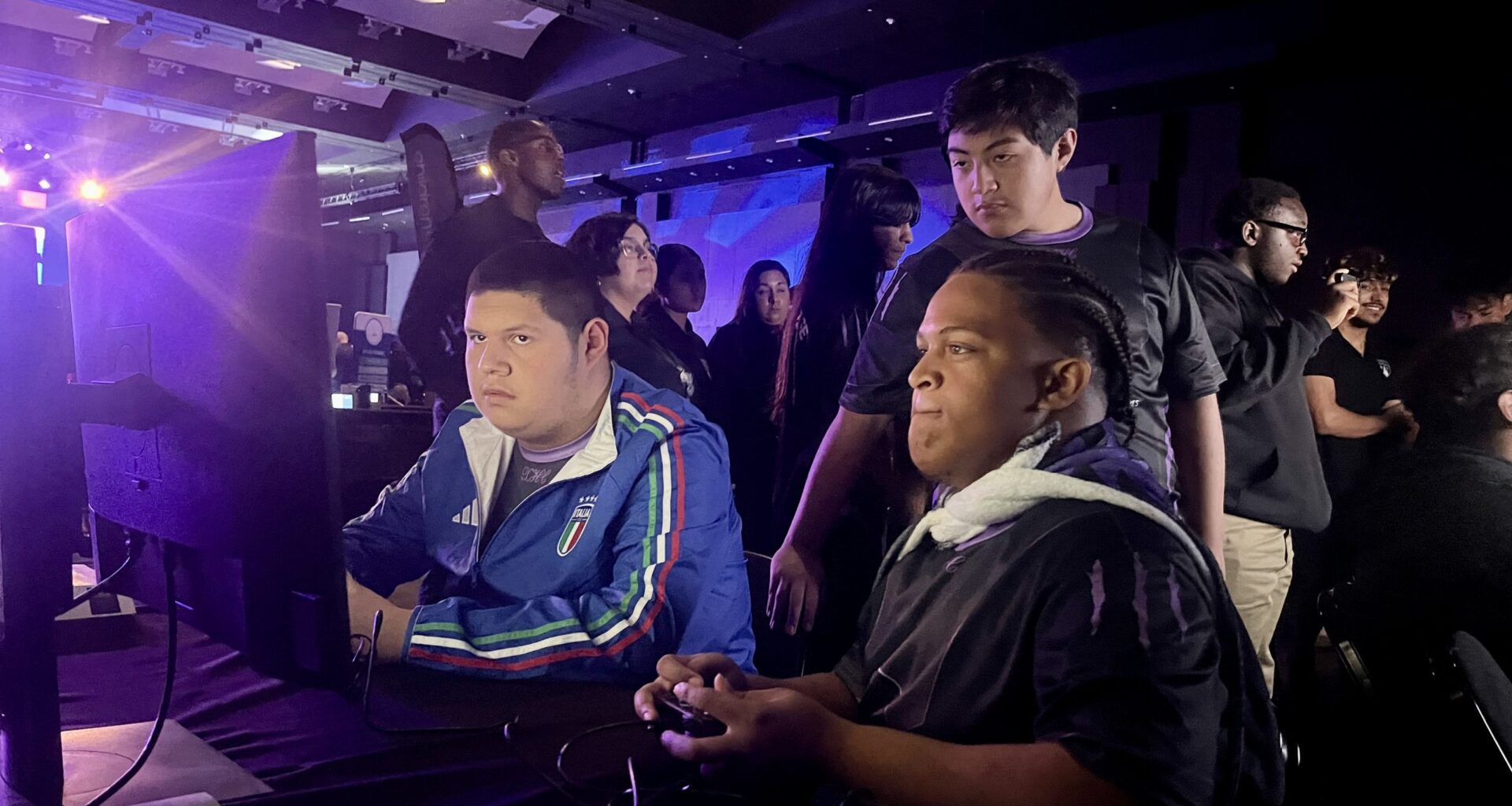
Racing down Acorn Heights, his digital tires skidding around a sharp turn, a flash of blue sparks gave Landers Stimms the boost he needed to edge ahead.
He then flicked a green shell backward — just for good measure.
Known to his teammates, and opponents, as “ShadowECR,” the Uplift Summit International junior pumped his fist as a few classmates standing behind him clapped and leaned in toward the screen, mouths wide open in awe.
Welcome to the growing world of high school esports, a realm where gaming meets teamwork, technology and education. Once an afterthought or hobby, competitive gaming is finding a home in Fort Worth-area classrooms as educators recognize its power to build communication skills, confidence and even career paths in science and technology.
For Stimms, captain of the Arlington charter school’s esports team, “Eclipse Raiders,” the white-knuckled race was not his usual online match.
Rather, winning with his teammates behind him — and not inside a chat box or on a livestream feed — was a small moment showing how focus, collaboration and creativity can carry beyond the screen.
At Uplift Education’s second annual Tech Expo, Stimms and his teammates joined students from all 13 of the charter network’s high schools at Esports Stadium Arlington. The event is one of many across North Texas that reflect a growing trend — schools blending technology, competition and community to prepare students for future careers. For the students gathered around Stimms, Nintendo Switch 2 consoles and 43-inch TVs, esports is a community, not just entertainment.
“It’s a lot more than just playing games,” junior J. Prince, also known as “LunarEclipse,” said. “A lot of it is learning specific strategies, and especially if it’s a team-based game, it’s being able to communicate well with your teammates.”
Across the country, scholastic esports has exploded.
PlayVS, formerly known as the High School Esports League, reaches more than 250,000 students in over 7,000 schools. Industry research shows participants attend school about seven more days a year than their peers. The programs keep students engaged, improve attendance and help them connect their interests to real-world skills, according to educators.
At Summit, the Eclipse Raiders built their program from scratch, designing jerseys, hosting livestreams and competing in tournaments around the region. The experience helped Stimms think like a leader, not just a player, he said.
“I want to turn this into a business. Something that helps other gamers build their own community and use technology in new ways,” he said.
The lessons extend far beyond the controller, teammate Araceli Magaña said.
“Each game brings its own thing to the table,” she said. “Whether they’re hard skills or soft skills, you can always use them later.”
Magaña, the only girl on the team, said gaming began as a family tradition — hours of Super Smash Bros. matches with her parents and brothers — and evolved into a way to connect with classmates and sharpen her problem-solving skills.
“It teaches you to think critically and plan ahead,” she said. “You have to adapt and react fast.”
‘They develop confidence’
Jacqueline Sanchez, a college and career counselor at Uplift Summit who sponsors the team, said she’s watched her students’ confidence grow since the club began.
“On the surface it might sound like it’s just for recreation, but there are so many career opportunities in the gaming world,” she said. “They also develop communication skills and leadership qualities they didn’t have before.”
Esports gives students — particularly those who might not join traditional athletics — a space to belong, Sanchez said.
“If you’re into video games, you can be pretty withdrawn,” she said. “Now they’re vocal. They’re encouraging, and they want to bring others in. It’s about connecting what they learn in class to the world outside it.”
And schools report better attendance and higher grades among players. In one California district, average GPAs for esports participants rose from 2.80 to 3.04 in a single school year, according to Modesto City Schools results.
Traditional school districts are seeing the same trend as the public charter network Uplift — more interest, more participation and more recognition of the benefits, officials said.
What began as a few after-school gaming clubs has evolved into formal teams, systemwide leagues and even varsity letters for competitors. The opportunities don’t end at graduation, either. Colleges such as the University of Texas at Arlington and Texas Wesleyan University now offer esports programs — and, in some cases, full-ride scholarships for top players.
White Settlement ISD has esports teams in Brewer High and Middle schools, allowing students to build a sense of belonging, coach Jesse Barnes said.
“Instead of going home and playing alone, students have a place to meet with friends and make new ones,” Barnes said in a statement. “It’s helped engage students in school who otherwise might not have been.”
🎮 How other Fort Worth-area school districts are playing to learn:
- Fort Worth: Five campuses host esports clubs and teams, where students build skills in strategy, teamwork, communication and leadership, spokesperson Jessica Becerra said in a statement. Those translate into career readiness across industries, such as aviation, engineering and computer science, she said.
- Hurst-Euless-Bedford: The district launched its varsity esports program in 2019 and has since earned top-three national finishes in speed chess and Hearthstone. Coach Stephen Walloch said esports teaches teamwork, inclusion and timeliness — “skills our students carry into their future careers.”
- Northwest: Three of four high schools host esports clubs or competitive teams. Cara Carter, the district’s chief technology officer, said the program promotes leadership, confidence and collaboration. “It’s so much more than gaming. It gives students who may not participate in traditional athletics a chance to lead, compete and connect,” she said in a statement.
- Crowley: Now in its fifth year, Crowley’s esports club engages students who may not otherwise join school activities, digital learning specialist Casey Smith said in a statement. “Participation reinforces academic eligibility, teamwork and quick decision-making — skills valued in technology and military careers.”
- Aledo and Eagle Mountain-Saginaw ISDs: These districts do not host esports programs or clubs.
Arlington, Keller, Burleson, Everman, Castleberry and Lake Worth district officials did not respond to requests for comment.
Back at Uplift Summit, Stimms was already thinking ahead — expanding the team’s presence on Twitch by planning more livestreams and recruiting younger students to take the reins once he graduates.
He hopes to build a sustainable program that outlasts his time at school.
“We’ve shown what you can build if you treat it like more than just a game,” he said.
And with the global esports market projected to surpass $2 billion by 2032, he and other students are finding their way into a growing industry — one that rewards the same skills they practice every day.
Focus, creativity and teamwork.
Matthew Sgroi is an education reporter for the Fort Worth Report. Contact him at matthew.sgroi@fortworthreport.org or @matthewsgroi1.
At the Fort Worth Report, news decisions are made independently of our board members and financial supporters. Read more about our editorial independence policy here.
Related
Fort Worth Report is certified by the Journalism Trust Initiative for adhering to standards for ethical journalism.
Republish This Story

Republishing is free for noncommercial entities. Commercial entities are prohibited without a licensing agreement. Contact us for details.