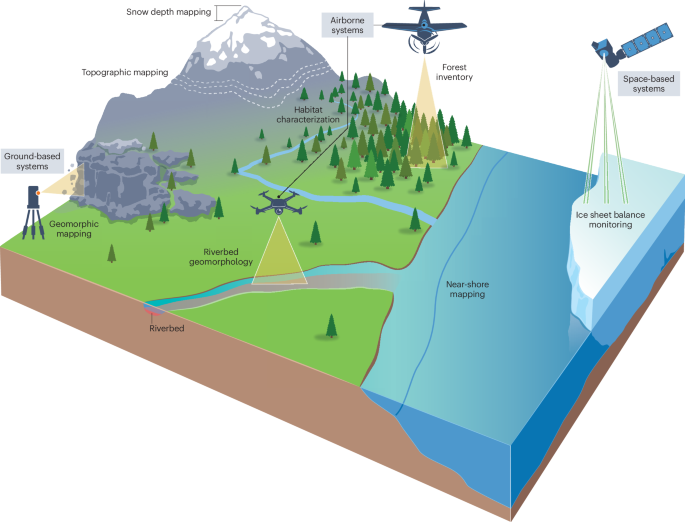
Duncanson, L. et al. Aboveground biomass density models for NASA’s global ecosystem dynamics investigation (GEDI) lidar mission. Remote. Sens. Environ. 270, 112845 (2022). This paper describes the use of the space-based lidar system GEDI to characterize biomass dynamics globally.
Smith, B. et al. Pervasive ice sheet mass loss reflects competing ocean and atmosphere processes. Science 368, 1239–1242 (2020). This paper demonstrates the ability of lidar data to characterize dynamic ice-sheet mass balance and provide insight into global change processes linked to anthropogenic climate change.
Winiwarter, L., Anders, K., Czerwonka-Schröder, D. & Höfle, B. Full four-dimensional change analysis of topographic point cloud time series using Kalman filtering. Earth Surf. Dynam. 11, 593–613 (2023).
Mandlburger, G., Hauer, C., Wieser, M. & Pfeifer, N. Topo-bathymetric LiDAR for monitoring river morphodynamics and instream habitats—a case study at the Pielach river. Remote. Sens. 7, 6160–6195 (2015).
Hamraz, H., Contreras, M. A. & Zhang, J. Forest understory trees can be segmented accurately within sufficiently dense airborne laser scanning point clouds. Sci. Rep. 7, 6770 (2017).
Wagner, N., Franke, G., Schmieder, K. & Mandlburger, G. Automatic classification of submerged macrophytes at Lake Constance using laser bathymetry point clouds. Remote. Sens. 16, 2257 (2024).
Chase, A. F. et al. Airborne LiDAR, archaeology, and the ancient Maya landscape at Caracol, Belize. J. Archaeo. Sci. 38, 387–398 (2011).
Eitel, J. U. H. et al. Beyond 3-D: the new spectrum of lidar applications for earth and ecological sciences. Remote. Sens. Environ. 186, 372–392 (2016). This review provides an overview of ecological lidar applications facilitated by integrating multi-temporal lidar scans and return intensity information.
Baltsavias, E. P. Airborne laser scanning: basic relations and formulas. ISPRS J. Photogramm. Remote. Sens. 54, 199–214 (1999).
Wagner, W. Radiometric calibration of small-footprint full-waveform airborne laser scanner measurements: basic physical concepts. ISPRS J. Photogramm. Remote. Sens. 65, 505–513 (2010).
Wehr, A. & Lohr, U. Airborne laser scanning—an introduction and overview. ISPRS J. Photogramm. Remote. Sens. 54, 68–82 (1999).
Wang, Q., Tan, Y. & Mei, Z. Computational methods of acquisition and processing of 3D point cloud data for construction applications. Arch. Computat Methods Eng. 27, 479–499 (2020).
Pfeifer, N. & Briese, C. Geometrical aspects of airborne laser scanning and terrestrial laser scanning. In ISPRS Workshop on Laser Scanning Vol. XXXVI (eds Rönnholm P. et al.) 311–319 (ISPRS, 2007).
Fiocco, G. & Smullin, L. D. Detection of scattering layers in the upper atmosphere (60–140 km) by optical radar. Nature 199, 1275–1276 (1963).
Rempel, R. C. & Parker, A. K. An information note on an airborne laser terrain profiler for micro-relief studies. In Proc. 3rd Symp. Remote Sensing of Environment 321–337 (University of Michigan Institute of Science and Technology, 1964).
Schawlow, A. L. & Townes, C. H. Infrared and optical masers. Phys. Rev. 112, 1940–1949 (1958).
Nelson, R. How did we get here? An early history of forestry lidar. Can. J. Remote. Sens. 39, S6–S17 (2013).
Lefsky, M. A., Cohen, W. B., Parker, G. G. & Harding, D. J. Lidar remote sensing for ecosystem studies. BioScience 52, 19 (2002).
Markus, T. et al. The Ice, Cloud, and Land Elevation Satellite-2 (ICESat-2): science requirements, concept, and implementation. Remote. Sens. Environ. 190, 260–273 (2017). This paper outlines the design and implementation of ICESat-2.
Dubayah, R. et al. The global ecosystem dynamics investigation: high-resolution laser ranging of the earth’s forests and topography. Sci. Remote. Sens. 1, 100002 (2020).
Li, J. et al. 3D forest mapping using a low-cost UAV laser scanning system: investigation and comparison. Remote. Sens. 11, 717 (2019).
Wallace, L., Lucieer, A. & Watson, C. S. Evaluating tree detection and segmentation routines on very high resolution UAV LiDAR data. IEEE Trans. Geosci. Remote. Sens. 52, 7619–7628 (2014).
Brown, R., Hartzell, P. & Glennie, C. Evaluation of SPL100 single photon lidar data. Remote. Sens. 12, 722 (2020).
Mandlburger, G., Lehner, H. & Pfeifer, N. A comparison of single photon and full waveform lidar. In ISPRS Ann. Photogramm. Remote Sens. Spatial Inf. Sci. Vol. IV-2/W5 (eds Vosselman G. et al.) 397–404 (ISPRS, 2019).
Næsset, E. Predicting forest stand characteristics with airborne scanning laser using a practical two-stage procedure and field data. Remote. Sens. Environ. 80, 88–99 (2002). This paper outlines the concept of using area-based lidar summary metrics to predict forest attributes.
Butler, H., Chambers, B., Hartzell, P. & Glennie, C. PDAL: an open source library for the processing and analysis of point clouds. Computers Geosci. 148, 104680 (2021).
Roussel, J.-R. et al. lidR: an R package for analysis of airborne laser scanning (ALS) data. Remote. Sens. Environ. 251, 112061 (2020). This paper outlines an open-source software package that was originally developed for processing lidar point cloud data into output datasets for ALS in forest environments and is now widely used across many applications.
Goodbody, T. R. H. et al. Integration of airborne laser scanning data into forest ecosystem management in canada: current status and future directions. Forestry Chron. 100, 238–258 (2024). This paper outlines the integration of ALS into the management of Canadian forests, exemplifying the multi-use and cost-sharing principles of modern ALS collections.
White, J. C. et al. Enhanced forest inventories in Canada: implementation, status, and research needs. Can. J. For. Res. 55, 1–37 (2025).
Puliti, S. et al. Benchmarking tree species classification from proximally sensed laser scanning data: introducing the FOR-species20K dataset. Methods Ecol. Evol. https://doi.org/10.1111/2041-210X.14503 (2025). This paper demonstrates various deep learning techniques that accurately classify tree species from lidar point clouds.
Li, N. et al. A progress review on solid-state LiDAR and nanophotonics-based LiDAR sensors. Laser Photonics Rev. 16, 2100511 (2022).
Stysley, P. R. et al. Long term performance of the high output maximum efficiency resonator (HOMER) laser for NASAresonator (HOMER) laser for NASA’s global ecosystem dynamics investigation (GEDI) lidar. Opt. Laser Technol. 68, 67–72 (2015).
Magruder, L., Brunt, K., Neumann, T., Klotz, B. & Alonzo, M. Passive ground-based optical techniques for monitoring the on-orbit ICESat-2 altimeter geolocation and footprint diameter. Earth Space Sci. 8, e2020EA001414 (2021).
Hopkinson, C., Chasmer, L., Gynan, C., Mahoney, C. & Sitar, M. Multisensor and multispectral LiDAR characterization and classification of a forest environment. Can. J. Remote. Sens. 42, 501–520 (2016).
Szafarczyk, A. & Toś, C. The use of green laser in LiDAR bathymetry: state of the art and recent advancements. Sensors 23, 292 (2022).
Irwin, L., Coops, N. C., Queinnec, M., McCartney, G. & White, J. C. Single photon lidar signal attenuation under boreal forest conditions. Remote. Sens. Lett. 12, 1049–1060 (2021).
Degnan, J. Scanning, multibeam, single photon lidars for rapid, large scale, high resolution, topographic and bathymetric mapping. Remote. Sens. 8, 958 (2016).
Gluckman, J. Design of the processing chain for a high-altitude, airborne, single photon lidar mapping instrument. In Laser Radar Technology and Applications XXI Vol. 9832 (eds Turner, M. D. & Kamerman, G. W.) 1–9 (SPIE, 2016).
Riu, J., Sicard, M., Royo, S. & Comerón, A. Silicon photomultiplier detector for atmospheric lidar applications. Opt. Lett. 37, 1229 (2012).
Buzhan, P. et al. Silicon photomultiplier and its possible applications. Nucl. Instrum. Methods Phys. Res. Sect. A 504, 48–52 (2003).
White, J. C. et al. Evaluating the capacity of single photon lidar for terrain characterization under a range of forest conditions. Remote. Sens. Environ. 252, 112169 (2021).
Brown, R., Hartzell, P. & Glennie, C. Evaluation of SPL100 Single Photon Lidar Data. Remote Sensing. 12, 722 (2020).
Shan, J. & Toth, C. K. Topographic Laser Ranging and Scanning: Principles and Processing (CRC Press, 2018). This text explains the fundamentals of laser scanning and its applications in topography and across other disciplines.
Glira, P., Pfeifer, N. & Mandlburger, G. Rigorous strip adjustment of UAV-based laser scanning data including time-dependent correction of trajectory errors. Photogramm. Eng. Remote Sens. 82, 945–954 (2016).
Wang, X., Liang, X., Campos, M., Zhang, J. & Wang, Y. Benchmarking of laser-based simultaneous localization and mapping methods in forest environments. IEEE Trans. Geosci. Remote. Sens. 62, 1–21 (2024).
Ullrich, A. Resolving range ambiguities in high-repetition rate airborne light detection and ranging applications. J. Appl. Remote. Sens. 6, 063552 (2012).
Rieger, P. Range ambiguity resolution technique applying pulse-position modulation in time-of-flight scanning lidar applications. Opt. Eng. 53, 061614 (2014).
Kersten, T. P. & Lindstaedt, M. Geometric accuracy investigations of terrestrial laser scanner systems in the laboratory and in the field. Appl. Geomat. 14, 421–434 (2022).
Lin, Y., Hyyppä, J. & Kukko, A. Stop-and-go mode: sensor manipulation as essential as sensor development in terrestrial laser scanning. Sensors 13, 8140–8154 (2013).
Knechtel, J., Klingbeil, L., Haunert, J.-H. & Dehbi, Y. Optimal position and path planning for stop-and-go laser scanning for the acquisition of 3D building models. In ISPRS Ann. Photogrammetry, Remote. Sens. Spat. Inf. Sci. Vol. V-4-2022 (eds Zlatanova S. et al.) 129–136 (ISPRS, 2022).
Weiser, H. et al. Individual tree point clouds and tree measurements from multi-platform laser scanning in German forests. Earth Syst. Sci. Data 14, 2989–3012 (2022).
Kissling, W. D. et al. Country-wide data of ecosystem structure from the third Dutch airborne laser scanning survey. Data Brief. 46, 108798 (2023).
Vosselman, G. Automated planimetric quality control in high accuracy airborne laser scanning surveys. ISPRS J. Photogramm. Remote. Sens. 74, 90–100 (2012).
Takeuchi, N., Baba, H., Sakurai, K. & Ueno, T. Diode-laser random-modulation CW lidar. Appl. Opt. 25, 63 (1986).
Nasim, H. & Jamil, Y. Diode lasers: from laboratory to industry. Opt. Laser Technol. 56, 211–222 (2014).
Fitzgerald A. M. MEMS inertial sensors. In Position, Navigation, and Timing Technologies in the 21st Century: Integrated Satellite Navigation, Sensor Systems, and Civil Applications Vol. 2 (eds Morton Y. et al.) 1435–1446 (Wiley, 2021).
Wulder, M. A. et al. Fifty years of Landsat science and impacts. Remote. Sens. Environ. 280, 113195 (2022).
Toth, C. & Jóźków, G. Remote sensing platforms and sensors: a survey. ISPRS J. Photogramm. Remote. Sens. 115, 22–36 (2016).
Thomas, T. C., Luthcke, S. B., Pennington, T. A., Nicholas, J. B. & Rowlands, D. D. ICESat-2 precision orbit determination. Earth Space Sci. 8, e2020EA001496 (2021).
Sun, X. Review of photodetectors for space lidars. Sensors 24, 6620 (2024).
Neumann, T. A. et al. The Ice, Cloud, and Land Elevation Satellite-2 mission: a global geolocated photon product derived from the advanced topographic laser altimeter system. Remote. Sens. Environ. 233, 111325 (2019).
Brede, B. et al. Non-destructive tree volume estimation through quantitative structure modelling: comparing UAV laser scanning with terrestrial LIDAR. Remote. Sens. Environ. 233, 111355 (2019).
Dubayah, R. et al. GEDI launches a new era of biomass inference from space. Environ. Res. Lett. 17, 095001 (2022).
Deems, J. S., Painter, T. H. & Finnegan, D. C. Lidar measurement of snow depth: a review. J. Glaciol. 59, 467–479 (2013).
Côté, J.-F., Fournier, R. A. & Egli, R. An architectural model of trees to estimate forest structural attributes using terrestrial LiDAR. Environ. Model. Softw. 26, 761–777 (2011).
Hodgson, M. E. & Bresnahan, P. Accuracy of airborne lidar-derived elevation: empirical assessment and error budget. Photogramm. Eng. Remote. Sens. 70, 331–339 (2004).
May, N. C. & Toth, C. Point positioning accuracy of airborne LIDAR systems: a rigorous analysis. In PIA07: Photogramm. Image Analysis Vol. 36 (eds Stilla U. et al.) 107–111 (ISPRS, 2007).
Bae, S. et al. Performance of ICESat-2 precision pointing determination. Earth Space Sci. 8, e2020EA001478 (2021).
Acar, M. et al. Deformation analysis with total least squares. Nat. Hazards Earth Syst. Sci. 6, 663–669 (2006).
Besl, P. J. & McKay, N. D. A method for registration of 3-D shapes. IEEE Trans. Pattern Anal. Mach. Intell. 14, 239–256 (1992).
Glira, P., Pfeifer, N., Briese, C. & Ressl, C. A correspondence framework for ALS strip adjustments based on variants of the ICP algorithm. PFG 2015, 275–289 (2015).
Legat, K. Approximate direct georeferencing in national coordinates. ISPRS J. Photogramm. Remote. Sens. 60, 239–255 (2006).
Makadia, A., Patterson, A. I. & Daniilidis, K. Fully automatic registration of 3D point clouds. In 2006 IEEE Computer Society Conf. Computer Vision and Pattern Recognition—Volume 1 (CVPR’06) Vol. 1 1297–1304 (IEEE, 2006).
Schröder, D., Anders, K., Winiwarter, L. & Wujanz, D. Permanent terrestrial LiDAR monitoring in mining, natural hazard prevention and infrastructure protection—chances, risks, and challenges: a case study of a rockfall in Tyrol, Austria. In Proc. 5th Joint Int. Symp. Deformation Monitoring—JISDM 2022 (Editorial de la Univ. Politècnica de València, 2022).
Kuhlmann, H., Schwieger, V., Wieser, A. & Niemeier, W. Engineering geodesy—definition and core competencies. J. Appl. Geodesy 8, 279–290 (2014).
Axelsson, P. Processing of laser scanner data—algorithms and applications. ISPRS J. Photogramm. Remote. Sens. 54, 138–147 (1999).
Axelsson, P. DEM generation from laser scanner data using adaptive TIN models. Int. Arch. Photogramm. Remote. Sens. 33, 110–117 (2000).
Zhao, X. et al. A comparison of LiDAR filtering algorithms in vegetated mountain areas. Can. J. Remote. Sens. 44, 287–298 (2018).
Jin, S., Su, Y., Zhao, X., Hu, T. & Guo, Q. A point-based fully convolutional neural network for airborne LiDAR ground point filtering in forested environments. IEEE J. Sel. Top. Appl. Earth Obs. Remote. Sens. 13, 3958–3974 (2020).
Van Ewijk, K. Y., Treitz, P. M. & Scott, N. A. Characterizing forest succession in central Ontario using lidar-derived indices. Photogramm. Eng. Remote. Sens. 77, 261–269 (2011).
Lefsky, M. A. et al. Lidar remote sensing of the canopy structure and biophysical properties of Douglas-fir western hemlock forests. Remote. Sens. Environ. 70, 339–361 (1999).
Drake, J. B. et al. Estimation of tropical forest structural characteristics using large-footprint lidar. Remote. Sens. Environ. 79, 305–319 (2002).
Popescu, S. C. & Wynne, R. H. Seeing the trees in the forest: using lidar and multispectral data fusion with local filtering and variable window size for estimating tree height. Photogramm. Eng. Remote. Sens. 70, 589–604 (2004).
Zhao, H., Morgenroth, J., Pearse, G. & Schindler, J. A systematic review of individual tree crown detection and delineation with convolutional neural networks (CNN). Curr. Forestry Rep. 9, 149–170 (2023).
Otepka, J., Ghuffar, S., Waldhauser, C., Hochreiter, R. & Pfeifer, N. Georeferenced point clouds: a survey of features and point cloud management. IJGI 2, 1038–1065 (2013).
Remondino, F. From point cloud to surface: the modeling and visualization problem. In Int. Workshop on Visualization and Animation of Reality-based 3D Models (eds Gruen A. et al.) 1–11 (ISPRS, 2003).
Li, J. & Wong, D. W. S. Effects of DEM sources on hydrologic applications. Computers Environ. Urban. Syst. 34, 251–261 (2010).
Lague, D., Brodu, N. & Leroux, J. Accurate 3D comparison of complex topography with terrestrial laser scanner: application to the Rangitikei canyon (N-Z). ISPRS J. Photogramm. Remote. Sens. 82, 10–26 (2013).
Ötsch, E., Harmening, C. & Neuner, H. Investigation of space-continuous deformation from point clouds of structured surfaces. J. Appl. Geodesy 17, 1–13 (2023).
Harmening, C., Hobmaier, C. & Neuner, H. Laser scanner-based deformation analysis using approximating B-spline surfaces. Remote. Sens. 13, 3551 (2021).
Gojcic, Z., Zhou, C. & Wieser, A. F2S3: robustified determination of 3D displacement vector fields using deep learning. J. Appl. Geodesy 14, 177–189 (2020).
De Gélis, I., Lefèvre, S. & Corpetti, T. Siamese KPConv: 3D multiple change detection from raw point clouds using deep learning. ISPRS J. Photogramm. Remote. Sens. 197, 274–291 (2023).
Han, M., Sha, J., Wang, Y. & Wang, X. PBFormer: point and bi-spatiotemporal transformer for pointwise change detection of 3D urban point clouds. Remote. Sens. 15, 2314 (2023).
Kharroubi, A., Poux, F., Ballouch, Z., Hajji, R. & Billen, R. Three dimensional change detection using point clouds: a review. Geomatics 2, 457–485 (2022).
Schwarz, R. K., Pfeifer, N., Pfennigbauer, M. & Mandlburger, G. Depth measurement bias in pulsed airborne laser hydrography induced by chromatic dispersion. IEEE Geosci. Remote. Sens. Lett. 18, 1332–1336 (2021).
Guenther, G. C., Cunningham, A. G., LaRocque, P. E. & Reid, D. J. Meeting the accuracy challenge in airborne laser bathymetry. In Proc. EARSeL LiDAR Workshop Vol. 1, 1–27 (EARSeL, 2000).
Mandlburger, G., Pfennigbauer, M. & Pfeifer, N. Analyzing near water surface penetration in laser bathymetry—a case study at the River Pielach. In ISPRS Ann. Photogramm. Remote Sens. Spatial Inf. Sci. Vol. II-5/W2 (eds Scaioni M. et al.) 175–180 (ISPRS, 2013).
Wang, C. et al. A comparison of waveform processing algorithms for single-wavelength LiDAR bathymetry. ISPRS J. Photogramm. Remote. Sens. 101, 22–35 (2015).
Schwarz, R., Mandlburger, G., Pfennigbauer, M. & Pfeifer, N. Design and evaluation of a full-wave surface and bottom-detection algorithm for LiDAR bathymetry of very shallow waters. ISPRS J. Photogramm. Remote. Sens. 150, 1–10 (2019).
Schwarz, R., Pfeifer, N., Pfennigbauer, M. & Ullrich, A. Exponential decomposition with implicit deconvolution of lidar backscatter from the water column. PFG 85, 159–167 (2017).
Mitchell, S., Thayer, J. P. & Hayman, M. Polarization lidar for shallow water depth measurement. Appl. Opt. 49, 6995 (2010).
Ackroyd, C., Donahue, C. P., Menounos, B. & Skiles, S. M. Airborne lidar intensity correction for mapping snow cover extent and effective grain size in mountainous terrain. GIScience Remote Sens. 61, 2427326 (2024).
Studinger, M. et al. Estimating differential penetration of green (532 nm) laser light over sea ice with NASA’s airborne topographic mapper: observations and models. Cryosphere 18, 2625–2652 (2024).
White, J. C. et al. A best practices guide for generating forest inventory attributes from airborne laser scanning data using an area-based approach. Forestry Chron. 89, 722–723 (2013).
Keefe, R. F., Zimbelman, E. G. & Picchi, G. Use of individual tree and product level data to improve operational forestry. Curr. Forestry Rep. 8, 148–165 (2022).
Krisanski, S., Taskhiri, M. S., Gonzalez Aracil, S., Herries, D. & Turner, P. Sensor agnostic semantic segmentation of structurally diverse and complex forest point clouds using deep learning. Remote Sens. 13, 1413 (2021).
Puliti, S., Breidenbach, J. & Astrup, R. Estimation of forest growing stock volume with UAV laser scanning data: can it be done without field data? Remote Sens. 12, 1245 (2020).
Seely, H. et al. Modelling tree biomass using direct and additive methods with point cloud deep learning in a temperate mixed forest. Sci. Remote Sens. 8, 100110 (2023).
Yrttimaa, T. et al. Exploring tree growth allometry using two-date terrestrial laser scanning. For. Ecol. Manag. 518, 120303 (2022).
Riofrío, J., White, J. C., Tompalski, P., Coops, N. C. & Wulder, M. A. Harmonizing multi-temporal airborne laser scanning point clouds to derive periodic annual height increments in temperate mixedwood forests. Can. J. For. Res. 52, 1334–1352 (2022).
Tompalski, P. et al. Estimating changes in forest attributes and enhancing growth projections: a review of existing approaches and future directions using airborne 3D point cloud data. Curr. Forestry Rep. 7, 1–24 (2021).
Jarron, L. R., Coops, N. C., MacKenzie, W. H., Tompalski, P. & Dykstra, P. Detection of sub-canopy forest structure using airborne LiDAR. Remote Sens. Environ. 244, 111770 (2020).
Dakin Kuiper, S. et al. Characterizing stream morphological features important for fish habitat using airborne laser scanning data. Remote Sens. Environ. 272, 112948 (2022).
Stackhouse, L. A. et al. Characterizing riparian vegetation and classifying riparian extent using airborne laser scanning data. Ecol. Indic. 152, 110366 (2023).
Tompalski, P., Coops, N. C., White, J. C., Wulder, M. A. & Yuill, A. Characterizing streams and riparian areas with airborne laser scanning data. Remote Sens. Environ. 192, 73–86 (2017).
Dakin Kuiper, S., Coops, N. C., Jarron, L. R., Tompalski, P. & White, J. C. An automated approach to detecting instream wood using airborne laser scanning in small coastal streams. Int. J. Appl. Earth Obs. Geoinf. 118, 103272 (2023).
Jarron, L. R., Coops, N. C., MacKenzie, W. H. & Dykstra, P. Detection and quantification of coarse woody debris in natural forest stands using airborne LiDAR. For. Sci. 67, 550–563 (2021).
Cosgrove, C., Coops, N., Waterhouse, F. & Goodbody, T. Modeling marbled murrelet nesting habitat: a quantitative approach using airborne laser scanning data in British Columbia, Canada. Avian Conserv. Ecol. 19, art5 (2024).
Neuenschwander, A. & Pitts, K. The ATL08 land and vegetation product for the ICESat-2 mission. Remote Sens. Environ. 221, 247–259 (2019).
Queinnec, M., Coops, N. C. & White, J. C. Characterizing post-fire northern boreal forest height dynamics. Int. J. Remote Sens. 45, 2182–2207 (2024).
Travers-Smith, H. et al. Mapping vegetation height and identifying the northern forest limit across Canada using ICESat-2, Landsat time series and topographic data. Remote Sens. Environ. 305, 114097 (2024).
Arkin, J., Coops, N. C., Daniels, L. D. & Plowright, A. Estimation of vertical fuel layers in tree crowns using high density LiDAR data. Remote Sens. 13, 4598 (2021).
Gerbrecht, E. C., Coops, N. C., Carroll, A. L., Bater, C. W. & Buechner, L. Estimation of forest structure and fuel change across mountain pine beetle-attacked forests using mobile and RPAS-based LiDAR. Can. J. Remote Sensing. 51, 2505418 (2025).
Qi, Y., Coops, N. C., Daniels, L. D. & Butson, C. R. Comparing tree attributes derived from quantitative structure models based on drone and mobile laser scanning point clouds across varying canopy cover conditions. ISPRS J. Photogramm. Remote Sens. 192, 49–65 (2022).
Kraus, K. & Pfeifer, N. Determination of terrain models in wooded areas with airborne laser scanner data. ISPRS J. Photogramm. Remote Sens. 53, 193–203 (1998).
Fabbri, S., Sauro, F., Santagata, T., Rossi, G. & De Waele, J. High-resolution 3-D mapping using terrestrial laser scanning as a tool for geomorphological and speleogenetical studies in caves: an example from the Lessini Mountains (North Italy). Geomorphology 280, 16–29 (2017).
Xiong, L., Li, S., Tang, G. & Strobl, J. Geomorphometry and terrain analysis: data, methods, platforms and applications. Earth Sci. Rev. 233, 104191 (2022).
Passalacqua, P. et al. Analyzing high resolution topography for advancing the understanding of mass and energy transfer through landscapes: a review. Earth Sci. Rev. 148, 174–193 (2015).
Telling, J., Lyda, A., Hartzell, P. & Glennie, C. Review of Earth science research using terrestrial laser scanning. Earth Sci. Rev. 169, 35–68 (2017).
Brasington, J., Vericat, D. & Rychkov, I. Modeling river bed morphology, roughness, and surface sedimentology using high resolution terrestrial laser scanning. Water Resour. Res. 48, W11519 (2012).
Wheaton, J. M., Brasington, J., Darby, S. E. & Sear, D. A. Accounting for uncertainty in DEMs from repeat topographic surveys: improved sediment budgets. Earth Surf. Process. Landf. 35, 136–156 (2010).
Jaboyedoff, M. et al. Use of LIDAR in landslide investigations: a review. Nat. Hazards 61, 5–28 (2012).
Dietrich, A. & Krautblatter, M. Deciphering controls for debris-flow erosion derived from a LiDAR-recorded extreme event and a calibrated numerical model (Roßbichelbach, Germany). Earth Surf. Process. Landf. 44, 1346–1361 (2019).
Jaboyedoff, M. et al. in Natural Hazards (eds Singh, R. P. & Bartlett, D.) 397–420 (CRC, 2018).
Evans, I. S. Geomorphometry and landform mapping: what is a landform? Geomorphology 137, 94–106 (2012).
Tarolli, P. High-resolution topography for understanding earth surface processes: opportunities and challenges. Geomorphology 216, 295–312 (2014).
Székely, B., Zámolyi, A., Draganits, E. & Briese, C. Geomorphic expression of neotectonic activity in a low relief area in an airborne laser scanning DTM: a case study of the Little Hungarian Plain (Pannonian Basin). Tectonophysics 474, 353–366 (2009).
Qin, R., Tian, J. & Reinartz, P. 3D change detection—approaches and applications. ISPRS J. Photogramm. Remote Sens. 122, 41–56 (2016).
Rosser, N. J., Petley, D. N., Lim, M., Dunning, S. A. & Allison, R. J. Terrestrial laser scanning for monitoring the process of hard rock coastal cliff erosion. QJEGH 38, 363–375 (2005).
Jaboyedoff, M. et al. Use of terrestrial laser scanning for the characterization of retrogressive landslides in sensitive clay and rotational landslides in river banks. Can. Geotech. J. 46, 1379–1390 (2009).
Abellán, A., Calvet, J., Vilaplana, J. M. & Blanchard, J. Detection and spatial prediction of rockfalls by means of terrestrial laser scanner monitoring. Geomorphology 119, 162–171 (2010).
Anders, N. S., Seijmonsbergen, A. C. & Bouten, W. Geomorphological change detection using object-based feature extraction from multi-temporal LiDAR data. IEEE Geosci. Remote Sens. Lett. 10, 1587–1591 (2013).
Goodwin, N. R., Armston, J., Stiller, I. & Muir, J. Assessing the repeatability of terrestrial laser scanning for monitoring gully topography: a case study from Aratula, Queensland, Australia. Geomorphology 262, 24–36 (2016).
Cosma, M. et al. Sedimentology of a hypertidal point bar (Mont-Saint-Michel Bay, north-western France) revealed by combining lidar time-series and sedimentary core data. Sedimentology 69, 1179–1208 (2022).
Lindenbergh, R. C., Soudarissanane, S. S., De Vries, S., Gorte, B. G. H. & De Schipper, M. A. Aeolian beach sand transport monitored by terrestrial laser scanning. Photogramm. Record 26, 384–399 (2011).
Lindenbergh, R. et al. Permanent terrestrial laser scanning for near-continuous environmental observations: systems, methods, challenges and applications. ISPRS Open J. Photogramm. Remote Sens. 17, 100094 (2025).
Czerwonka-Schröder, D. & Gaisecker, T. The permanent three-dimensional data acquisition of geotechnical structures by means of a web-based application of terrestrial LiDAR sensors. Geomech. Tunn. 15, 596–604 (2022).
Kromer, R. A. et al. Automated terrestrial laser scanning with near-real-time change detection—monitoring of the Séchilienne landslide. Earth Surf. Dynam. 5, 293–310 (2017).
Vos, S. et al. A high-resolution 4D terrestrial laser scan dataset of the Kijkduin beach-dune system, The Netherlands. Sci Data 9, 191 (2022).
Campos, M. B. et al. A long-term terrestrial laser scanning measurement station to continuously monitor structural and phenological dynamics of boreal forest canopy. Front. Plant Sci. 11, 606752 (2021).
Williams, J. G., Rosser, N. J., Hardy, R. J. & Brain, M. J. The importance of monitoring interval for rockfall magnitude–frequency estimation. JGR Earth Surface 124, 2841–2853 (2019).
Perks, M. T., Pitman, S. J., Bainbridge, R., Díaz-Moreno, A. & Dunning, S. A. An evaluation of low-cost terrestrial lidar sensors for assessing hydrogeomorphic change. Earth Space Sci. 11, e2024EA003514 (2024).
Ruttner-Jansen, P. et al. Monitoring snow depth variations in an avalanche release area using low-cost lidar and optical sensors. Nat. Hazards Earth Syst. Sci. 25, 1315–1330 (2025).
Mandlburger, G. A review of active and passive optical methods in hydrography. IHR 28, 8–52 (2022).
Wozencraft, J. & Millar, D. Airborne lidar and integrated technologies for coastal mapping and nautical charting. Mar. Technol. Soc. J. 39, 27–35 (2005).
Hickman, G. D. & Hogg, J. E. Application of an airborne pulsed laser for near shore bathymetric measurements. Remote Sens. Environ. 1, 47–58 (1969).
Parrish, C. E., Dijkstra, J. A., O’Neil-Dunne, J. P. M., McKenna, L. & Pe’eri, S. Post-sandy benthic habitat mapping using new topobathymetric lidar technology and object-based image classification. J. Coastal Res. 76, 200–208 (2016).
European Parliament. Directive 2000/60/EC of the European Parliament and of the Council of 23 October 2000 Establishing a Framework for Community Action in the Field of Water Policy. Publications Office of the European Union. Document 32000L0060 (European Parliament, 2000).
Richter, K., Maas, H.-G., Westfeld, P. & Weiß, R. An approach to determining turbidity and correcting for signal attenuation in airborne lidar bathymetry. PFG 85, 31–40 (2017).
Rhomberg-Kauert, J., Dammert, L., Grömer, M., Pfennigbauer, M. & Mandlburger, G. Macrophyte detection with bathymetric LiDAR—applications of high-dimensional data analysis for submerged ecosystems. IHR 30, 98–115 (2024).
Haslinger, K. et al. Increasing hourly heavy rainfall in Austria reflected in flood changes. Nature 639, 667–672 (2025).
Danielson, J. J. et al. Topobathymetric elevation model development using a new methodology: coastal national elevation database. J. Coastal Res. 76, 75–89 (2016).
Bhardwaj, A., Sam, L., Bhardwaj, A. & Martín-Torres, F. J. LiDAR remote sensing of the cryosphere: present applications and future prospects. Remote Sens. Environ. 177, 125–143 (2016).
Hopkinson, C., Sitar, M., Chasmer, L. & Treitz, P. Mapping snowpack depth beneath forest canopies using airborne lidar. Photogramm. Eng. Remote Sens. 70, 323–330 (2004).
Kirchner, P. B., Bales, R. C., Molotch, N. P., Flanagan, J. & Guo, Q. LiDAR measurement of seasonal snow accumulation along an elevation gradient in the southern Sierra Nevada, California. Hydrol. Earth Syst. Sci. 18, 4261–4275 (2014).
Schöber, J. et al. Snow cover characteristics in a glacierized catchment in the Tyrolean Alps—improved spatially distributed modelling by usage of lidar data. J. Hydrol. 519, 3492–3510 (2014).
Varhola, A. et al. The influence of ground- and lidar-derived forest structure metrics on snow accumulation and ablation in disturbed forests. Can. J. For. Res. 40, 812–821 (2010).
Hopkinson, C. & Demuth, M. N. Using airborne lidar to assess the influence of glacier downwasting on water resources in the Canadian Rocky Mountains. Can. J. Remote Sens. 32, 212–222 (2006).
Bamber, J. L., Krabill, W., Raper, V., Dowdeswell, J. A. & Oerlemans, J. Elevation changes measured on Svalbard glaciers and ice caps from airborne laser data. Ann. Glaciol. 42, 202–208 (2005).
Rees, W. G. & Arnold, N. S. Mass balance and dynamics of a valley glacier measured by high-resolution LiDAR. Polar Record 43, 311–319 (2007).
Berthier, E., Schiefer, E., Clarke, G. K. C., Menounos, B. & Rémy, F. Contribution of Alaskan glaciers to sea-level rise derived from satellite imagery. Nat. Geosci. 3, 92–95 (2010).
Herzfeld, U. C., Trantow, T., Lawson, M., Hans, J. & Medley, G. Surface heights and crevasse morphologies of surging and fast-moving glaciers from ICESat-2 laser altimeter data—application of the density-dimension algorithm (DDA-ice) and evaluation using airborne altimeter and Planet SkySat data. Sci. Remote Sens. 3, 100013 (2021).
Zwally, H. J., Yi, D., Kwok, R. & Zhao, Y. ICESat measurements of sea ice freeboard and estimates of sea ice thickness in the Weddell Sea. J. Geophys. Res. 113, 2007JC004284 (2008).
Vinci, G., Vanzani, F., Fontana, A. & Campana, S. LiDAR applications in archaeology: a systematic review. Archaeological Prospection 32, 81–101 (2025).
Cairo, F., Di Liberto, L., Dionisi, D. & Snels, M. Understanding aerosol–cloud interactions through lidar techniques: a review. Remote Sens. 16, 2788 (2024).
Chen, W. et al. Review of airborne oceanic lidar remote sensing. Intell. Mar. Technol. Syst. 1, 10 (2023).
Churnside, J. H., Marchbanks, R. D., Vagle, S., Bell, S. W. & Stabeno, P. J. Stratification, plankton layers, and mixing measured by airborne lidar in the Chukchi and Beaufort seas. Deep Sea Res. Part II 177, 104742 (2020).
Wang, Z. & Menenti, M. Challenges and opportunities in lidar remote sensing. Front. Remote Sens. 2, 641723 (2021).
Næsset, E. Effects of different sensors, flying altitudes, and pulse repetition frequencies on forest canopy metrics and biophysical stand properties derived from small-footprint airborne laser data. Remote Sens. Environ. 113, 148–159 (2009).
Höfle, B. & Pfeifer, N. Correction of laser scanning intensity data: data and model-driven approaches. ISPRS J. Photogramm. Remote Sens. 62, 415–433 (2007).
Isenburg, M. LASzip: lossless compression of lidar data. Photogramm. Eng. Remote Sens. 79, 209–217 (2013).
Neumann, T. et al. Ice, Cloud, and Land Elevation Satellite (ICESat-2) Project Algorithm Theoretical Basis Document (ATBD) for Global Geolocated Photons ATL03 Version 6 (NASA Goddard Space Flight Center, 2022).
Fassnacht, F. E., White, J. C., Wulder, M. A. & Næsset, E. Remote sensing in forestry: current challenges, considerations and directions. Forestry Int. J. For. Res. https://doi.org/10.1093/forestry/cpad024 (2023).
Winiwarter, L. et al. Virtual laser scanning with HELIOS++: a novel take on ray tracing-based simulation of topographic full-waveform 3D laser scanning. Remote Sens. Environ. 269, 112772 (2022). This paper explains the concept of VLS, which can simulate lidar point clouds from user-defined and sensor-specific parameters applied across a scene.
Schäfer, J. et al. Assessing the potential of synthetic and ex situ airborne laser scanning and ground plot data to train forest biomass models. Forestry Int. J. For. Res. 97, 512–530 (2024).
Esmorís, A. M., Weiser, H., Winiwarter, L., Cabaleiro, J. C. & Höfle, B. Deep learning with simulated laser scanning data for 3D point cloud classification. ISPRS J. Photogramm.Remote Sens. 215, 192–213 (2024).
Takhtkeshha, N., Mandlburger, G., Remondino, F. & Hyyppä, J. Multispectral light detection and ranging technology and applications: a review. Sensors 24, 1669 (2024).
Murray, B. A., Coops, N. C., White, J. C., Dick, A. & Ragab, A. Tree species proportion prediction using airborne laser scanning and Sentinel-2 data within a deep learning based dual-stream data fusion approach. Int. J. Remote Sens. 46, 5436–5464 (2025).
Queinnec, M. et al. Mapping dominant boreal tree species groups by combining area-based and individual tree crown LiDAR metrics with Sentinel-2 data. Can. J. Remote Sens. 49, 2130742 (2023).
Stackhouse, L. A. et al. Modeling instream temperature from solar insolation under varying timber harvesting intensities using RPAS laser scanning. Sci. Total Environ. 912, 169459 (2024).
Coops, N. C., Goodbody, T. R. H. & Cao, L. Four steps to extend drone use in research. Nature 572, 433–435 (2019).
Jarraya, I. et al. GNSS-denied unmanned aerial vehicle navigation: analyzing computational complexity, sensor fusion, and localization methodologies. Satell. Navig. 6, 9 (2025).
Olson, L. G., Coops, N. C., Moreau, G., Hamelin, R. C. & Achim, A. The assessment of individual tree canopies using drone-based intra-canopy photogrammetry. Comput. Electron. Agric. 234, 110200 (2025).
You, H., Xu, F., Ye, Y., Xia, P. & Du, J. Adaptive LiDAR scanning based on RGB information. Autom. Constr. 160, 105337 (2024).
Martino, A. J. et al. ICESat-2/ATLAS at 4 years: instrument performance and projected life. In Advanced Photon Counting Techniques XVII (eds Itzler, M. A., McIntosh, K. A. & Bienfang, J. C.) 17 (SPIE, 2023).
Gastellu-Etchegorry, J. P., Martin, E. & Gascon, F. DART: a 3D model for simulating satellite images and studying surface radiation budget. Int. J. Remote Sens. 25, 73–96 (2004).
Caltagirone, L., Bellone, M., Svensson, L. & Wahde, M. LIDAR–camera fusion for road detection using fully convolutional neural networks. Robotics Autonomous Syst. 111, 125–131 (2019).
Berrio, J. S., Shan, M., Worrall, S. & Nebot, E. Camera–LIDAR integration: probabilistic sensor fusion for semantic mapping. IEEE Trans. Intell. Transport. Syst. 23, 7637–7652 (2022).
Mandlburger, G. et al. Improved topographic models via concurrent airborne lidar and dense image matching. In ISPRS Ann. Photogramm. Remote Sens. Spatial Inf. Sci. Vol. IV-2/W4, 259–266 (ISPRS, 2017).
Winiwarter, L., Mandlburger, G., Schmohl, S. & Pfeifer, N. Classification of ALS point clouds using end-to-end deep learning. PFG 87, 75–90 (2019).
Kölle, M. et al. The Hessigheim 3D (H3D) benchmark on semantic segmentation of high-resolution 3D point clouds and textured meshes from UAV LiDAR and Multi-View-Stereo. ISPRS Open J. Photogramm. Remote Sens. 1, 100001 (2021).
Irwin, L. UAV laser scanning—managed forest transect—classified and normalized. Zenodo https://doi.org/10.5281/zenodo.16413906 (2025).
Wang, J., Letard, M., Chang, M. & Anders, K. Terrestrial laser scanning point clouds of the Isar river bed near Wallgau acquired in August and November 2024. Zenodo https://doi.org/10.5281/zenodo.16633317 (2025).
Winiwarter, L., Anders, K. & Höfle, B. M3C2-EP: pushing the limits of 3D topographic point cloud change detection by error propagation. ISPRS J. Photogramm. Remote Sens. 178, 240–258 (2021).
Mandlburger, G. et al. Mapping shallow inland running waters with UAV-borne photo and laser bathymetry. J. Applied Hydrography 130, 22–31 (2025).
Irwin, L. UAV laser scanning—managed forest—pre and post commercial thinning. Zenodo https://doi.org/10.5281/zenodo.16413783 (2025).
Irwin, L. A. K. UAV laser scanning—natural forest—normalized point cloud. Zenodo https://doi.org/10.5281/zenodo.16413742 (2025).