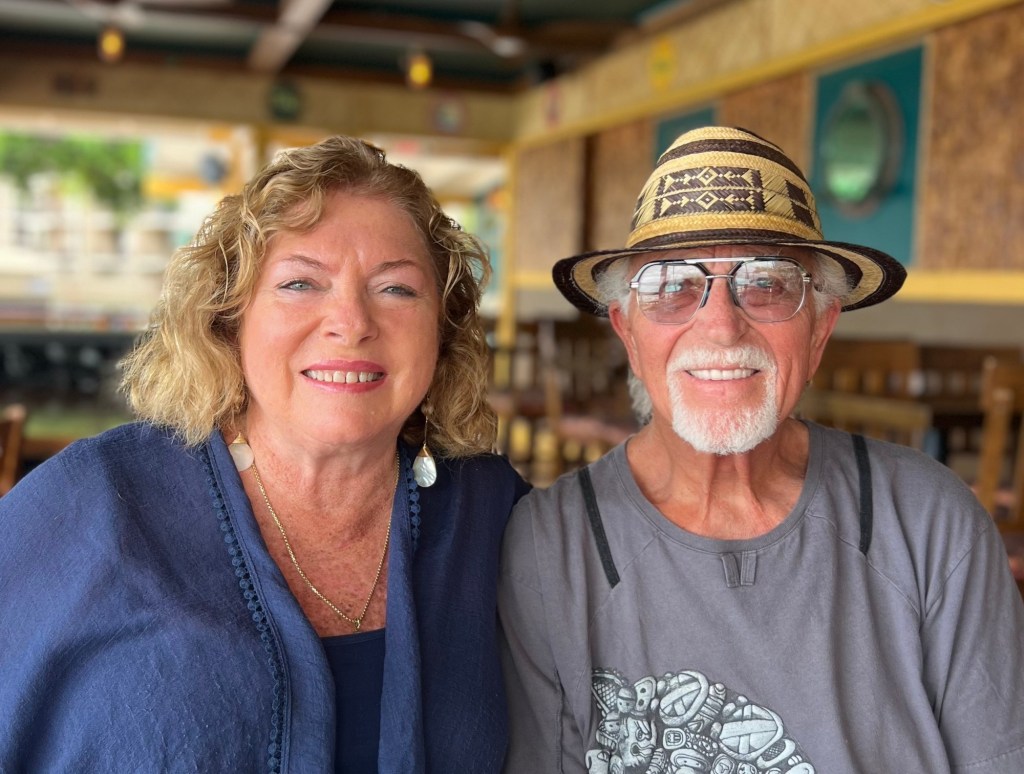
When Ron Eisenberg’s Great News Cookware Store and Cooking School closed in 2015 after 38 years, the then-75-year-old pharmacist-turned-retailer went through what he calls “a grieving process.” Amazon and online competition had forced him to close the Pacific Beach institution where customers became friends, and cooking became community.
“I was bored,” says Eisenberg, now 85, with characteristic directness as I talk on Zoom with him and his wife, Devora Safran. “I discussed all this with Devora, who pointed out to me that I was a social fellow and liked to drive. It was obvious. I became an Uber driver.”
For the next few years, he drove a “gently used” Prius. He kept water, mints, towelettes for customers — the same customer-centric, service-oriented approach that he had used successfully at Great News.
Finally, during COVID, and now 79, he parked the car for good. Now it was time for Safran to suggest her retirement ideas. For six or seven years, she’d been researching international living, forwarding Eisenberg articles about health care in Panama and the cost of living in Mexico. “He stonewalled me,” Safran laughs. “He wouldn’t even read them.”
Then the couple attended an International Living conference in Las Vegas. After filling a spiral notebook front to back with information about various countries, they narrowed their focus. “At the end,” Eisenberg said, “The only place I would really consider is Mexico, so we’re close to the U.S. and can come back for health care.”
Fast forward to early 2024. Safran, who had spent 25 years as a cabinetry and interior designer, was laid off as post-COVID business slowed. She was 65. Eisenberg was 84. They looked at each other and thought: If not now, when?
In 60 days, they packed up their Point Loma house and rented it out, and moved to Ajijic (pronounced ah-hee-HEEK), a village of about 11,400 on the shores of Lake Chapala, Mexico’s largest lake. The town sits at 5,000 feet, less than an hour from Guadalajara’s airport, with what they describe as “spring-like weather year-round.”
Their research process reads like a master class in retirement planning. They attended multiple conferences, visited San Miguel de Allende and Puerto Vallarta, and visited Ajijic twice — once in winter, once during the rainy summer season — before committing. When they finally decided, they spent 10 days looking at 35 properties before signing a lease.
What they found was a 100-year-old mini-hacienda fully furnished in the center of town with two large bedrooms, two bathrooms, two kitchens (one with a built-in barbecue), a swimming pool, and a bathtub — both hard to find in Ajijic. The rent? About $1,800 a month. Yes, you read that correctly. In San Diego dollars, that’s about what you’d pay for a one-bedroom apartment in a decent neighborhood.
The medical care proved equally astonishing. Eisenberg, who has had some health issues since moving, discovered doctors who make house calls, spend an hour with patients, and charge about $35 per visit. Safran, a breast cancer survivor who couldn’t get a mammogram appointment in San Diego for nine months, walked into a clinic in Ajijic, self-referred, and got a 360-degree mammogram for under $100. Results came back in 24 hours.
Perhaps most surprising is how Mexicans approach the final chapter of life. In Ajijic’s expat community, death is discussed openly. Day of the Dead celebrations honor loved ones with personal altars and community gatherings. Classes and workshops teach people how to prepare physically, emotionally, financially and spiritually for death. Trained “doulas” help with end-of-life rituals, and the state allows physician-aided death.
“There’s no hospice here because families take care of their elders,” Safran explains. “For us, it seems kinder, gentler, and perhaps a more natural circle of life.”
Their daily routine now resembles “summer camp every day.” Safran takes ceramics and oil painting classes, attends water aerobics, plays bridge, and goes to art workshops. Eisenberg joined a men’s breakfast group. They entertain friends, attend concerts and plays.
The challenges? Limited Spanish (though Safran gets by on what she remembers from a college summer in Mexico), and the political uncertainty about how U.S. policy might affect expats abroad. The cobblestone streets require careful navigation, especially for Eisenberg, who walks with a cane due to a metal plate in his foot.
Now when Eisenberg visits San Diego, he finds himself more stressed each time. They’ve extended their original one-year “gap year” experiment by another 18 months. Their Point Loma house remains rented. The storage unit holds memories of their former life.
“Living the dream,” Safran said. At $1,800 a month in paradise, with doctors who care and neighbors who smile, who could argue?
I’m interested in writing a column about seniors who are working part-time. Please email me with your suggestions at bbry@askturing.ai.