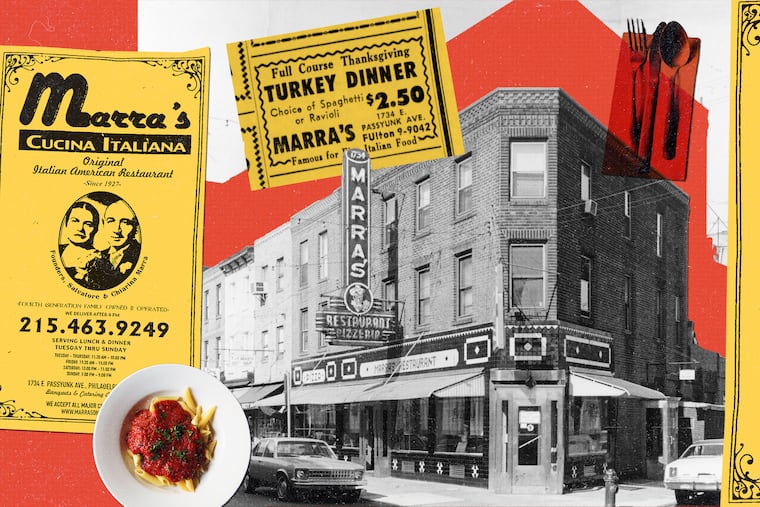
Antoinette and Chris Caserio walked out of Marra’s on Sunday afternoon with their children, a menu, a pizza box, and a bag of leftovers they called “their last supper.”
“It’s super sad,” Antoinette Caserio said. “My dad’s 80 and this was his spot.”
Marra’s, the family-run restaurant widely considered Philadelphia’s oldest pizzeria, closed Sunday after 98 years — a day in advance of the sale of its iconic black-and-white-tiled building at 1734 E. Passyunk Ave. in South Philadelphia. The property had been on the market for several years.
The buyer, Chinatown restaurateur and publisher Dan Tsao, said he plans to open a branch of his popular Sichuan restaurant EMei next year.
Marra’s was one of the last remaining links to East Passyunk Avenue’s featured role in the Italian American immigrant experience of the early 20th century. It also marks a transition for the founding Marra and D’Adamo families, who say they are exploring a new location for the restaurant, which opened in 1927.
Mario D’Adamo Jr., a grandson of founders Salvatore and Chiarina Marra and brother of co-owner Robert D’Adamo, said business had dipped after the pandemic, but that wasn’t the impetus for the sale. “The biggest killer was parking,” he said by phone while searching for a spot Sunday. “Small restaurants can survive that; large places can’t.” With 160 seats, including its 80-seat banquet room on the second floor, Marra’s lost a lot of business because of it, D’Adamo said.
Robert D’Adamo, 75, and cousin Maurizio DeLuca, 61, who took over ownership in 2000, declined to speak with The Inquirer over the last few weeks as word spread of the impending sale, citing their emotions. In a statement, they said they were prepared to move on with “the same love that has always defined us — just in a location that better serves our guests.”
Mario D’Adamo Jr., 71, a lawyer and deputy court administrator for Philadelphia’s Family Court, sold his stake about 25 years ago but retains an interest in the Marra’s name.
With the sale to Tsao, the building will remain a restaurant. Tsao has said he intends to renovate the building while respecting its look and feel.
Marra’s oil-fired brick oven, believed to be one of the city’s oldest, may not be salvageable, D’Adamo said.
The life of the bricks is about 100 years and the inside is collapsing, even though an artisan patched it about two years ago. “The oil flame is so hot that the bricks are now pulverizing,” he said.
Marra’s backstory
The families of Salvatore Marra and Chiarina Daniele were baking pizza in Naples before the turn of the 20th century.
Shortly after the couple married, they set out for the United States.
Marra family lore holds that Salvatore arrived at Ellis Island in 1921 with a single dime — likely a 10-centesimi coin — which he tossed into New York Harbor so he could say that he had begun his life in America with nothing. Chiarina joined him soon after.
His early attempts to recreate Neapolitan pizza were discouraging — first in Brooklyn and then Chicago. He thought that the pies were lacking and blamed the ovens.
Back in Naples, the ovens were lined with lava bricks from Mount Vesuvius, which radiated and retained heat in a way he couldn’t replicate. When the Marras moved to Philadelphia, he ordered bricks from Naples and had the oven built for their first pizzeria, which opened in 1924 at Eighth and Christian Streets in South Philadelphia. This time, the pizza tasted right.
In 1927, when the Marras bought a former butcher shop at 1734 E. Passyunk Ave., the oven was dismantled brick by brick and rebuilt there.
The neighborhood was teeming with immigrants, and East Passyunk’s diagonal path through the city’s rowhouse grid — historically, it was a Lenape trail — had made it a natural commercial strip. For generations, families bought their church clothes, shoes, furniture, and sundries on the Avenue.
Salvatore and Chiarina still lived on the restaurant’s third floor after their retirement in 1947. She died in 1973 at age 73. Salvatore, in his usual fedora, was a familiar presence on the Avenue until his death in 1984 at age 89.
Their children, Bianca and Vincent Marra, carried Marra’s business forward after Salvatore and Chiarina’s retirement. By that time, Bianca had married Mario D’Adamo Sr., a Marra’s busboy who lived around the corner. (Their children, Robert, Mario Jr., Linda and Marlene, represented the next generation.)
Bianca D’Adamo, known as “Mama D’Adamo,” became one of the restaurant’s most visible figures. In a 1980s interview with The Inquirer, she recalled a particularly loud regular from years past: a kid named Fred Cocozza. “He’d come in, stand right over there, and sing at the top of his lungs,” she said. “Papa would come out of the kitchen and tell him to get out. He thought it was bad for business.” In 1947, he performed for 20,000 people at the Hollywood Bowl and signed a film contract with MGM as Mario Lanza.
In 1950, Bianca and Vincent bought the bakery next door and expanded the restaurant. Vincent Marra opened his own Marra’s restaurant on Baltimore Pike in Springfield, Delaware County in 1954.
Marra’s fame
During Bianca and Mario’s oversight, Marra’s began attracting the spotlight. For National Pizza Week in 1955, Salvatore Marra was named Pizza Man of the Year. In 1977, Eastern Airlines’ in-flight magazine, Pathways, cited Marra’s as one of the five best pizzerias in the country. Philadelphia Magazine named it South Philly’s top pizzeria in 1985 — the same year Villanova University won the NCAA men’s basketball championship. That year, coach Rollie Massimino, a regular, inspired the dish known as Rollie’s ziti in white, a bowl of ziti and broccoli in garlic sauce, that remained on the menu till the end.
Marra’s celebrity guest list read like an index of 20th-century American entertainment: Mickey Rooney, John Wayne, Frank Sinatra, Frankie Avalon, Eddie Fisher, Jimmy Darren, Bobby Rydell, Al Martino, John Travolta, Eugene Ormandy, Conan O’Brien.
When Passyunk Avenue’s fortunes began dipping in the 1990s, a group now known as Passyunk Avenue Revitalization Corp. began buying and rehabbing distressed properties. (PARC was originally created in 1991 as Citizens’ Alliance for Better Neighborhoods, but later became embroiled in a scandal that brought down State Sen. Vincent Fumo.)
The early 2000s saw a new wave of residents moving in from outside the neighborhood as PARC’s work helped spark an influx of chef-driven restaurants and bars to join such traditional spots as Mamma Maria and Mr. Martino’s (which opened in 1992) and Tre Scalini (1994).
Le Virtù, serving the rustic cuisine of Abruzzo, opened in 2007 in a former community newspaper office at 1927 E. Passyunk. That year, Fiore’s, which fed generations in a low-slung building where Passyunk crosses 12th and Morris Streets, became a Mexican restaurant, Cantina Los Caballitos.
Restaurants continued to usher in change along the Avenue as the years went on. The distinctive curved building at 1709 E. Passyunk morphed through the years from an appliance store to a bank and then to a men’s clothing store before opening in 2017 as Barcelona Wine Bar. What is now Rice & Sambal, an Indonesian BYOB at 1911 E. Passyunk, was a photographic-supply shop for years after World War II.
Marra’s closing is painful to Mario D’Adamo Jr., as he recounted late Sunday after the last pizza — topped with spinach, broccoli, tomatoes, and mozzarella — slid out of the oven. Like his brother, he grew up on the third floor of the restaurant’s building.
“It became part of your DNA,” he said. “We used to close at 2 or 3 in the morning. My whole life, I heard the jukebox playing Sinatra, Dean Martin, Tony Bennett. I still go to bed late because of that. Some of my earliest memories are my father coming up the steps, tired, smelling like the restaurant, folding his apron over the banister.
“Other families watched football. We watched cooking shows,” D’Adamo said. “Everything in your mind connects back to the restaurant.”