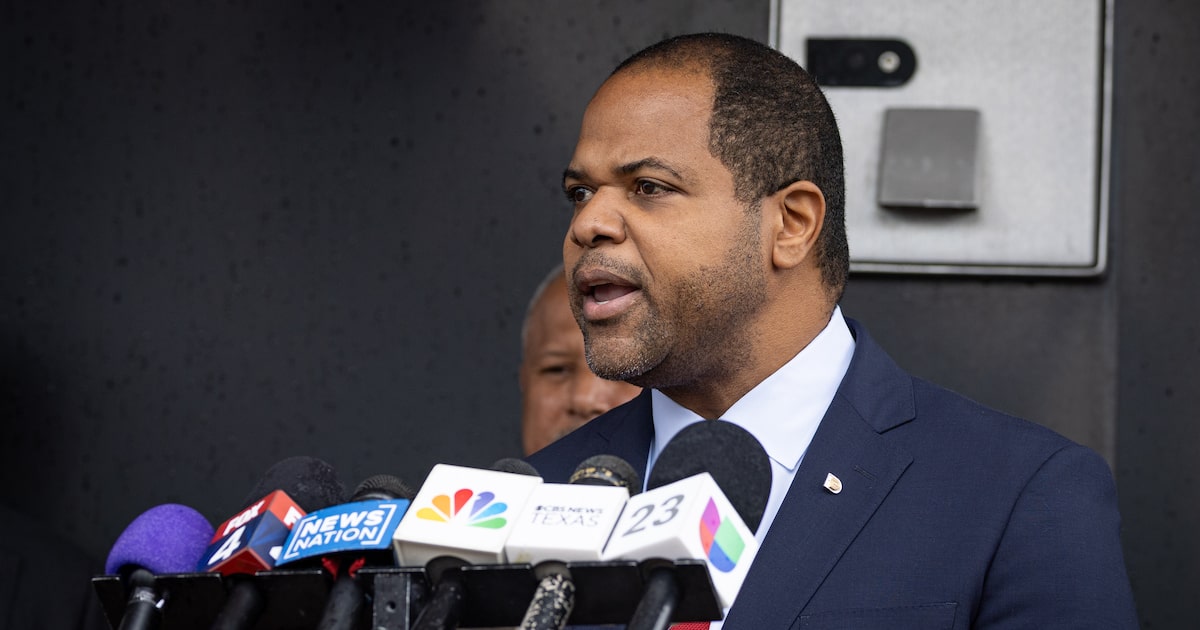
Dallas Mayor Eric Johnson met with federal immigration officials in early September to discuss a proposal that would authorize city police to enforce federal immigration laws — weeks before the public would learn it had been under consideration.
Newly obtained records reviewed by The Dallas Morning News show Johnson met Sept. 4 with U.S. Immigration and Customs Enforcement officials to discuss the 287(g) program, which would give local officers the authority to enforce immigration laws normally handled by federal agents. The proposal, once it was widely known, drew strong opposition.
Johnson has not publicly disclosed the meeting. It came nearly six weeks before police Chief Daniel Comeaux, while fielding questions about the department’s dealings with ICE, told an oversight panel in October he had already rejected a $25 million “offer” to join the program.
It was Comeaux’s disclosure in October that thrust the federal program into the spotlight, sparking debate on the City Council and drawing condemnation from immigrant advocates. Days later, Johnson sent a memo — which made no mention of his September meeting with ICE — to council members, asking two city committees to hold a special joint session to publicly discuss whether the program was a good fit for Dallas.
Breaking News
In the memo, Johnson wrote that Comeaux had “unilaterally rejected” the program and that, “As the elected body charged with setting City policy and overseeing its budget, the City Council should be briefed on all the relevant information that went into Chief Comeaux’s decision in a public meeting and with an opportunity for input from residents.”
Two City Council members said they had not been aware of Johnson’s meeting with ICE. One of them, Jaime Resendez, who represents District 5, said he was troubled the September meeting had not been widely communicated at the time.
“Any effort by the mayor to explore 287(g) should have been disclosed to the full council from day one,” Resendez wrote in a message to The News. “The fact that this was kept quiet, and then framed as a reactive request for information, raises serious concerns about the mayor’s honesty with both the council and the residents we serve.”
Johnson and his staff have not responded to The News’ questions about his meeting with ICE officials, including what exactly they discussed, whether the mayor informed any City Council members and how it informed his position on the 287(g) program.
The joint meeting called by Johnson ran nearly six hours and culminated in nearly the entire City Council rejecting the program and backing Comeaux’s decision.
ICE pitches the meeting
Johnson, a longtime Democratic lawmaker who left the party in 2023 to join the GOP, has increasingly aligned himself with conservative views on immigration. An expansion of the 287(g) program, named after its statutory citation in the Immigration and Nationality Act, is a piece of President Donald Trump’s mass deportation agenda.
An assistant director with ICE’s Dallas field office reached out to Johnson on Aug. 7 to pitch a meeting to discuss the 287(g) program, emails show. The official, Latice Curry, described the program as allowing ICE to partner with state and local law enforcement agencies to “identify and process removable noncitizens encountered during regular law enforcement operations.”
“These partnerships,” Curry wrote in the email, “help enhance public safety and promote consistent enforcement of immigration laws, all while respecting local authority and priorities.”
Scheduled meeting attendees included Curry; Jeanine Crawford, a 287(g) program manager; and Joshua Johnson, the head of ICE’s Dallas field office. A spokesperson for the mayor, Noah DeGarmo, confirmed in a message that the meeting took place.
It is unclear who attended. Neither the mayor nor DeGarmo provided answers to The News’ list of questions.
In her initial email to Johnson’s office, Curry said ICE had already scheduled a meeting with Dallas County Sheriff Marion Brown to discuss the program. Sheriff’s office records obtained by The News show that the meeting was scheduled for Aug. 27.
Neither Brown nor spokespeople for the sheriff’s office responded to a list of questions about the meeting, including what exactly was discussed and whether the sheriff plans to join the program.
Public debate ends with consensus
Weeks after the mayor’s Sept. 4 sit-down with ICE, Comeaux’s rejection of 287(g) surfaced in public.
In his memo to City Council members days afterward, Johnson requested the city’s public safety and government efficiency committees meet in a joint session to publicly discuss the program. The mayor’s memo framed the program as a possible boost to the city’s budget and a potential “force multiplier” for the police department.
Comeaux expanded on his opposition to the program during the joint meeting. The chief said the program would strain department resources and negatively impact efforts to reduce 911 response times. The chief expressed worries that it would undermine the trust the department has worked to foster with communities.
“I see no value at all for us to be involved in this program,” he said while fielding questions from council members.
After a lengthy and at times heated discussion, City Council members roundly rejected the program during the joint meeting. Their unanimous decision was celebrated by immigrant advocates.
District 4 council member Maxie Johnson, who chairs the government efficiency committee and presided over the joint meeting, told The News on Friday that he was unaware the mayor had met with ICE. District 12 council member Cara Mendelsohn, who chairs the public safety committee, did not respond to messages seeking comment about the meeting.
During the joint meeting, Mendelsohn questioned city staff on whether the City Council should have been informed sooner about the proposal, saying she learned of it only when Comeaux disclosed it at the October police oversight meeting.
Dallas City Manager Kimberly Bizor Tolbert responded, saying she was aware of and approved of Comeaux’s decision. The chief, she added, has the “operational authority” to make such a call.
Eric Johnson did not attend the meeting. His office issued a statement the day after the council rejected the program, calling the public debate necessary to make an informed decision. He thanked residents who spoke, council members who “asked thoughtful questions and kept an open mind” and Comeaux.
“Clearly, there remains some confusion about how this program would work fiscally — and whether and how it would work operationally for the Dallas Police Department,” the mayor’s statement read. “While we should always be willing to discuss ways we can cooperate with our federal law enforcement partners to make our communities safer, we cannot afford to stray from our public safety strategies that have led to a remarkable five-straight years of violent crime reduction in Dallas.”
Staff writer Tracey McManus contributed reporting for this article.