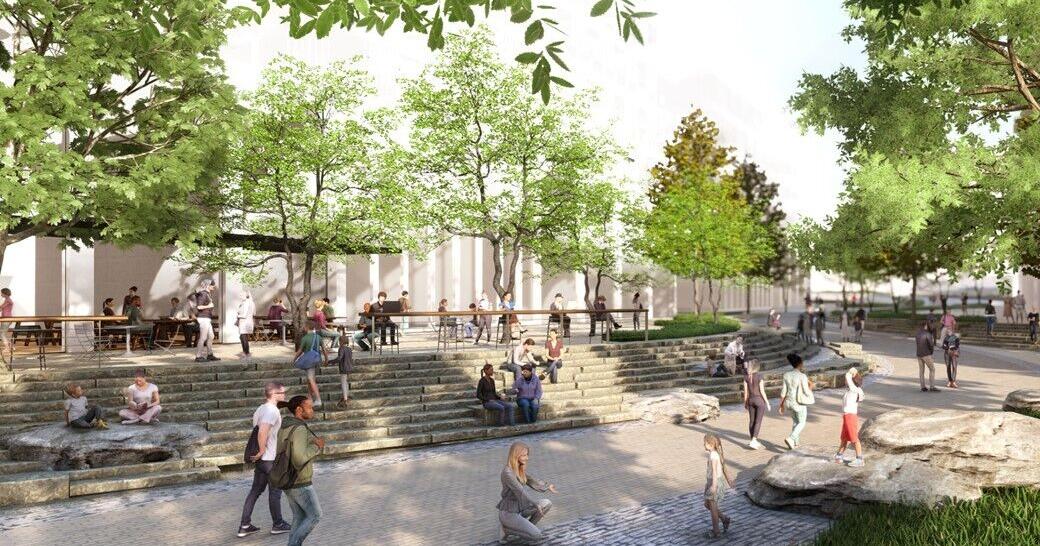
Vanderbilt University is now seeking a rezoning that would allow about 40 underutilized acres located on the western segment of the campus to be transformed with a mixed-use innovation district.
Specifically, and according to a release, Vanderbilt will seek from the Metro Planning Commission a specific plan zoning for an area dominated by a sea of surface parking. The land mass is essentially bordered by Vanderbilt Place, Natchez Trace and 31st Avenue South. Notwithstanding an athletics field and a solid number of trees, the area differs greatly from the Gothic-inspired architecture integral to the character of the renowned university. The area also includes buildings Vanderbilt owns and that are located on the north side of Vanderbilt Place.
A specific plan (SP) rezoning, if approved, would offer the university maximum flexibility in reinventing what Vanderbilt Chancellor Daniel Diermeier, in partnership with the Nashville Innovation Alliance, eyes as a mixed-use innovation district. The area would be home to business incubator spaces and a hub for entrepreneurship. It is also expected to include arts and retail businesses, residential buildings, offices space and restaurants.
A date for which the rezoning will be voted upon is unclear. However, the release notes the Metro Planning Department staff will consider the proposal and provide an opportunity for community members to offer feedback. Over several months, Vanderbilt, the community and the planning department will work together to determine next steps and what will be the “final framework” for the area’s development.
Currently, the parcels comprising the area envisioned for the update are variously zoned for office, residential and retail. An SP zoning would allow for a more cohesive form and function of the future development than otherwise.
Vanderbilt has not disclosed a preferred construction start date or estimated cost to undertake the effort.
Vanderbilt’s plans for the area — which would likely require a minimum of three phases, with the first phase potentially to focus on 10 acres — began to emerge this past summer.
“We want to play a leading role in helping further develop the innovation economy in Nashville,” Diermeier told the Post for a previous article (read here).
“We think that we’re at a point right now where the city and the university, indeed the entire region, could benefit from having a place where entrepreneurs interact with our faculty, where there are students, where there’s space to develop new businesses, and where there’s a vibrant environment where business creation can be fostered.”
Diermeier noted the proposed district’s proximity to key facilities like Vanderbilt University Medical Center could boost innovation in health and biomedical sciences.
The Vanderbilt chancellor said he wants the future district to differ from an innovation park, with the latter typically reserved for office users.
When conceptualizing the innovation district, the university studied both U.S. examples, such as Atlanta’s Tech Square, and international areas, including the development of King’s Cross in London and districts located in Tel Aviv and Barcelona.
To date, Vanderbilt has worked with Copenhagen-based Bjarke Ingels Group, Field Operations of New York and locally based Hastings Architecture on early designs.
Diermeier previously told the Post the existing surface parking would be replaced in some form (likely via parking garages) and interact with many of Vanderbilt’s athletic facilities located nearby.
“We hope that would definitely enhance the gameday experience as well,” Diermeier said at the time. “That’s not the main purpose, but … if done well, athletic facilities can both enliven a neighborhood and a district.”