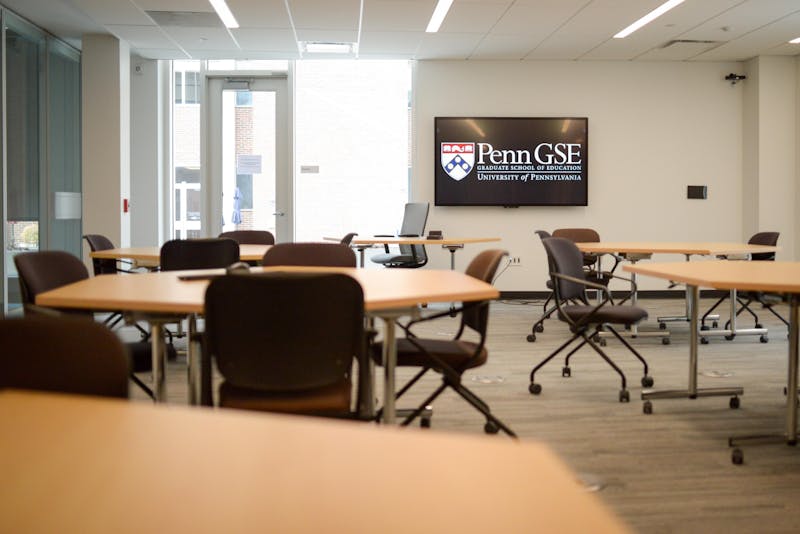
Unless you’ve been doing a full internet cleanse for the past few weeks, you’ve probably read all about the Penn Graduate School of Education hacker and received the multiple blunt emails impersonating Penn’s administrative board. While Penn has always loved a scandal, reading “We hire and admit morons because we love legacies, donors, and unqualified affirmative action admits” felt bolder than usual. It’s no secret that people have strong opinions about Penn — we’ve all seen the people handing out flyers ‘exposing’ our school’s corrupt ways and the comments on every school Instagram post — but lately the resentment has amped up. It brought to light a sentiment that the administration can’t ignore: Penn’s PR needs to change direction.
Penn was founded in 1740 and is the oldest university in the United States. It rose to prestige in the late 20th century and is now ranked No. 7 in the nation. Not only that, but it’s now No. 5 in terms of lowest acceptance rates, and its admission process is only getting more selective. Penn’s history is broad and full of notable successes, including the creation of the first medical and business schools in the U.S., pioneering research in the medical and computational fields, and boasting a long list of successful, household-name alumni. It was long regarded as a respectable and accomplished institution.
But does that still ring true today?
Recently, it seems the nation is facing a rising trend in anti-education sentiments which not only stem from the governmental slashing of funding, but also an idea, whether or not the job market reflects it, that a college education just isn’t valuable anymore. This puts Ivy League schools in a difficult place. With Penn’s reputation closely tied to the Wharton School, it’s hard to put this idea of elite political and business wealth against the new values our generation holds. It’s becoming increasingly apparent that Ivy League institutions are more about politics than education, and people are rarely happy with our political decisions.
Whether it be Penn’s decision to ‘negotiate’ with Trump over the Compact (we all know they love constructive feedback), the decision to revoke Lia Thomas‘ medals, or the questionable handling of anti-Semitism on campus from then-president Liz Magill, the past few years, it seems, have been scandal after scandal for Penn. But it’s not just political events, it’s the value Penn has been pushing for over a hundred years: prestige.
It’s not that people don’t accept the idea of prestige; it’s that Penn has created an image of elitism tied to politics that doesn’t sit well with the rest of the country. It’s a message that shouts to people teetering on anti-education: Colleges are political, not educational. There’s a difference between innate and performative elitism. Penn used to be an institution that spoke for itself; its name alone carried the title of respect and priority. But now, with the lack of enthusiasm for high-level education, we seem to be manufacturing a picture of elitism through political decisions and glossy pamphlets. Unfortunately, it’s no longer appealing to the public. There’s no need for a Top 10 school to promote wealth through political deals or put on a performative front telling the country about how amazing we are; we should be showing them.
Penn’s PR needs to shift away from trying to project elitism onto the nation and move towards letting our actions speak for themselves — in a good way, for once. Instead of telling communities how much further above them Penn is, we should be working with them to make education more accessible. Instead of presenting a facade of perfection, we should promote transparency and accountability within education. And instead of tailoring every decision to politics, we should be focused on who Penn is actually made up of: people from every corner of the world.
GSE being hacked was, at first, a humorous email that took over Sidechat for a day, but it turned into a call for Penn’s administrative board. Prestige doesn’t come from money or political alliances; it comes from making a genuine impact on the community. So, what do we really want to be known for, elitism or prestige? After 285 years, it’s time for Penn to decide.
CHARLOTTE PULICA is a first year student studying Criminology and Economics from Enoch, Utah. Her email is cpulica1@sas.upenn.edu.