Brits often scoff at American imports. The commercialisation of Halloween trick or treating, 24-hour rolling news, adults wearing snapbacks, gender reveals… the list goes on and on.
But an increasingly stubborn blight on football — goalkeepers claiming they are injured so their manager can call a pitch-side meeting with their team — should force a break with that instinct and prompt the adoption of a U.S. staple: the ‘timeout’.
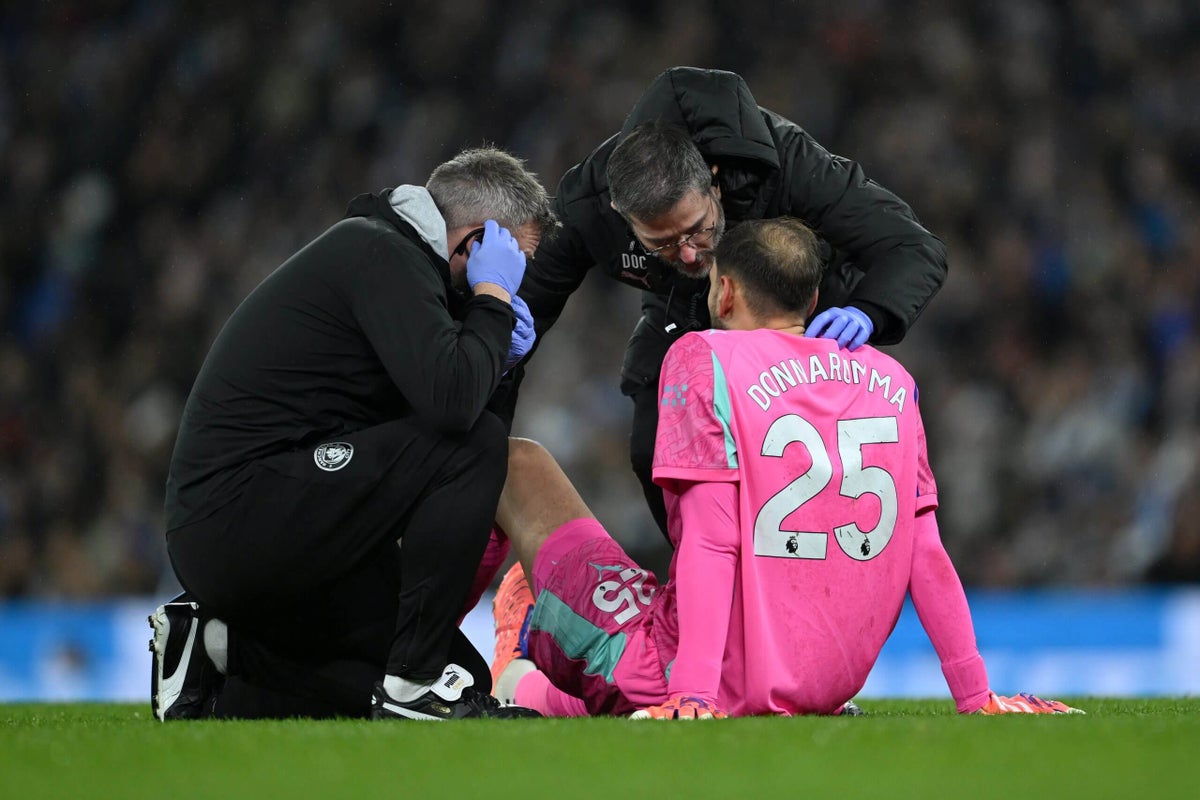
The prompt for this was Saturday’s controversy in the Premier League, when Leeds United manager Daniel Farke was left on the verge of spontaneous combustion after Manchester City goalkeeper Gianluigi Donnarumma dropped to the ground and called for treatment midway through the second half.
City were in a state of disarray at the time. From 2-0 up and cruising at half-time, their guests had pulled that back to 2-2 after 68 minutes. With Donnarumma prone on the turf, every City outfield player ran across to Pep Guardiola, gathering around a piece of paper as he dictated his commands. City did not immediately rectify their problems but they did manage to stem the flow and eventually found a stoppage-time goal to win 3-2.
Farke was furious, saying it was “obvious” why Donnarumma had collapsed. “I asked the fourth official, ‘Do you want to do something?’” Farke told reporters. “He said, ‘No, our hands are tied. We can’t do anything’. We should think about how we can deal with it.”
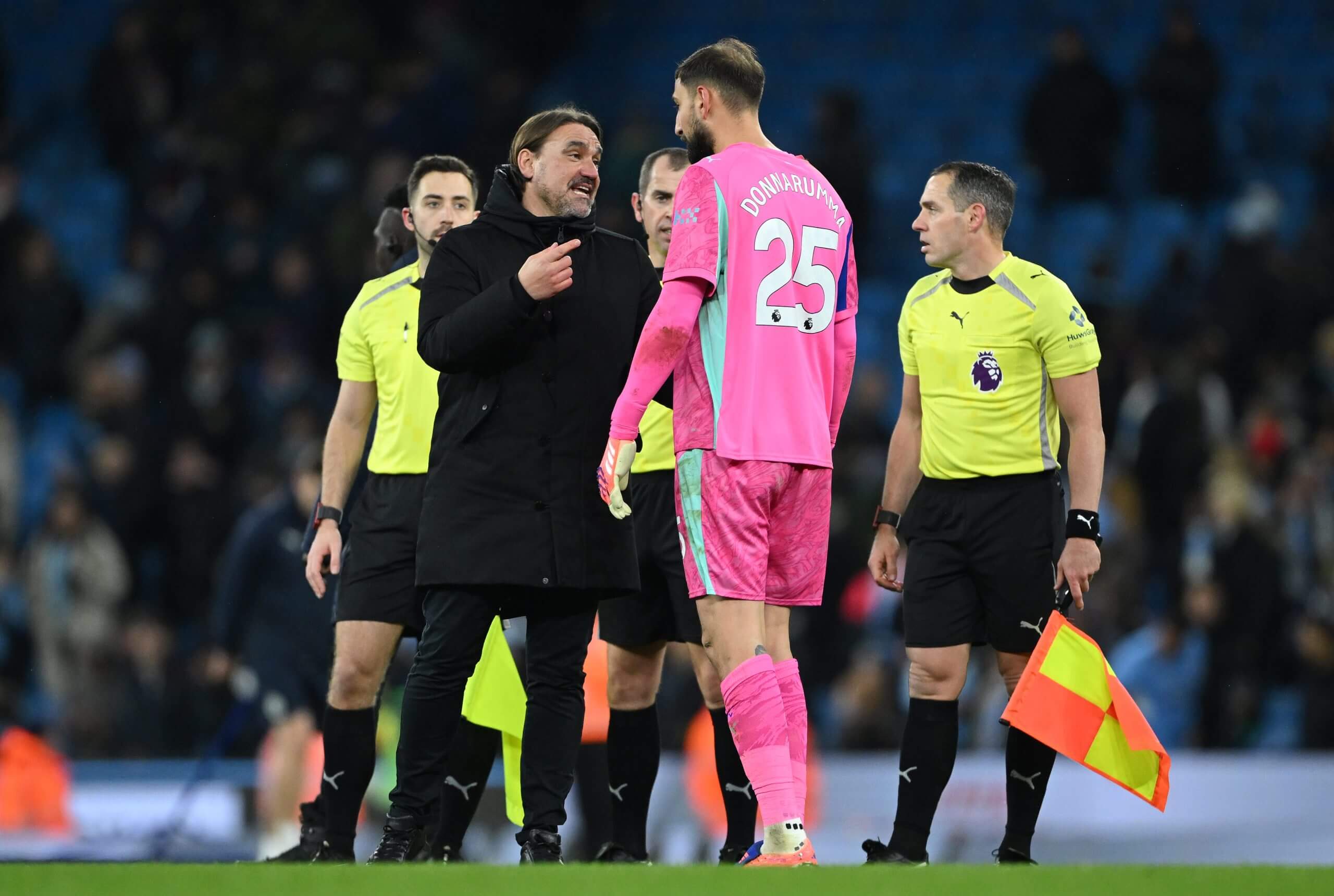
Daniel Farke was angry with Gianluigi Donnarumma (Shaun Botterill/Getty Images)
Guardiola pleaded the fifth when asked whether his team talk was very far from impromptu, but the wider point is that Donnarumma is not alone in being accused of gaming the system. The habit of Arsenal goalkeeper David Raya in sitting down and awaiting treatment has become a running joke in the last two seasons.
Unlike outfielders, goalkeepers are not ordered to receive treatment off the field of play because then there would be a big empty net to score into. Teams are now seeing the opportunity this valuable time offers, whether that be in disrupting the rhythm of the opposition or strategising how they find the decisive goal.
It has become a problem in other sports, too. In tennis, the ATP, the governing body of men’s tennis, changed the rules around toilet breaks after it became obvious that they were being called at strategic moments (often before an opponent was about to serve a crucial game). Now, only one break can be taken, for a maximum of three minutes, at the end of a set. Two are permitted at Grand Slams.
In cricket, batters trying to save a match regularly call for treatment from the physio or a change in gloves or bat to eat up precious minutes. In college football it became such an issue the rules were changed so any player going down on the field after the ball is spotted would cost a team timeout or a five-yard penalty for delaying the game.
Imposing punishments in football could be tricky. You could award a corner to the opposition if the goalkeeper goes down but if he is genuinely injured that would prove controversial. If a free-kick was awarded in the attacking half it may not prove a great enough deterrent to stop it.
The Arab Cup, which is taking place this week in Qatar, is trialling a new rule aimed at cracking down on players feigning injuries. There, a player who receives treatment for an injury has to leave the pitch for two minutes unless they are the victim of a foul that results in a yellow or red card. That wouldn’t, however, solve the issue around goalkeepers.
So, how does football stop it?
It is difficult for match officials to outright accuse players of lying, and teams would inevitably find loopholes in attempts to block them from conversing with coaches. Even when the concussion substitution was introduced in 2021 — a worthy attempt to dissuade managers from gambling on the health of their player by not having it count towards the five substitutes quota — there were some who said teams would encourage their players to go down claiming a head knock.
If deterrents are almost impossible to enforce, and teams are going to unilaterally call timeouts anyway, the only solution is to legalise them.
Football should permit one 60-second timeout (shorter than the time currently being chewed up by unofficial stoppages) to be called by either the team’s manager or the captain when play is dead. The clock would either be paused, or the additional minute or two added onto the total stoppage time.
To prevent all 11 players from loitering for longer than 60 seconds, play could resume as soon as the whistle blows to signal the end of the minute. And maybe, just as the rules changed when it comes to conversing with the referee, perhaps only the captain is allowed to speak with his manager.
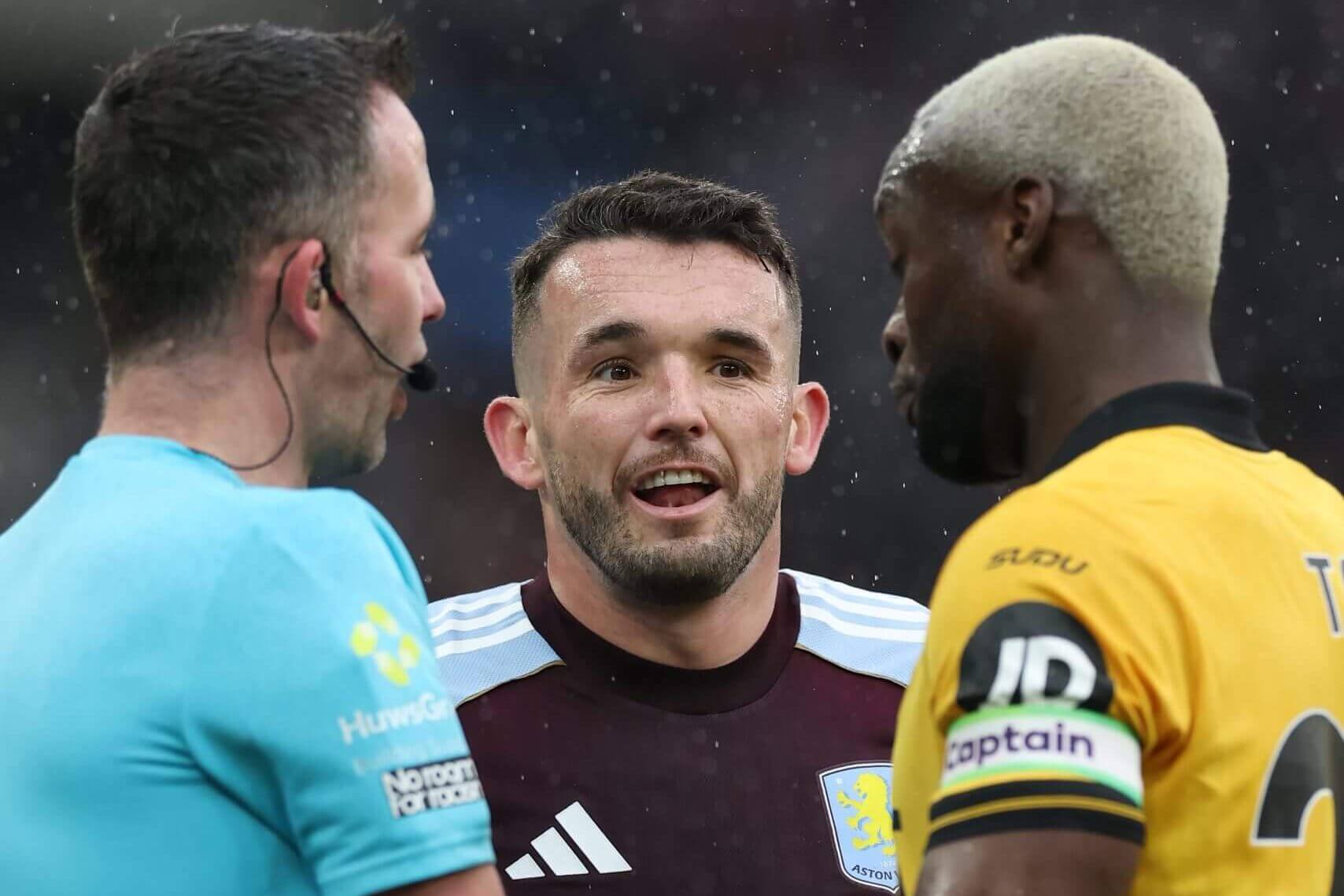
Should captains be allowed to call timeouts? (Michael Steele/Getty Images)
Would teams then still send the goalkeeper down after using their timeout? Possibly, but it feels unlikely if the manager has already got their message across.
Any changes to football’s rules have to improve the sport’s entertainment value without sacrificing any of its sacrosanct characteristics. A tactical timeout would add drama inside the stadium, emboldening the in-game influence of the manager and make the captaincy more of a strategic role rather than just a ceremonial one.
Not everyone is convinced. Guardiola is adamantly opposed to timeouts, saying it “will slow the game”, and he has a point. Adding another two minutes of delay to a sport that already has a 15-minute half-time interval and endless Video Assistant Referee delays — now extended still further by the referee having to announce his reasoning for the overruling of on-field decision — would meet with resistance.
The alternative is to let this gamesmanship go on unabated and continue the trend of less actual football being played.
The introduction of VAR in 2019-20 saw an additional minute added onto the Premier League’s average match time, to over 97 minutes. The most seismic jump came in 2023-24 when new directives on more accurately deciding stoppage time were introduced in a bid to disincentivise time-wasting. The average match time shot up to over 101 minutes.
Ball-in-play also jumped considerably, up by three-and-a-half minutes. It was lauded as giving fans better value for money — the equivalent of 24 extra games across the entire season — but the real indicator as to whether it has had a meaningful effect or not is whether it has reduced the percentage of total time lost to stoppages. If it has not, we are simply dragging the game out for longer with no added entertainment.
Initially, the changes worked but the trend has not sustained. Games are still lasting over 100 minutes on average this season but, at 45.4 per cent, the percentage of minutes lost to stoppages — be that fouls, disciplinary sanctions, substitutions, injury assessments, time-wasting, VAR checks or goal celebrations — is now at its highest point in the last decade.
Liverpool head coach Arne Slot said he wants to see it clamped down on and has offered to share his ideas with those who govern the game. Newcastle United manager Eddie Howe simply said “it happens” when asked by reporters yesterday. A clue, perhaps, that his goalkeeper Nick Pope may not always have been as badly hurt as he seemed.
There is no one club purely at fault for this but it is a loophole that needs closing. Looking to the U.S. might just offer a solution.