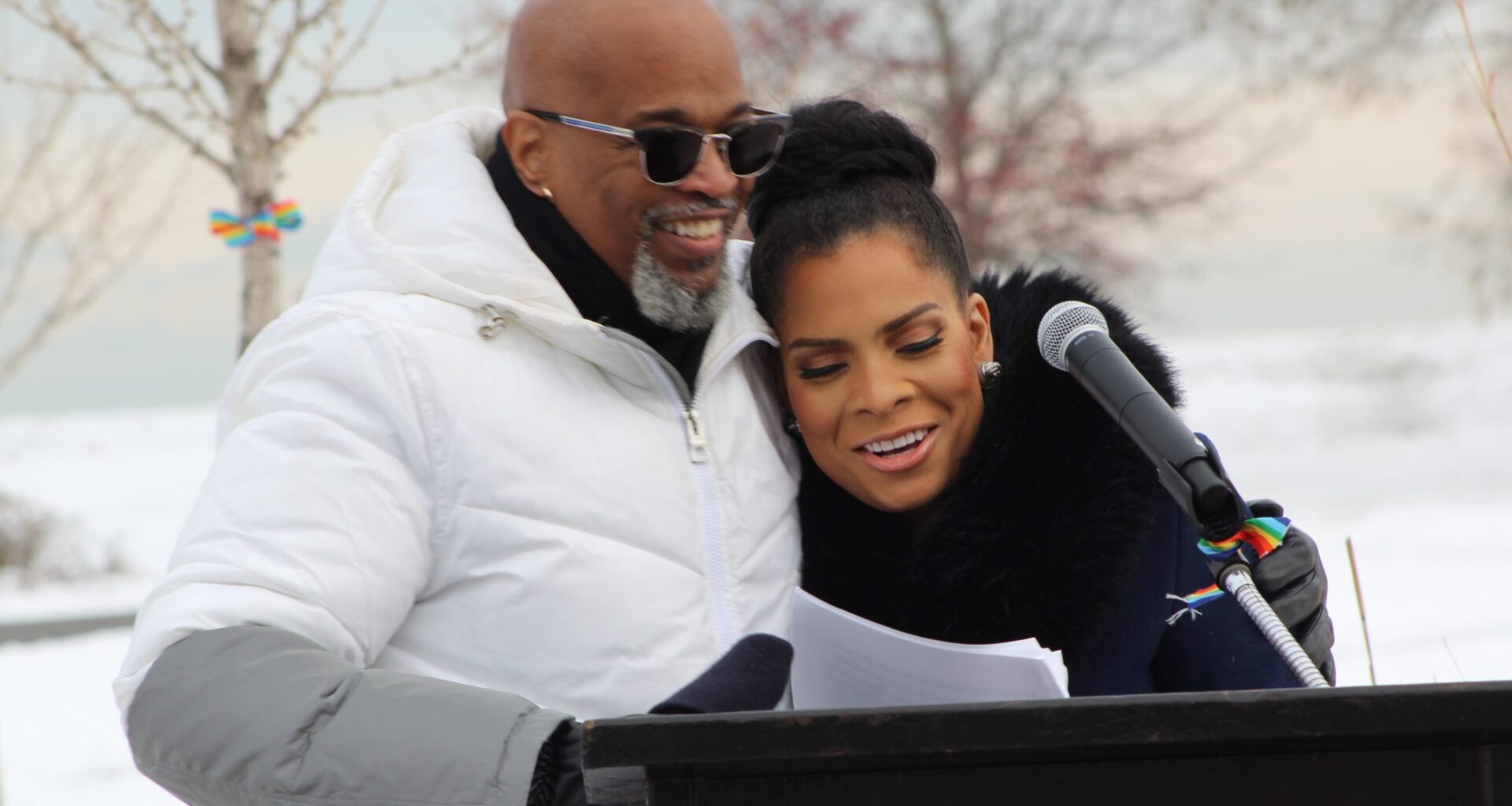
LGBTQ+ leaders and longtime HIV/AIDS activists gathered at the AIDS Garden Chicago on World AIDS Day for a ceremony that blended remembrance with a call to action.
The program was held at the base of the towering Keith Haring sculpture that anchors the AIDS Garden Chicago, 3100 N. Lake Shore Drive, which opened in 2022 as the city’s first public monument to memorialize the early days of Chicago’s HIV epidemic.
Former Ald. Tom Tunney (44th Ward), who was instrumental in the AIDS Garden’s opening, started the ceremony with a stark reflection on the early years of the epidemic when government denial and stigma fueled widespread death.
“Some of us in this room were veterans of not a foreign war, but a domestic war,” he said. “They called it a gay disease back then, and we fought like we were in World War III.” Tunney added that “the same kind of homophobia is back in the White House.”
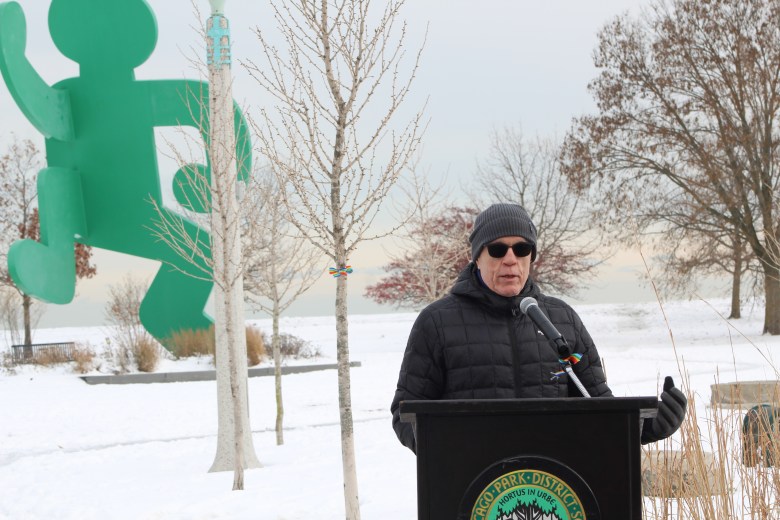 Former State Rep. Greg Harris speaks on World AIDS Day, Dec. 1, 2025, at the AIDS Garden Chicago. Photo by Jake Wittich
Former Illinois House Majority Leader Greg Harris, who was honored with a plaque at the AIDS Garden Chicago in June for his decades of HIV-related advocacy, echoed that sense of alarm. He warned that federal cuts to the National Institutes of Health and the Centers for Disease Control and Prevention will affect HIV funding and research across the country.
“All that money is disappearing out of the HIV care system,” Harris said.
With Chicago and Illinois both entering budget cycles, Harris stressed that local advocacy will be critical to protecting HIV services.
“The squeaky wheel gets the grease,” Harris said. “If your alderperson is asked, ‘Is this an important program?’ and they say, ‘I’ve never heard from anybody in my community about this,’ that’s very important.”
Antonio King, LGBTQ+ outreach liaison for the Chicago Department of Public Health, responded to the federal political climate with a vow that Chicago will continue to defend LGBTQ+ public health.
“We will not politicize public health,” King said, repeating the line for emphasis. “We are not done yet, and we will not let an administration—we will not let bigots—override us or kill us.”
Precious Brady-Davis, chief strategy officer at the Center on Halsted and commissioner for the Metropolitan Water Reclamation District, connected the threat of today’s federal cuts to the historical trauma of the AIDS crisis.
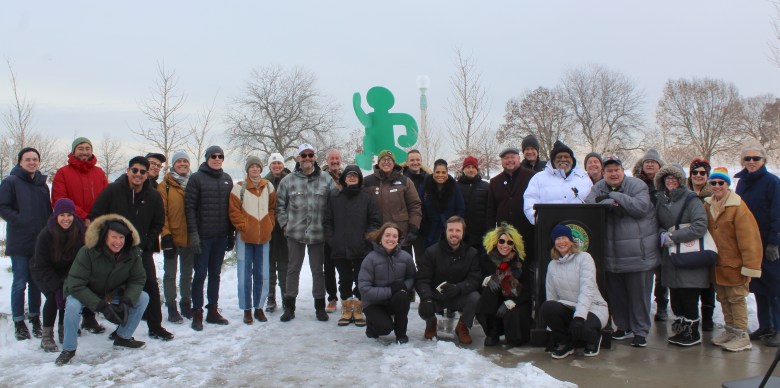 Community members gather in front of the Keith Haring sculpture at the AIDS Garden Chicago on World AIDS Day, Dec. 1, 2025. Photo by Jake Wittich
“We are facing a federal administration that refuses to even acknowledge that today is World AIDS Day,” Brady-Davis said. “That silence is intentional. It echoes the devastation of the Reagan era, a time when government neglect let people die.”
Brady-Davis called HIV/AIDS organizations the community’s “firewall,” ensuring that people living with HIV “can thrive, not just survive.”
For Omar Martínez González of AIDS Foundation Chicago, the pain and urgency of the moment are deeply personal.
“It’s unconscionable what this administration is doing… to dismantle the infrastructure that serves these individuals,” he said.
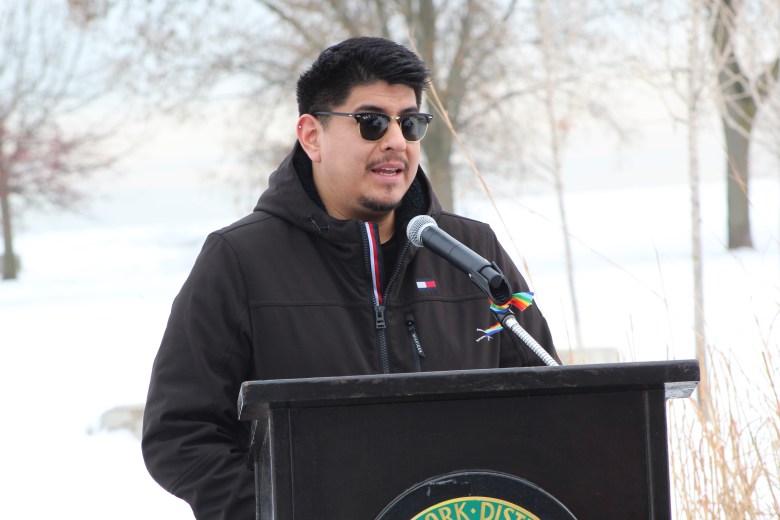 Omar Martínez González of AIDS Foundation Chicago speaks on World AIDS Day, Dec. 1, 2025, at the AIDS Garden Chicago. Photo by Jake Wittich
“I am committed to this fight because of the people who have come before me… who laid their lives on the line to ensure programs like HOPWA and the Ryan White program are a reality.”
The program closed with longtime activist Don Bell, who urged the community not to forget older people living with HIV—and not to allow age divisions to weaken the movement.
“We’re all on the same mandala of life—we’re just in different places,” Bell said, calling for an “intergenerational fight” to preserve resources and dignity for people aging with HIV.
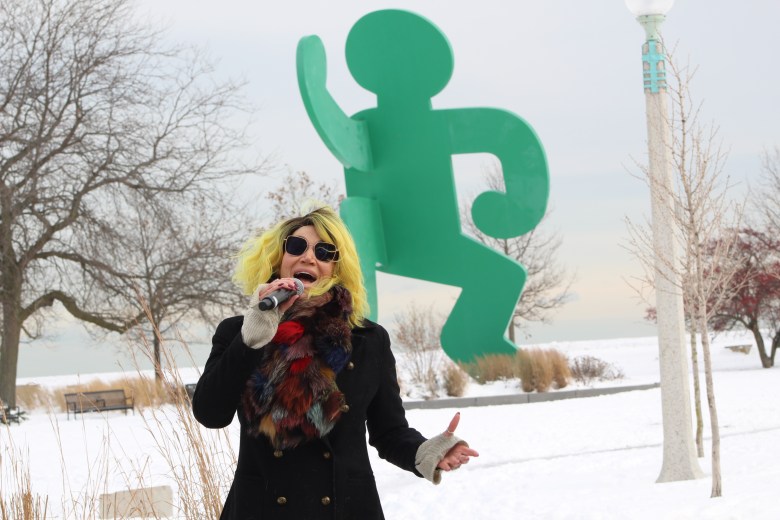 Molly Callinan sings at the AIDS Garden Chicago on World AIDS Day, Dec. 1, 2025. Photo by Jake Wittich
Related