This year’s New York City restaurant awards highlight the best new possibilities in the city’s dining scene. Each winner tells a story that translates to good cooking, great baking, or delicious drinks. More than in years past, they’re places we want to go to have fun.

This year has not been the easiest one. We seek out New York restaurants to eat, sure, but also to meet others in a place that helps us navigate the uncertainty that has framed 2025. Taken together, the winners go beyond buttoned-up technique and splashy dining rooms. They respect diners’ time and money, they don’t muddle a point of view, and they make room for simple pleasures even as the industry, the city, and the country shift in unpredictable ways. These are the new restaurants we keep returning to, the ones that remind us of a world of possibility within New York.
8 Extra Place, New York and 12 Extra Place, New York

A fluffy coconut turnover. Alex Staniloff
Kabawa and Bar Kabawa capture a mix of ambition and energy with a throughline of Caribbean culture that defined 2025 dining in New York City. Driven by chef Paul Carmichael — who, for years, worked at Momofuku restaurant Sieobo in Sydney — Kabawa reflects Momofuku’s ongoing command of the food-vibe-value trifecta.
The restaurant’s $145 three-course prix fixe is Carmichael’s personal narrative disguised as Jamaican pepper shrimp with hibiscus and Scotch bonnet jam, or the breadfruit toston topped with octopus and sauce chien. Put together, the meal tells the story of his Barbados upbringing, island sensibility, and international training with intimacy and polish. Next door, Bar Kabawa’s boisterous atmosphere delivers bay leaf-infused shaved ice daiquiris and rich brown butter concoctions in showy glassware. The patties — filled with short rib and bone marrow, curry goat, or conch — have helped fuel a full-tilt Manhattan patty moment. Together, Kabawa and Bar Kabawa offer something increasingly rare: a restaurant that is serious but doesn’t take itself too seriously, where diners can experience both the skill of the chef and the joy of the experience. — Melissa McCart, dining editorial manager, Eater Northeast

Cassava dumplings, raw shrimp dusted with sorrel, and a hunk of goat shoulder. Alex Staniloff
Bánh Anh Em earns Eater’s underdog award for the same reason its Union Square storefront draws a constant line: It offers accessible yet ambitious Vietnamese cooking. Owners Nhu Ton and John Nguyen, who opened their first restaurant Bánh in Harlem, built a following uptown for dishes like phở dặc biệt and bánh chưng that feel familiar yet lean creative as far as the making and sourcing of ingredients. Their follow-up restaurant expands that approach.

Phở at Bánh Anh Em. Lanna Apisukh/Eater NY

Vietnamese street food specialties abound at Bánh Anh Em. Lanna Apisukh/Eater NY
At Bánh Anh Em, the owners bake their own bread and make their rice noodles. The bánh mì — served on a light, crisp baguette — includes versions layered with pate, pork floss, pickled vegetables, and fermented hot sauce, as well as a richer option with bone marrow and brisket. One of the standout dishes, a rice-noodle bowl topped with pork-bone fish sauce, shredded mango, and mustard greens, is a regional style of Vietnamese cooking rarely seen in Manhattan. Though one might underestimate it based on the restaurant’s size and prices, the owners have raised the bar, not just for Vietnamese food, but for New York casual fare. — MM

Bánh uớt chồng, a five-layer tower of rice sheets. Lanna Apisukh/Eater NY
45-12 Greenpoint Avenue, Queens
You’ve probably heard their story by now: In 2020, Kimberly Camara and Kevin Borja found themselves furloughed from their jobs at Union Square Hospitality Group and decided to start making doughnuts from their Woodside home. They played on Camara’s grandmother’s recipes through Kora, and pushed forward Filipino American baking as it surged nationwide. Kora quickly dominated the pop-up game, at one point achieving a waitlist of over 10,000 people who wanted doughnuts topped with flan and others that emulated the many colors and textures of halo-halo. Still, for years, Kora operated as pick-up only and out of commissary kitchens.

Ube fried brioche doughnuts. Heami Lee/Eater NY

Leche flan-filled doughnuts. Heami Lee/Eater NY
In 2025, Camara and Borja finally made a home for Kora in Sunnyside. The larger, personalized space allowed them to expand into savory croissants, babka, cookies, and a coffee and matcha program, all of which reimagine Philippine flavors and ingredients through the precision of French pastry techniques: A stellar pain Suisse is filled with Spam, pimento cheese, hot honey, and chile crisp. Ensaymada, a sweet bun topped with salty grated cheese, is re-envisioned as a lacy, cheese-topped croissant. Tamarind adds a tropical touch to the crisp apple fritters. Kora’s expansion, which may include more savory options in the future, proves that they’re not just best-in-class when it comes to modern Filipino American baking but also among the new guard of the city’s wider pastry scene — one in which both diners and bakers increasingly desire the blurring of lines between cuisines. — Bettina Makalintal, senior reporter, Eater

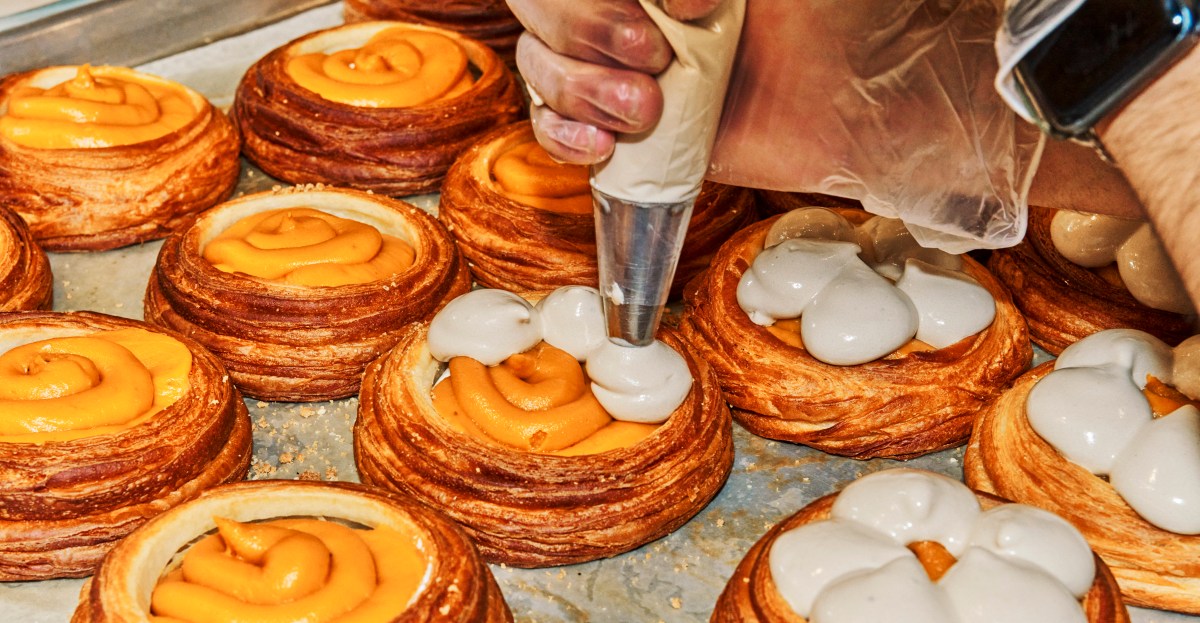
Baking sheets full of beautiful pastries are prepped at Kora. Heami Lee/Eater NY
139 Division Street, New York
What makes Sunn’s such a perfect wine bar is its simplicity: take a short and thoughtful Korean menu; add some wines; delight over the repurposed Jinro Soju water bottles adorned with toad labels; enjoy in the cozy, slim room. You’ve partaken in one of the most gratifying dining and drinking experiences in the city.
Chef and owner Sunny Lee’s banchan is a must-order. The selection of small plates is where she flexes her skill and experiments with textures, flavors, and ferments, like creamy tahini-smothered mushrooms, smoky eggplant, and tangy kimchi, in addition to chalkboard specials like the crunchy, sweet gochujang candied squid.

Tteokbokki in tomato-gochujang brown butter sauce topped with stracciatella and mozzarella cheese. Jutharat Pinyodoonyachet/Eater NY
The oft-changing salad is bountiful with vegetables and fruits, and not one, but two dressings. Forget about utensils; instead, use your hands to prepare layered bites using huge Napa cabbage leaves, lotus root slices, and persimmon segments. The rave tteokbokki, served like a baked ziti in a glass Pyrex dish, is one of those endlessly warming dishes.
The wine list, thanks to co-partner Grant Reynold of Parcelle’s and Sunn’s wine director Dora Grossman-Weir, is impeccable too, full of complementary options with a heavy natural and organic focus. The discoveries section is a fun mix of wines as well as Korean spirits like sool and soju.
Lee isn’t trying to make anything uber-fancy with her wine bar; she’s just serving what she knows — thoughtful bites with good wines. — Nadia Chaudhury, deputy dining editor, Northeast

An assortment of banchan. Jutharat Pinyodoonyachet/Eater NY
Queens was a sad place when Adda Indian Canteen, the groundbreaking Long Island City restaurant, closed up. But that borough’s loss became Manhattan’s gain when the Indian restaurant from Unapologetic Foods reemerged in the East Village in May. To paraphrase Charli XCX: Now it’s still Adda in a new address, but it’s the same, but the food has evolved, and the space is bigger, so it’s not.

A roasted cauliflower dish. Alex Lau/Adda
Adda 2.0’s menu, from co-owner and chef Chintan Pandya and chef de cuisine Neel Kajale, is still rooted in that regional Indian fare, but now with a glow-up. The original butter chicken has now transformed into a full-on experience with a tableside cart that you have to preorder. And outside of that fun flourish, the heart of the restaurant remains the same. The walls are still covered in the same press clippings, and the original handwritten Adda sign from it’s Queens era is there. The menu is still full of homey dishes that are now spruced up, like the creamy bheja masala (goat brains) paired with pao and biryani stuffed with baby goat leg meat.
Unapologetic Foods is not a company that sits still. Just this fall, it opened a fast-casual kebab stand in a Union Square Park food hall, but during all of its expanding and growing, its guiding principle is still that ever-flavorful Indian cuisine that is simply just fun. — NC

A roasted chicken dish. Alex Lau/Adda