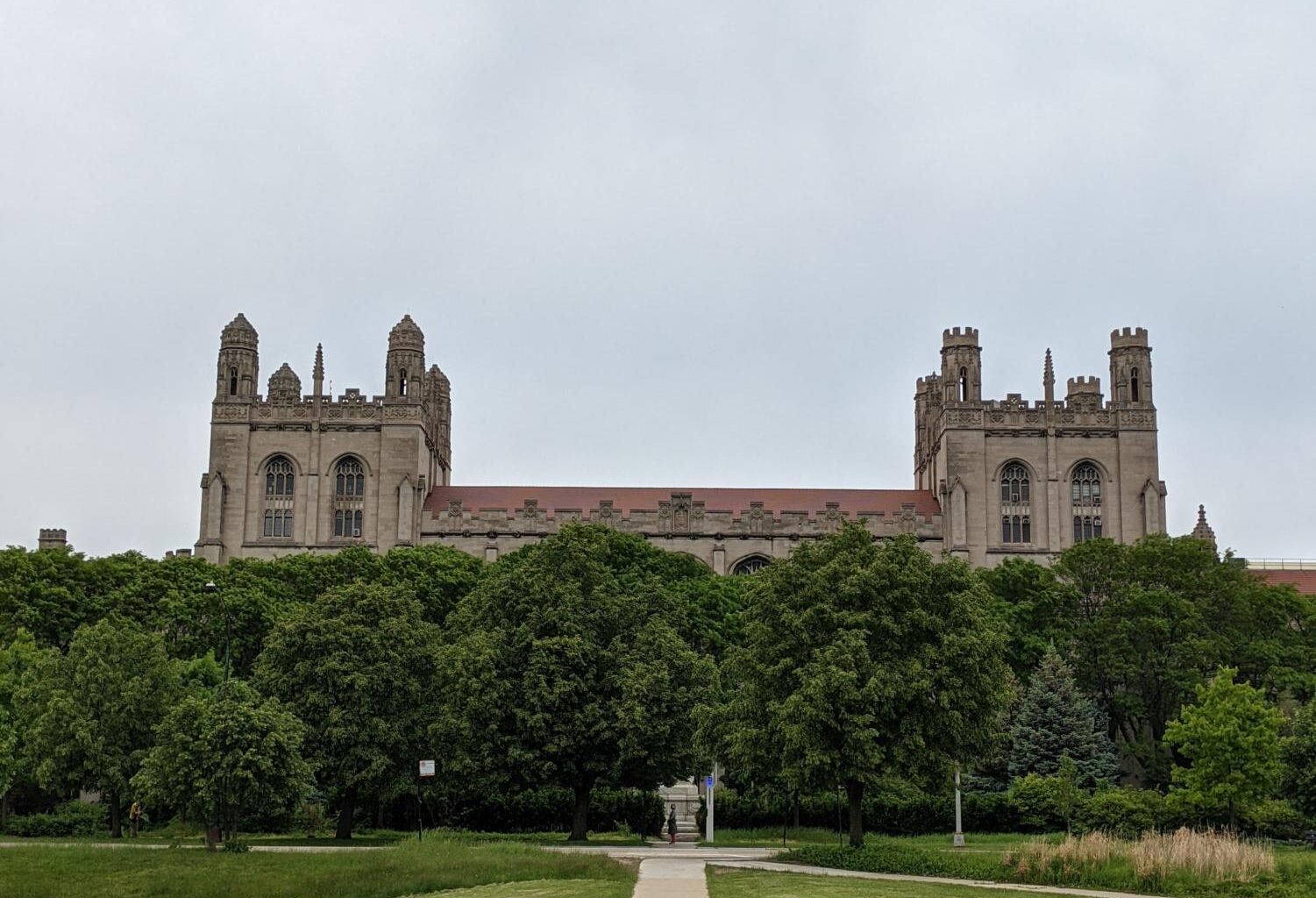

The UChicago Harm Reduction Project and the Pozen Center hosted speakers at an event in Harper Memorial Library on November 19.
The UChicago Harm Reduction Project (UCHP) and the Pozen Family Center for Human Rights hosted leaders from four harm reduction organizations on November 19 to discuss the state of drug policy and the harm reduction movement in Chicago.
Harm reduction refers to strategies aimed at minimizing the negative effects of drug use, especially in areas such as emergency services, community support, drug policy, and education.
Speakers from several harm reduction advocacy organizations described how recent changes in funding and political rhetoric have affected their harm reduction missions in Chicago.
Joey Tepper, a coalition coordinator at the Illinois Harm Reduction and Recovery Coalition (IHRRC), said that the “state of harm reduction policy in Illinois is pretty good in comparison to a lot of other places.” Tepper credited this success to a variety of harm reduction programs and legislation.
Organizations like IHRRC have worked to add an optional curriculum on harm reduction in schools, remove civil and criminal liabilities for individuals administering overdose reversal medications, and make drug-checking test strips more widely available, according to Tepper.
Recently, however, harm reduction efforts have faced significant political pushback.
In July 2024, President Donald Trump issued an executive order titled “Ending Crime and Disorder on America’s Streets,” which directed the Substance Abuse and Mental Health Services Administration (SAMHSA) not to “fund programs that fail to achieve adequate outcomes, including so-called ‘harm reduction’ or ‘safe consumption’ efforts that only facilitate illegal drug use and its attendant harm.”
While IHRRC and Students for Sensible Drug Policy (SSDP), another organization present at the November 19 event, do not receive federal funding, they work with many organizations that do. “Funding changes are impacting a lot of our partner organizations and the organizations that we source our harm reduction supplies from,” Jeanne Porges, a director at SSDP, said at the event. “They’ve recently lost a lot of their funding, and they’ve had to lay off a bunch of staff.”
One of the supplies IHRRC and SSDP obtain from their partner organizations is naloxone, or Narcan, a synthetic drug that can reverse opioid overdoses. Federal funds let groups like the Chicago Recovery Alliance purchase Narcan, which they then distribute to organizations including the IHRRC and SSDP.
“I’ve had the privilege of reversing five overdoses using naloxone,” said Taylor Puch, another director at SSDP. “If we didn’t have that, those five people would be gone. Those five families would be impacted. And those impacts have ripple effects.”
Puch added that the Trump administration has also contributed to a shift in people’s attitudes toward harm reduction.
“We fought for so long to destigmatize people who use drugs and drug use,” she said. “And now we see the tide shifting back, where now [we’re] starting to see an increase in the negative stigma against a lot of people [who use drugs].”
Shifting public perspectives could impact legislation in Illinois, according to Matthew McLoughlin, a campaign coordinator for the Illinois Network for Pretrial Justice. McLoughlin worked to pass the state’s Pretrial Fairness Act in 2021, which eliminated cash bail and requires courts to only detain individuals who pose a flight risk or a threat to public safety, such as people charged with armed robbery, home invasion, or other violent crimes.
The law also marked a step toward reducing criminal penalties for drug possession. “Charges are now largely what we refer to as ‘non-detainable’ in Illinois, meaning you can’t be locked up awaiting trial, say, for possession of a substance,” he said.
However, Trump and Cook County Sheriff Tom Dart have publicly opposed the Pretrial Fairness Act. “Trump, he goes on TV, [and] he says, ‘Oh, in Illinois, you could just kill somebody and then you’re back on the street the next day,’” McLoughlin said. He added that the backlash has made implementation of the Pretrial Fairness Act more difficult.
Education is one way in which the Illinois Network for Pretrial Justice has responded to the negative perceptions. “That’s why we do so much public education,” McLoughlin said. “We’ve realized that the best inoculum to [false narratives] is not to jump up and down screaming, ‘They’re liars.’ It’s to get ahead of that so that, when people hear it, they know it’s a lie.”