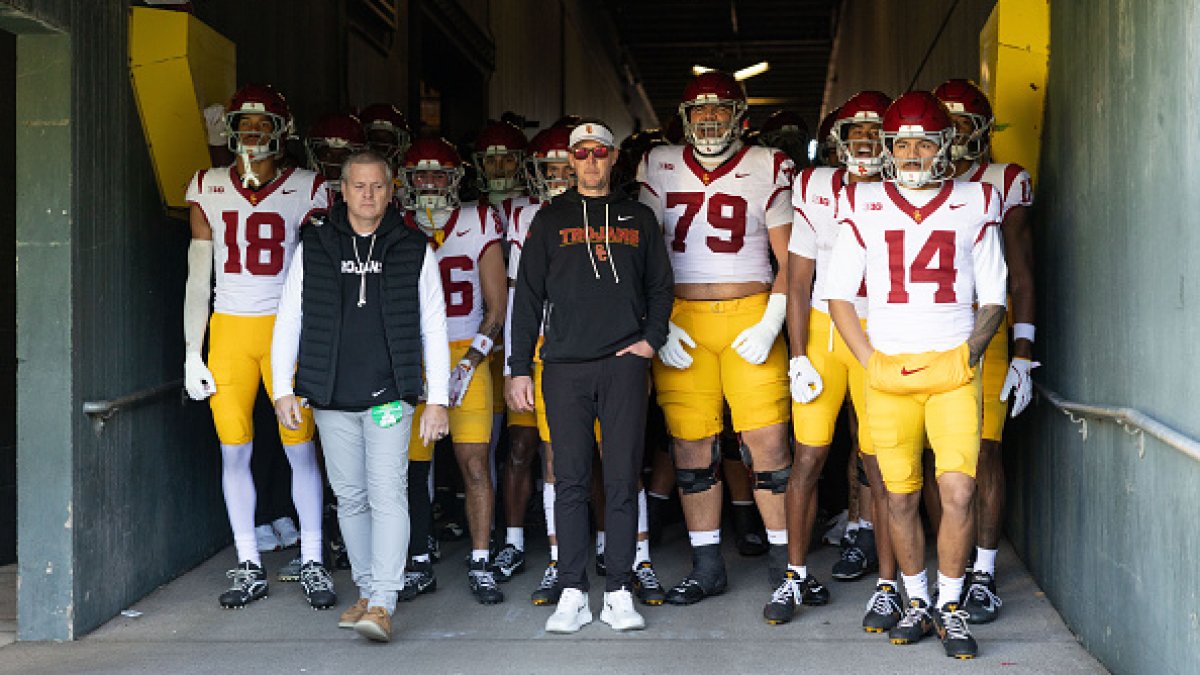
The buzz is back at the University of Southern California.
The Trojans won National Signing Day on Tuesday, reigniting the hope and optimism that has been missing from USC football for far too long.
According to the Rivals Industry Team Rankings, USC had the No. 1 recruiting class in college football, the first time a team outside of the SEC achieved that ranking since 2008.
For a program chasing its own restoration, this moment felt like more than a ranking. It felt like a turning point — a declaration that the Trojans are back in the orbit of college football’s true heavyweights.
However, the story of this cycle isn’t simply that USC surged to No. 1. It’s that rivals Oregon and Notre Dame were camped right behind them, close enough to make every signature matter, every flip seismic.
Oregon, fueled by Dan Lanning’s relentless recruiting machine, entered the day with five five-star signees and eyes on one more: Chris Henry Jr., the five-star wide receiver whose decision could tilt the entire national picture.
He was expected to be an Ohio State lock — he sat behind a placard with the Buckeye logo at Mater Dei’s signing ceremony — until the ground shifted beneath him. Minutes before he arrived, news broke that Ohio State offensive coordinator Brian Hartline, Henry’s most trusted relationship in recruiting, was leaving for the USF head-coaching job. Henry didn’t sign. And suddenly, the door cracked open.
Oregon pushed hardest. Texas lurked. USC, ever the quiet shadow in Mater Dei hallways, stayed present — not loud, but never irrelevant.
If Henry flips to Oregon, the Ducks could close the gap to a razor-thin margin, tight enough that the final Rivals300, Top247 and ESPN300 updates in January might ultimately decide who sits on the throne for 2026. But as of Wednesday night, USC held the edge.
If the Trojans reclaimed No. 1, Mater Dei served as their launchpad.
USC hammered home a dominant cycle at the nation’s top high school program, flipping four-star receiver Kayden Dixon-Wyatt from Ohio State and securing signatures from five-star tight end Mark Bowman, and four-star defenders Tomuhini Topui and Shaun Scott. It was a full-scale show of force inside California’s borders — something USC fans have begged to see for years.
The difference this year? Stability. Commitment. A sense of alignment.
Last year’s class was scarred by decommitments — especially from the Southeast — a storm that knocked USC down to the mid-teens despite big early wins. But the 2026 group was different. Steady. Drama-free. Only one late flip: JUCO defensive back Jakwon Morris, and that one was mutual.
Texas A&M tried to pry loose receiver Boobie Feaster. Oregon made a run at Topui. Other staffs probed and tested the Trojans’ class. Nothing stuck.
For the first time in years, USC nailed the finish line.
The 247Sports Composite now shows the battle narrowing to just two programs: USC and Oregon, a West Coast showdown for a crown long monopolized by the SEC. From Alabama to Georgia to Texas A&M, the Southeastern Conference has owned this space for nearly two decades.
Tonight, the map looks different.
USC at No. 1.
Oregon at No. 2.
And the entire sport leaning in to see what Chris Henry Jr. chooses next.
Behind them sits Notre Dame, then Alabama, Georgia, Ohio State, Tennessee, Texas, Texas A&M, and Miami.
The sport’s balance of power is shifting — maybe not permanently, but undeniably.
When the final signature dried and the last recruit grabbed his cap for the cameras, you could almost feel the energy rising off the USC campus. This wasn’t the hollow optimism of past cycles. It wasn’t built on flash or fleeting promise. It was built on retention, relationship, and resolve — the cornerstones of championship programs.
In a year where coaching changes rippled across the nation and elite prospects chose patience, USC chose certainty. And for the first time since Pete Carroll roamed these sidelines, the Trojans can say they have the best recruiting class in the country.
On a day defined by signatures, this one meant something more.