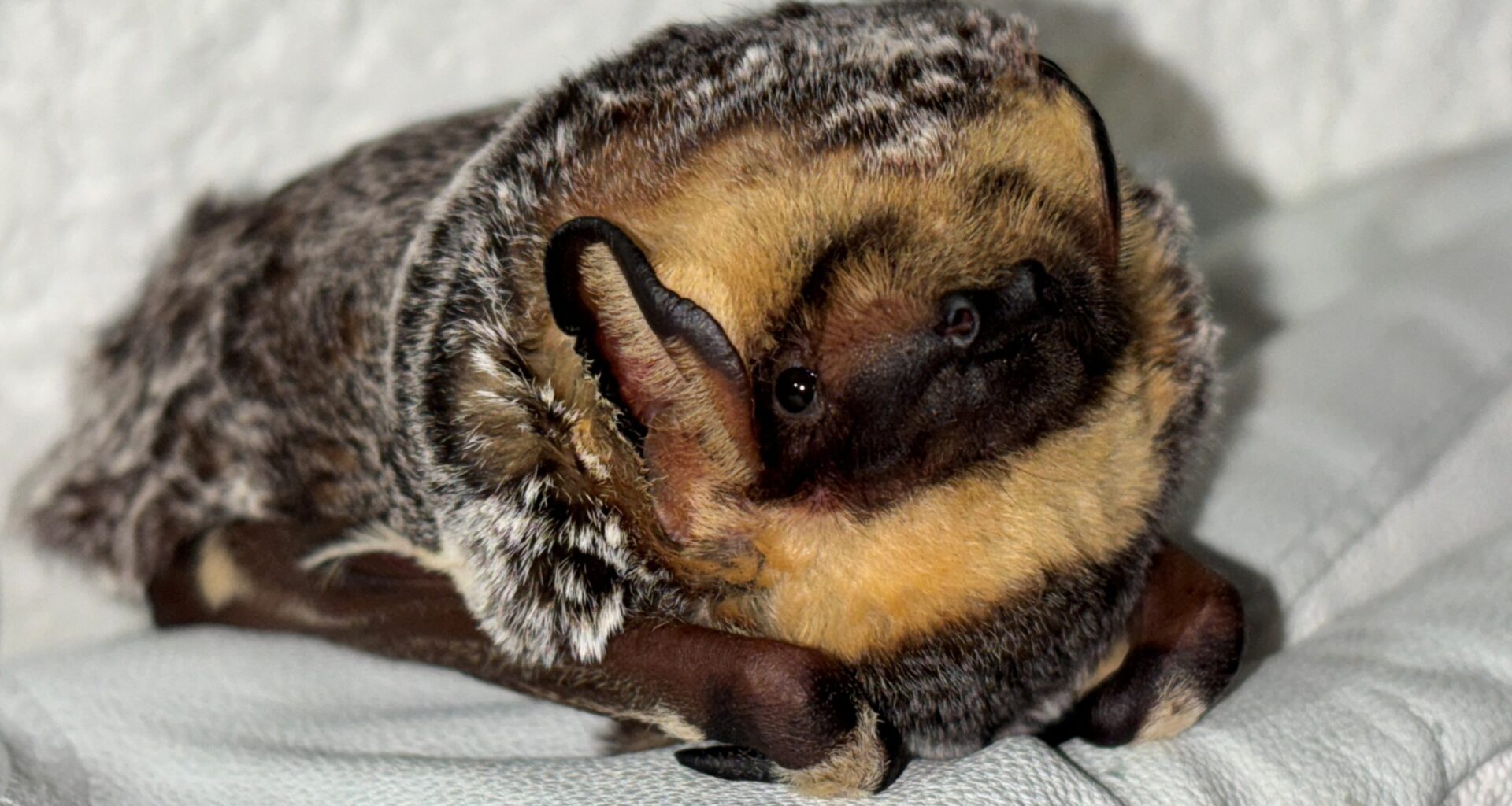
 A rescued hoary bat that was equipped with a tracker before being released back into the wild. (Photo courtesy San Diego Humane Society)
The San Diego Humane Society honored World Wildlife Conservation Day with a first-time event: the successful release of a hoary bat equipped with a Motus tracking device, a first for this species in southern California.
The adult male bat was rescued in near the coast during last month’s storm on Nov. 14 and taken to the Humane Society for care.
After a period of rest marked by seasonal torpor, a natural, low-energy state common for bats in cooler months, the bat regained full health and was deemed ready for release,” SDHS said in a statement.
The release took place in Carlsbad on Sunday near Agua Hedionda Lagoon, with the help of “Stellaluna” author and illustrator Janell Cannon, who has been an “enthusiastic supporter of the effort.” (“Stellaluna” is a 1993 classic children’s book about a young fruit bat.)
Cannon helped coordinate the release site, photographed the bat’s release, and recorded his echolocation calls with a bat detector as he flew away. She said she hoped the release and upcoming tracking data will help raise awareness about bat conservation.
According to the San Diego Humane Society, hoary bats are known for both long-distance migration and winter hibernation and often travel from northern regions into Southern California’s milder climate. Because they are “solitary species” and roost in tree foliage rather than caves or crevices, their habitats and seasonal movements remain less understood, officials said.
“This release is an exciting step forward for bat conservation in our region,” SDHS Wildlife Medical Supervisor Marie Bosch said in a statement. “Being able to track a species that is both migratory and arboreal will deepen our understanding of their needs and behaviors in Southern California.”
“With a Motus wildlife tracking tower located nearby, researchers and rehabilitators hope to receive valuable information about where the bat travels next — whether he remains in the area to hibernate or continues migrating along the Pacific Flyway,” SDHS said.
San Diego Humane Society’s Project Wildlife Program cares for more than 13,000 wild animals each year.
People who encounter an injured, sick, or truly orphaned wild animal can visit SDHS’s Wildlife Help Hub for assistance or call the San Diego Humane Society at (619) 299-7012.
City News Service contributed to this report.
READ NEXT