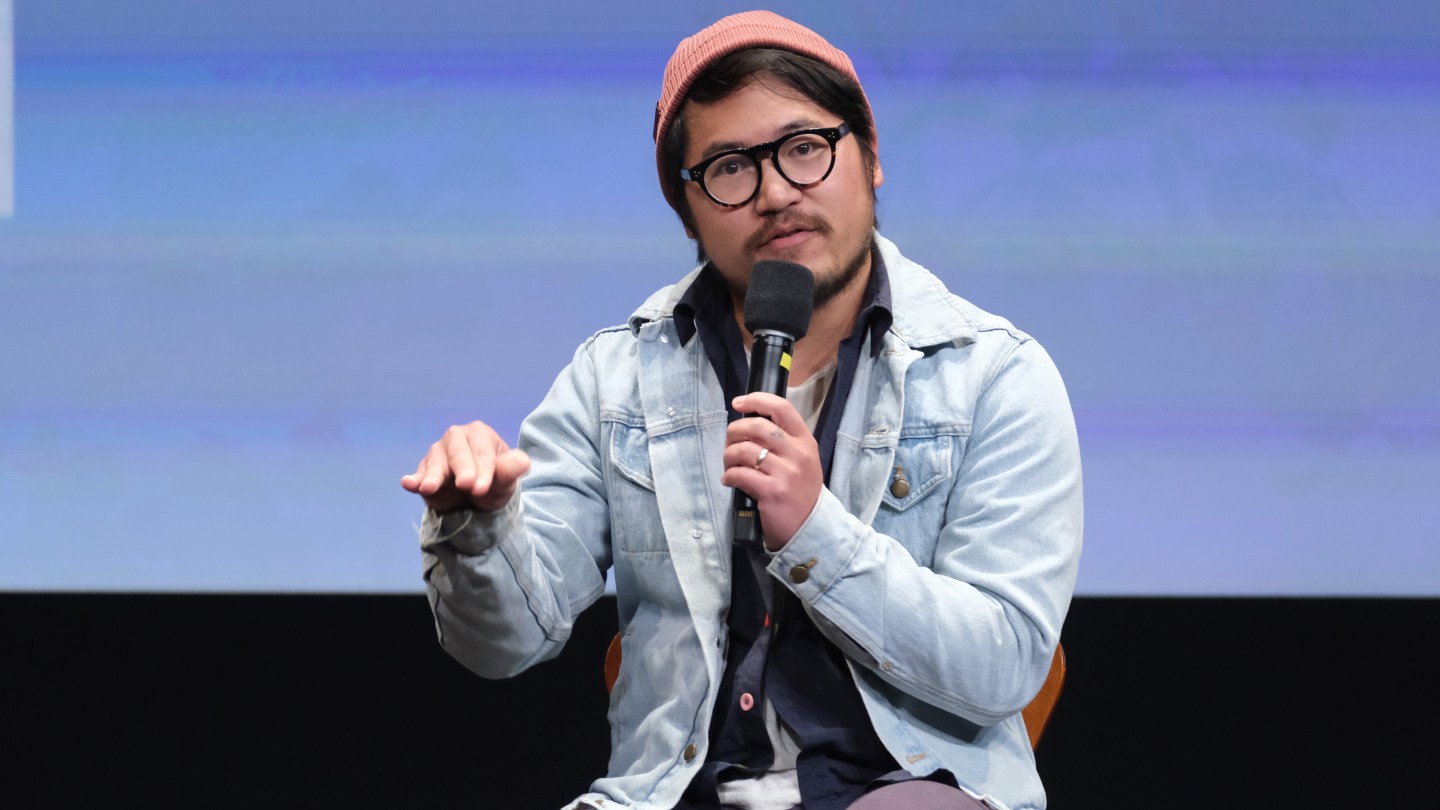
There was a recognizable face inside the walls of Los Angeles City Hall at an Oct. 8 meeting in front of the City Charter Reform Commission, and it wasn’t a local politician, lobbyist or well-placed operative. It was Academy Award winning filmmaker Daniel Kwan.
Kwan, one half of the Oscar winning duo behind Everything Everywhere All at Once, wasn’t hunting for ways to kill time or fill up his schedule — he and Daniel Scheinert are prepping a Universal release to theaters on Nov. 19, 2027 — but he was finding yet another way to focus on a new passion project. Kwan is part of newly launched Rewrite LA, an organization formed with the goal of ensuring “that public input, assemblies and digital engagement all feed directly into the city’s decision making process” as Los Angeles rewrites its City Charter.
The charter, referred to as a foundational governing document similar to the Constitution, is facing its first overhaul in nearly 30 years, and Rewrite LA members want to be part of the process to ensure that as many residents as possible are involved in or at least aware of the process as it takes place over the coming months. Specifically, their goal is to ensure that urgent issues like land use, housing, climate change, pandemics, economic shifts, and rapid advances in automation and technology are addressed as action items. “Today’s systems were designed for a world that no longer exists,” said Nick Goddard, co-founder of Rewrite LA. “Our goal is to empower everyday people to renovate democracy so that it is transparent, participatory, and compatible with the world we’re actually living in today.”
Ahead of the next mini civic assembly on Dec. 13 at Institute of Contemporary Art LA — at which the subject of land use will be discussed — Kwan spoke with The Hollywood Reporter about why he dove in headfirst, what he’s learned from being deep in the research and how his Hollywood peers can help.
For those who haven’t been paying attention, how do you describe what is going on with L.A.’s charter, the urgency and where you are in the process?
For the past five to 10 years, I like to think about the big picture and help solve problems. It’s a reason why I became a filmmaker and I’m fairly good at it because big picture problems excite me. I can’t stop thinking about them. About 10 years ago when the world was waking up to the fact that social media was really throwing a wrench into representative democracy, not just in the U.S. but all around the world, a lot of the people started to wake up and realize that our current system is not necessarily compatible with these new technologies.
Andrey Tang, who served as the first minister of digital affairs of Taiwan, decided to rapidly innovate and iterate to try and rebuild democracy into a thing she called “digital democracy,” which was a way to combat all of the problems that were happening. My mother’s from Taiwan — I love going back there, it’s such a beautiful place — so seeing what Audrey was doing there got me really excited. On a macro level, I started to realize it’s not just democracy but all of our systems that are beginning to show their age. All of our systems lag behind the needs of modern life. This is connected to my work in AI, with stories in Hollywood, and this general feeling that our old world and old systems are failing us.
More and more people are waking up to this so I feel less like the crazy person in the corner talking about conspiracy theories or the end of the world. In some ways, these old systems should be dying. If that’s true, then our job becomes pretty clear: Protect who you can and protect what you can. In doing so, plant the seeds for what comes next and the world that comes next.
How are you doing that?
What is happening within the space of renovating or upgrading democracy is one of the most important but it’s also an inspiring place to start. If we are going to upgrade our systems, we’re going to have to coordinate with one another. And if we’re going to coordinate, we’re going to have to upgrade our systems for deliberation and ways to find consensus while also upgrading democracy itself.
I’ve been reading up and nerding out on a lot on this stuff. About four or five months ago, a friend sent me an Instagram post that pointed out the fact that Los Angeles is currently rewriting its city charter for the first time in 30 years. No one is talking about it. I remember saying, “Wait, what? Why is no one talking about it?” I dug deeper into the research and looked at the history, the politics and the drama behind rewriting the charter. My brain just instantly snapped to the fact that this was an opportunity. This is a place we can try out some of these new systems and ideas that other thinkers in other countries have been conceptualizing and putting into practice in real world situations.
It also comes at a critical time in L.A. after such a devastating year.
Yes! Los Angeles, as everyone knows, is in the middle of this deep soul searching year. It really was a year of reckoning. We started the year by experiencing the devastating fires, which touched the lives of everyone in the city as we all know someone who lost everything. Out of that came something really beautiful as we saw a lot of community rebuilding as people came together to help one another out. But not long after that came another catastrophic situation when the federal government sent troops into Los Angeles for the ICE raids. The attack felt so unwarranted and against the will of the local L.A. population.
On top of that, Hollywood has really been suffering, and the suffering has only grown and made itself more clear that it’s not going away anytime soon. AI is coming, the Olympics are coming, we still haven’t figured out the housing crisis. Los Angeles is at the vortex of all of these things. Because of how big, complex and overlapping all of these problems are, it makes it more of a beautiful opportunity for us to potentially lead the way for other cities in the country. If we’re able to make it through the next 30, 40 years, we’re going to have to be incredibly nimble, we must listen, respond and move. We can’t afford any gridlock. We can’t afford corruption. We can’t afford to operate as a city where the power is so diffuse that no one actually holds any responsibility. To me, rewriting the city charter, which is basically the constitution for our city, is an incredible opportunity to introduce Angelenos to new forms of democracy by making it more tangible and accessible while helping us to collectively move forward.
There is a timeline to this, and an assembly scheduled for Dec. 13, correct? What happens?
The December assembly is a mini assembly. As we’re still finding our way with funding and with the relationship with the City Charter Reform Commission, we’re starting with a mini assembly to discuss one subject. What’s really exciting is that we’re using a new innovative process based on what Audrey Tang was doing in Taiwan. They call it deliberative alignment technology or deliberative alignment platforms. Essentially, Audrey looked at what was happening with social media and how algorithms polarized the public. What happens if you make algorithms do the opposite? We can use the technology to find consensus in a way to help everyone move forward together. If you think about good couples counseling, you don’t start with the problem, you start with the shared goals, shared values and you build trust from there. Then you move on. She used this in Taiwan to great success so we’re trying to see if we can bring that to L.A. The mini assembly will be our first experience as a seed trying to use civil assemblies to allow the public to vote on issues that matter most to them. The first assembly will be focused on land use, which was the highest ranked topic on our platform.
The process will continue with other assemblies, all moving toward a submission to the city council and eventually a path to the ballot next summer. Is that accurate?
That’s correct. The City Charter Reform Commission is doing its own work which is really important and that’s how the city has always done it. What we’re trying to do is basically help supplement and help by taking on some of the work between us. There’s too much work and too much to discuss for the commission to do in the timeline they’ve been given. If you look at their schedule and agenda, they’re avoiding a lot of the harder conversations. Many of the things I’ve mentioned — everything from AI in government and AI governance, climate reform, police reform, city corruption, land use — all of these hot button issues that are essential and on so many people’s minds are not even being discussed on the charter reform agenda. I think that they’re not doing a lot of the long-term thinking that we should be doing.
We really stepped in to say, “Hey, we will take that load off you guys and help try to figure out how to have civil conversations that we can present to you next year. By then, we hope to have a growing group of dedicated and committed people so we can show up to the commission and share how crucial these issues are to the future. All of this is happening very fast, and in some ways, we should have started this two years ago. Obviously, the second best time to start something is now.
What has been the response from your Hollywood friends? Are you getting help or input?
I have not done much outreach within our industry yet for this kind of stuff. It’s a good question though because when most people hear about this kind of stuff, their eyes glaze over. But I wish that wasn’t the case because this charter affects everyone. This is going to affect how production runs and that will affect our work. I do think all of us in Hollywood should be paying attention and should be aware that this is happening. The thing we should all be avoiding is letting the status quo move as it’s always moved because we cannot allow another 30 years to go by like this. The last time the charter was rewritten was 30 years ago and we’ve seen what the final outcome of that has been on our city. If we see how our city has functioned for the past few decades, then we cannot afford another 30 years of the same thing.
Anyone in Hollywood that reads this and gets excited should come and get involved. Obviously, we’re doing a million things at the same time but for those who feel passionate about city issues and about democracy itself, there’s work to do. The future is all about planting seeds and you do that by focusing on where you are and what you can control, hoping that those seeds will grow and spread. What happens in L.A. has the potential to grow far beyond our city.
What help do you need right now?
We need people to become aware of what’s going on. We need storytellers and spokespeople and entertainers to really come out for the city to help make people aware that this is happening. This is a once in a generation opportunity for us to shape the future of our city. For the most part, it’s been happening behind closed doors without any of us knowing about it or realizing that it’s happening. If anyone from the industry wants to help out, that would be incredible. We are filming, editing and sharing stories online and the Rewrite LA team can use help when it comes to that kind of work. Come as you are and we’ll figure out how you can fit in. The more, the merrier. This whole thing is about bringing people together to find the most productive way forward.