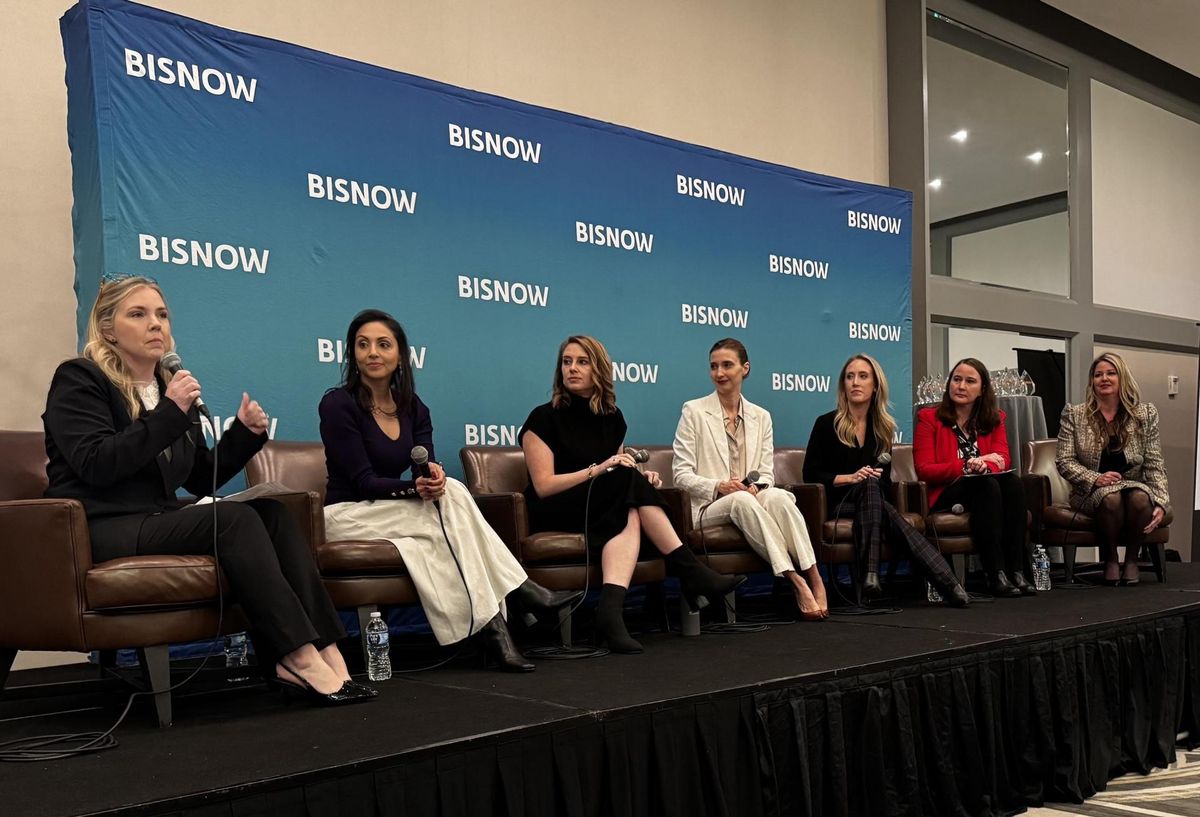
Women who started their careers being the youngest and only woman in the room are now mentoring the next diverse generation entering the architecture, engineering and construction industries.

Bisnow/Maddy McCarty
7 Rivers Marketing’s Shannon Bedinger, TDK Construction Co.’s Tina Khatri, Mirador Group’s Krystyn Haecker, HOK’s Linnea Wingo, Stream Realty Partners’ Kristin Wall, Walter P Moore’s Rachel Calafell and JRH Engineering & Environmental Services’ Jennifer Henrichs.
The industry has come a long way, but women still only account for about 26% of architecture and engineering jobs and 11% of the construction industry. Even women in executive positions are still regularly asked to take notes or complete tasks usually expected of interns or new associates, panelists said at Bisnow’s 2025 Houston Women Leading Real Estate Awards.
The event at the Omni Houston Hotel on Wednesday celebrated female leaders, innovators, dealmakers and rising stars in the AEC industry. Though they have faced challenges while being underrepresented in the industry, the panelists said they have learned to handle it with grace and use the advantages that come with being a woman.
“As females, typically we have a little bit higher emotional intelligence,” said Kristen Wall, vice president of construction for Stream Realty Partners, who was a dealmaker of the year honoree.
That emotional intelligence boosts communication skills, helping women decipher what everyone in a meeting is trying to accomplish.
“Our industry is so people-oriented … if you can read the room, you’re in a better position than if you cannot,” Wall said.
It took years of experience for Wall to get comfortable using those skills to her advantage — and to stop being mistaken for an architect or property manager when she was actually a project manager, she said.
All women AEC executives have likely been asked to take notes, even when they have a decade more experience than other people in the room, said Linnea Wingo, director of interiors design at HOK and an innovator of the year honoree.
Women have to learn to politely say no, but having advocates also helps in that regard. Wingo had a mentor in a very experienced senior associate at Gensler years ago, she said.
“I remember being in a situation where the client always asked me, ‘Can you get us the drinks?’” Wingo said. “I was the only woman in the room, and he stepped up and said, ‘I can do that. Linnea’s giving the presentation.’”
It also helps to be extremely prepared and knowledgeable about your role, said Mirador Group partner Krystyn Haecker, a leader of the year honoree.
Though she was often the youngest person in the room early in her career, she was often most involved in projects, having done the drawings and prepared the plans herself. That means the team would defer to her on questions.
“I was always the most prepared from our team, because I had the most information,” Haecker said.
Tina Khatri, CEO of TDK Construction Co. and a dealmaker of the year honoree, said she didn’t realize she would be treated differently early in her career, but she still wanted to be informed. She took classes, read as much as possible and dedicated her nights and weekends to learning more about the construction industry, she said.
“When you go prepared, you’re confident, you know your stuff, people aren’t going to look at you like, ‘Oh, but you’re a woman. But you’re young,’” Khatri said. “That’s what helped me throughout the years. Now, I just can’t believe how far we’ve come.”
Now, as they still seek mentorship and community themselves, the women also serve as mentors for the next generation.
“Regardless of where you are in your career, I think a mentor is very pertinent and important,” Wall said.
Houston is experiencing a shift from generic to bespoke design, Wingo said, referencing the repetitive atrium-lobby office design of the 1980s and ’90s contrasted with newer office buildings designed with their hyperlocal community in mind.
The diversity of Houston and the people joining the industry is making for a richer design community, Haecker said.
“We’re able to walk into a room and speak on behalf of a community because we’ve represented it at the table,” she said. “That alone is only going to improve it.”