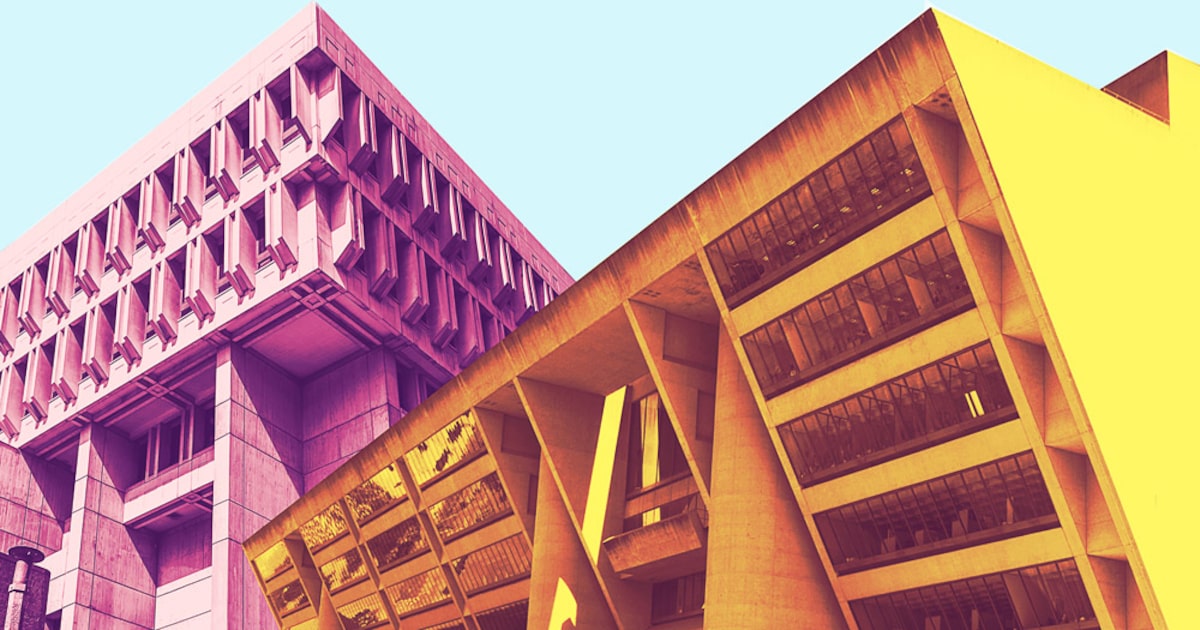

Dallas is buzzing with talk about our neglected City Hall and what to do with it. Some say it’s time to leave the 1978 building behind. Others want the city to reinvest in the people’s beleaguered house.
In the thicket of that debate, Boston City Hall keeps cropping up. Situated about an hour away from the roughly 260-year-old Massachusetts house I grew up in, Boston’s civic center is like Dallas’ in many ways.
Both structures are celebrated icons of brutalist architecture, which is to say, they’re a pair of concrete behemoths that many architects and art critics consider beautiful for reasons I don’t understand.
And importantly, both have also faced serious maintenance issues in recent years. But while the scales in Dallas appear to be tipping toward the “tear it down” side of things, Boston has committed to staying in its concrete home.
I’m not yet convinced one way or the other what Dallas should do with 1500 Marilla. I expect an upcoming report on the issue will shed light on that. In the meantime, there are a few things Dallas can learn from my Yankee brothers and sisters.
Opinion
For starters, the cost of commitment to Boston City Hall is high.
Like its counterpart in Dallas, the building features a large plaza. Although it has been renovated, the 7-acre space had previously been described as “bleak,” “barren” and “windswept,” The Boston Globe reported. Those three words can just as easily describe the unwelcoming expanse at our own City Hall.
But in 2022, the plaza at Boston City Hall reopened after a renovation that added a “kinder-brutalist” playground, event and gathering spaces, public art and green infrastructure, according to The Globe.
The project was originally supposed to cost taxpayers $70 million, but the total came to $95 million when everything was said and done, The Globe reported. Unsurprising, given the cost overruns government projects face so often.
Zooming out to broader capital needs, a report dated October 2017 states that City Hall’s systems and infrastructure are outdated, with many needing repair or full replacement. The report’s subject is Boston City Hall, but it could just as easily have been Dallas’.
At the time, Boston was facing $225 million to $255 million in capital repair costs over the next 15 years, for City Hall, the plaza and two smaller buildings, according to the report.
What those numbers look like today, I’m not entirely sure. Based on my review of coverage of the issue and city of Boston documents, it’s been difficult to pin down exactly what’s been fixed and at what cost. I requested an interview with a city official, but didn’t hear back in time for publication.
Still, a review of Boston’s fiscal year 2026 budget and capital plan indicates the city has a lot more spending to do: $8 million for a new elevator, $50 million for a second phase of the plaza renovations and about $78 million for HVAC. There is also a $30 million item for “building renovations at various municipal buildings including City Hall.”
Projects at Boston City Hall have been costly and are likely to continue being costly for a while longer, if the budget is anything to go by. But maintenance is challenging on another level, too.
In 2023, WBUR — Boston’s NPR station — reported that some of the building’s hot water pipes were leaking and needed fixing, but many were “nearly inaccessible, completely encased in concrete.” The city had to core into the concrete just to be able to repair and identify leaks, WBUR reported.
The massive concrete wedge driven into the downtown Dallas ground shares some of those difficulties.
“Dallas City Hall was built with extensive concrete construction, which makes access to plumbing and other mechanical systems more challenging,” city officials said. “While there are some accessible areas, such as cable trenches, overhead piping, and accessible mechanical spaces, much of the building’s infrastructure runs through or behind concrete shafts.”
Hardly a model of efficiency and practicality.
And then there’s Dallas City Hall’s aquatic challenges. There have been issues with water leaking from the reflecting pool into the parking garage underneath the plaza, city officials said. Years ago, Boston faced similar problems.
Boston’s plaza once had a water fountain, but The Globe reported that from the day it opened, it leaked “polluted water that looked like pea soup.” Water even leaked into the subway tunnel below. The fountain was shut down in 1977. Dallas probably should have followed suit years ago.
In 2018, Boston Magazine named City Hall the best building in the city. “Though it’s been ranked one of the ugliest structures in the world, City Hall is, in fact, not ugly. It’s brutal and it’s beautiful.”
Earlier this year, Boston City Hall gained historical landmark status. Mayor Michelle Wu said “this milestone serves as an affirmation of our commitment to preserving this space as a vital symbol of our democracy and a center for civic engagement,” The Globe reported.
Not everyone agrees with that assessment. Boston.com asked its readers whether they thought City Hall deserved to become a landmark. Three-quarters said no.
Thomas Menino served as mayor of Boston from 1993 until 2014. He hated the building, The Globe reported, and once floated the idea of selling it. A 2013 column by Paul McMorrow describes Boston City Hall as “an atrocious waste of space” and advocated for tearing it down.
As surely as both buildings are poured concrete, they’re also loved and hated by the communities they serve.
Dallas City Hall was designed by architecture legend I.M. Pei and opened its doors in 1978. Boston City Hall was designed by Kallmann McKinnell and Knowles and was completed in 1968. They aren’t twins, but they’re similar in a lot of important ways.
There’s nothing wrong with wanting to save Dallas City Hall the way Bostonians are saving theirs. I get it; I love historic buildings. I was raised in a house that’s older than the Constitution.
As a transplant, I view Dallas City Hall as a sort of embodiment of the city — ambitious, unique, vast, a bit intimidating and striving to shift its titanic weight into the modern era. So, setting aside my confusion about the appeal of brutalism, I understand why so many people want Dallas City Hall to stay Dallas City Hall.
But I don’t think it will. The building is not designed to be efficient for any use, and it’s hard to see a path that will make the likely cost of repairs affordable or justifiable, especially when the city has such limited resources and there are other historical properties that are far more deserving of a hefty investment. Looking at you, Fair Park.
Boston’s pricey journey to spare its city hall might be a good fit for them. Dallas has a lot of thinking to do before deciding whether to follow the northern path.