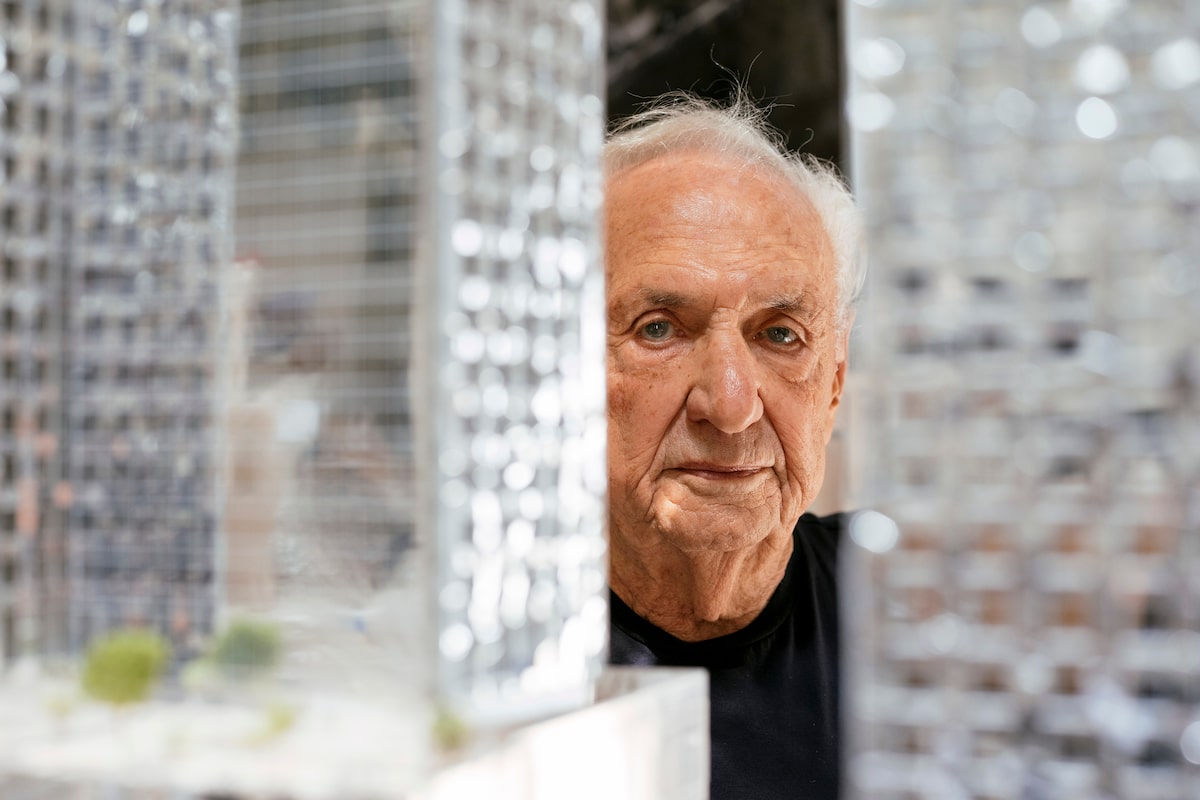
When Frank Gehry visited the University of Waterloo in 1992, he did all the things expected of a prominent architect: he lectured, exchanged ideas with colleagues and commented on student work. But what he really wanted was to play hockey. “He was wildly enthused about the games,” recalls Larry Wayne Richards, an architect and academic who was Mr. Gehry’s host for the visit. “He’d brought the uniforms with him – his passion for the game was absolutely real. There was this side of him that was very ordinary, very human.”
But this unpretentious and playful man had a steely side. Mr. Gehry, who died on Friday morning at his home in Los Angeles, was a creative force and a relentless innovator. He was 96. His death was confirmed by his chief of staff Meaghan Lloyd. He had become an unlikely star, the best-known architect of the last half-century.
Over a career of more than 60 years, spent almost entirely in Los Angeles, Mr. Gehry defined his own idiosyncratic path. His early buildings of the 1950s and 1960s were shaped by the orthodoxies of the Modernist movement; later, he was influenced by artist friends, and pursued experimental and varied work that overlapped with – but never quite fit into – the Postmodern architecture of the 1970s and 1980s, which engaged with history in a playful or ironic manner. “I want to engage people,” he said in a 2015 interview. “But I don’t want to copy the past.”
Mr. Gehry was eager that his architecture should communicate in its own way. His 1997 building for the Guggenheim Museum Bilbao, which made him globally famous, was both a technical achievement and a deeply personal, aesthetically unorthodox work. “He was very difficult to categorize,” said Mr. Richards. “In the end none of the labels fit, because he was a very individualistic artist in the broadest sense.”
Frank Gehry poses in front of the Guggenheim Bilbao Museum during its 25th anniversary celebrations.ANDER GILLENEA/AFP/Getty Images
His path to difference began early. He was born Frank Owen Goldberg at Toronto General Hospital in February, 1929, and grew up in a tight but fractious working-class family. Mr. Gehry’s mother Thelma (née Caplan) was committed to culture and bettering their station; his father Irving Goldberg was a political radical and a hapless entrepreneur, boisterous and brash.
Frank was a creative child who drew inspiration from what he saw. At his uncle’s hardware store, he worked with bits of wood. His grandmother Leah Caplan would buy live carp, put them in the bathtub at home and then serve them at Friday night dinner; playing with those fish would provide the basis, maybe apocryphal, for Frank’s later obsession with fish, culminating in a sculptural installation for the 1992 Barcelona Olympics.
Frank grew up determined to follow his mother and her parents, with whom he read and discussed the texts of Jewish law captured in the Talmud. They spent hours “getting into the old arguments of Why this, and Why that,” he recalled. “It’s a kind of iterative process until you stop and say, ‘okay.’” At the same time he remained hungry for Mr. Goldberg’s approval.
Intelligent and shy – self-conscious about a tumour on his left leg – Frank had trouble relating to his father. Jews in 1930s Toronto were embattled by anti-Semitism but saw commercial and social opportunities opening up. Still Irving’s talent, as Saul Bellow wrote about his own similar father, “was for failure.” A scheme to run slot machines took the family to Timmins, Ont., in 1937; after five years full of hockey and discrimination, Frank returned with his family to Toronto. After a bumpy few years, they were forced by Irving’s ill health to head for warmer climes.
That meant Southern California, where the Goldbergs moved in 1947 and where Frank would live almost his whole life. That was where he discovered his calling and his profession: after a stint in the U.S. Army, he attended the University of Southern California, and moved from art to architecture – absorbing the politics and aesthetics of a new milieu. Southern California was a hotbed of modernist architecture, which was informed by Japanese buildings, the work of European expatriates such as Rudolf Schindler, a deep engagement with the natural world, and a commitment to the idea that architecture could build a better world.
Young Frank soon married his first wife Anita, whom he’d met while working as a kitchen installer, and then – at her request, he would later say – he changed his name. “Gehry” sounded Gentile, and yet was close to his familiar name in rhythm and in the appearance of the word: both names, goldberg and gehry, took the same visual line of a fall, and then a rise, and then a fall.
Architect Frank Gehry poses with miniatures of his designs in Los Angeles in 1989.Bonnie Schiffman Photography/Getty Images
His career took more or less the opposite course: from apprenticeship and two decades of businesslike practice, then a radical reset at midlife, followed by extraordinary success in art and business.
Gehry spent several years in and out of top Los Angeles firms, and spent a year working for a Paris architect in 1960, but from that point on, he settled in California and, beginning in 1962, ran his own ship. He spent his 30s and 40s designing stores, warehouses and offices, often working for developers; at the same time he was pursuing a separate stream of experimental work. His 1964 house and studio for the graphic designer Louis Danziger is a collection of rectilinear boxes wrapped in gray stucco: a radically simplified, abstracted version of the ordinary Los Angeles building.
His biographer, the critic Paul Goldberger, writes that Gehry “was struggling in the early 1960s to find a way to make architecture that would feel new, cost little, and have the expensive, even the emotive, quality of older buildings.”
That creative struggle was informed by events in in the art world. Gehry became friends around this time with a circle of artists in the city; Ed Ruscha, Ed Moses and Billy Al Bengston among them. Within the next decade, he also established relationships with several important New York artists. “In L.A. they were building tract houses, and hammer marks were part of the game,” Gehry said in a 2015 interview. “And artist friends were making paintings with trash – Rauschenberg, Jasper Johns – and I went with it.” Robert Rauschenberg’s “Combines” – three-dimensional works that blended painting and collage, incorporating trash and castoff objects – were touchstones for his work, which included several other houses for artist clients.
Gehry would call the work of this period “cheapskate architecture.” He first gained notoriety in the late 1970s with the house he built for his second wife and two young sons – wrapping a Dutch colonial in a sharply angled structure of plywood, corrugated metal and chain-link fence.
In the field of architecture, which was then struggling with how to move forward from the pristine, ambitious Modernism of the 1960s, this was seen as a radical move. Yet Gehry offered two other explanations of his own. One, the house was inspired directly by art: “I was interested in the … unfinished quality you find in paintings by Jackson Pollock, for instance, or de Kooning … I wanted to try that out in a building.” And second, this was his way of incorporating the stuff of Los Angeles’s everyday building culture. Chain-link was everywhere; architects chose to ignore it. Instead, why not celebrate it? “I think architecture should deal with the mess,” he would later say.
The mess of Gehry’s own psyche proved more difficult to renovate. Gehry began seeing psychotherapist Milton Wexler in the 1960s, and Wexler guided him through a 1966 split with Anita – the end of what Gehry has described as many years of unhappiness. The divorce was bitter, and one of their two daughters, Leslie, took her stepfather’s name to mark the split. Just a year later, he met Berta Aguilera; the Panamanian-born Aguilera first interviewed for a job as his office manager, and they shortly became a couple. After a decade on-again, off-again – she wanted children, and he didn’t – they were married in 1975; they had two sons, Alejandro and Sam, in 1976 and 1979, and remained together to the end.
Gehry, now near 50, was approaching the quiet years of a normal professional’s career path. But in architecture, the most important work often comes late; this was true for Gehry to an exceptional degree. In the early 1980s he made a decision to lay off much of his staff, which had been working on many projects with a single developer. The goal was to concentrate on the work he cared about most deeply. “He feared a conventional kind of success,” writes the biographer Paul Goldberger, “far more than he feared artistic failure.”
At the same time he became associated with a new “Los Angeles School” of architecture, including the future Pritzker Prize winner Thom Mayne. Slightly younger and creatively ambitious, they were each trying to figure out how to move the art forward, as the Postmodern movement dominated the conversation.
Gehry’s own answer, which he elaborated through the 1980s, was highly personal. He loved Italian Baroque architecture but did not quote it directly; instead he turned to something much more historic, as he joked, the form of the fish. This became the basis for projects in Japan, in Germany and then in Spain in 1992. Another thread was inspired by Pop Art: a 1991 office building for the ad agency Chiat-Day included a volume shaped like a giant pair of binoculars. A third stream, which animated a series of expensive houses through the 1980s, was the motif of the building as village, a collection of discrete objects each containing a separate room and joined together in a composition that blends the urban and the sculptural.
Frank Gehry in front of his Santa Monica, Calif., home in 1988.George Rose/Getty Images
But Gehry’s most important work was, and remained, buildings for culture. In 1988 he won a competition for what became Disney Hall, the new home for the Los Angeles Philharmonic; this major hometown commission would take 15 years to complete, but became a vessel for creative and technical experimentation.
The form of the hall – a village of small volumes, wrapped in a rippling, curving skin – tested the limits of the architecture and construction industry. The Gehry office, thanks to partner Jim Glymph, responded to this with the use of computers: specifically CATIA, a piece of software designed by a French aerospace company, that was used to draw 3-D forms digitally.
These creative and technical advances made possible the Guggenheim Bilbao, one of the best-known and most highly acclaimed buildings of the past 50 years. The New York Times critic Herbert Muschamp, in a rapturous review, compared it to “the reincarnation of Marilyn Monroe.” Wrapped in a skin of titanium, which shimmers in the daylight, the building speaks to its site on a river, and it contains a series of galleries of different sizes and configurations; Gehry believed passionately in such variety for art galleries, and dismissed as “folklore” the idea of the unassuming white-box as the ideal space for art. “No architecture is neutral,” he said.
The Guggenheim museum at Bilbao, built by architect Frank Gehry next to the Bilbao river.DOMINIQUE FAGET/Getty Images
The building put Bilbao, a Basque steel town, on the map of international tourism and culture; it also helped birth an era of so-called “starchitecture,” in which cultural institutions asked architects to design them expressive buildings that would serve as calling cards. In this vein, Gehry would go on to complete the Experience Music Project in Seattle, and later the Fondation Louis Vuitton in Paris.
Yet Gehry’s career is also a long list of unrealized projects. He burned through several long-term professional partners and many potential clients, thanks to a temperament – and somewhat deliberate tactics – that allowed only collaborators who were willing to play by his rules. “In the end he was a problem-solver,” Richards says, “but it’s the drive to make something [creatively], and to be confrontational, that sometimes was at the core of it.” Gehry wanted to build and to reach people, but not waste time having his ideas second-guessed. His friendly, “aw-shucks” public demeanor, as Goldberger has described it, was a mask for ambition and single-minded commitment.
Trained in urban design, Gehry long had aspirations to build a large commercial effort; yet his architecture, more complex and expensive to build than the average, was not a natural fit with developers. The New York developer Bruce Ratner hired Gehry to design the huge, mixed-use Atlantic Yards complex in Brooklyn. After the economic downturn of 2008, Gehry was removed from the project, in what many saw as an act of bad faith by Ratner. However the two did collaborate on what became Gehry’s largest completed building, an apartment tower in Lower Manhattan that was branded as “New York by Frank Gehry.”
In Canada, his most important work by far is the 2008 renovation and addition to the Art Gallery of Ontario in Toronto. While widely praised by critics at its opening and still today seen as successful, this was no Bilbao; the architecture was constrained by the complexities of the existing building and a moderate budget.
Hundreds of people line up to see the newly transformed Art Gallery of Ontario designed by Toronto native Frank Gehry in 2008.Arantxa Cedillo / Veras/The Globe and Mail
The wooden structure in the renovated and redesigned Art Gallery of Ontario, which was designed by architect Frank Gehry.NATHAN DENETTE/The Canadian Press
He did, however, make a large mark on the city’s downtown skyline. A two-tower project called Forma, mostly condominium apartments broke ground in 2023. The first tower, which will be 73 storeys tall, is now under construction; its textured metal skin recalls Gehry’s long fixation on textured, iridescent surfaces, an interest he shared with many artist friends.
His only other completed Canadian works were interiors for the Montreal Museum of Decorative Arts and for Chiat/Day; neither survive. Richards, who organized a lectureship in Gehry’s name at the University of Toronto, laments that “there never seemed to be a client or a budget available to bring about a Gehry.” He was considered for Toronto’s new opera house, what would become the Four Seasons Centre for the Performing Arts, but talks broke down over budget. In the late 1990s, Richards introduced Gehry to the owners of the Toronto Maple Leafs; they were imagining new uses for the arena Maple Leaf Gardens. “Imagine what a marriage that would have been,” Richards says. “Frank Gehry and hockey.”
The last decade of his life saw Gehry’s office working on a series of mid- and large-scale projects. The biggest of these is Mirvish Gehry, the mixed-use complex of condominiums, retail and cultural space commissioned for downtown Toronto by the entrepreneur and art collector David Mirvish. Approved by the city in 2014, this complex would include two towers reaching 82 and 92 storeys, with rippling facades and staggered masses; these would dominate the Toronto skyline with their sculptural forms and varied materials.