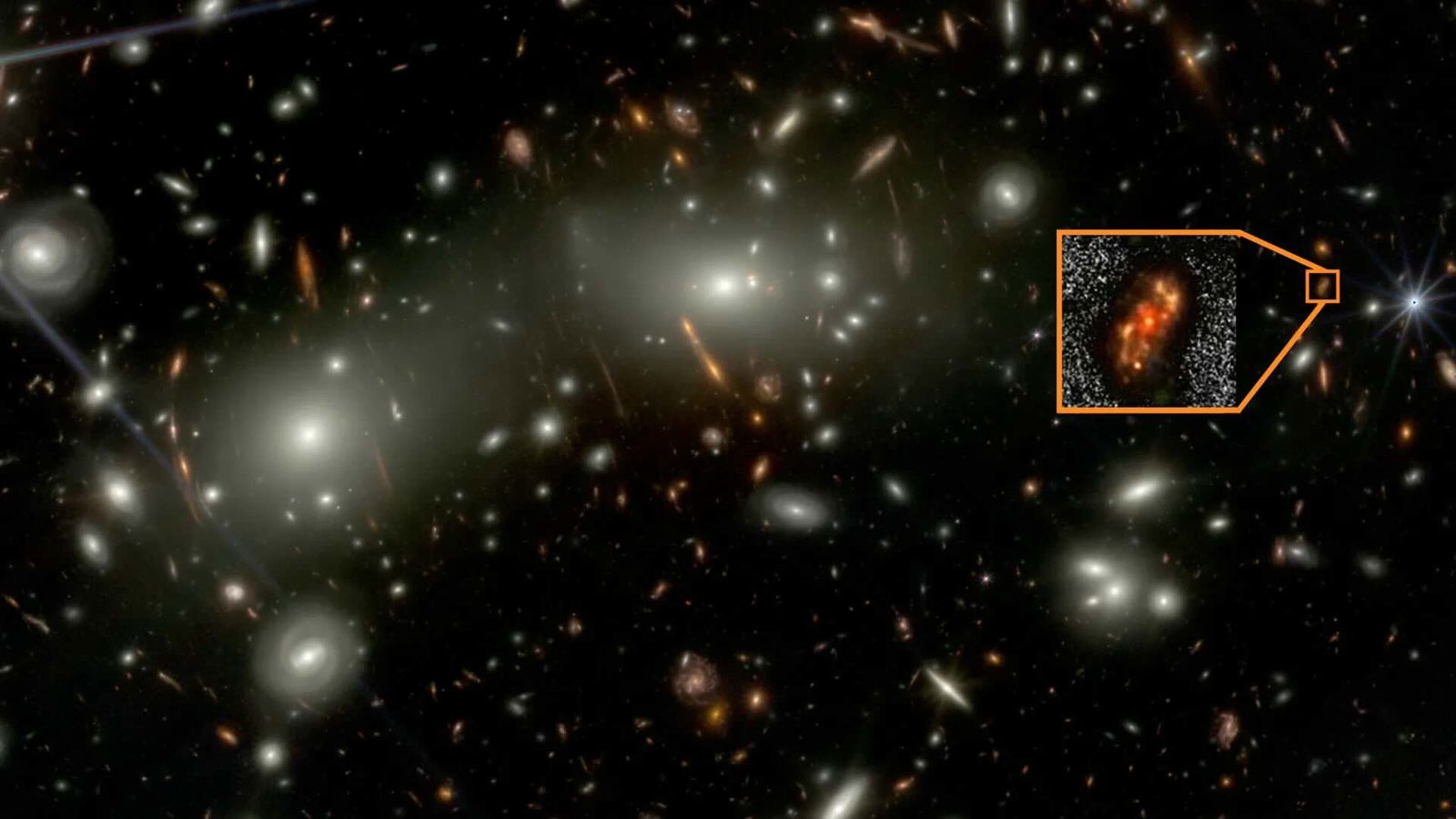
James Webb Space Telescope observations have revealed a galaxy that shouldn’t exist, in what astronomers have dubbed “Alaknanda,” a complex spiral galaxy that matured far too early for our present understanding of galactic formation and evolution to allow.
Alaknanda resembles our Milky Way, yet the distant images Webb collected were from only 1.5 billion years after the Big Bang. Webb’s ability to detect dim light across these immense distances allows researchers to peer far back into the ancient universe, since the light from these objects takes many years to reach us.
The Milky Way’s Twin
Rashi Jauin and Yogesh Wadadekar of the National Centre for Radio Astrophysics of the Tata Institute of Fundamental Research (NCRA-TIFR) in Pune, India, made the discovery, revealed in a recent paper published in Astronomy & Astrophysics.
Their sighting of the mature galaxy comes from light emitted when the universe was only one-tenth of its current age. Their name for the galaxy, Alaknanda, ties it to the Milky Way and to one of India’s most sacred features, the Ganges River. Before flowing through India, the Ganges originates from two headstreams in the Himalayas: Alaknanda and its twin, Mandakini, which is the Hindi name for the Milky Way.
The Milky Way and Alaknanda both feature grand design spirals, formed by two symmetric arms. Achieving this beautiful order from the irregular chaos of a new galaxy was believed to take billions of years, as the gas slowly accreted and was sculpted by slow-moving density waves into the ordered spiral shape.
Star Producing Power
At Alaknanda’s center is a bright, rounded bulge 30,000 light-years across. This central feature produces new stars at a rate 20 times that of the Milky Way, coming out to a combined mass of 60 times the Earth’s Sun annually. At this tremendous speed, half of Alaknanda’s stars were formed in just 200 million years.
“Alaknanda has the structural maturity we associate with galaxies that are billions of years older,” said lead author Rashi Jain. “Finding such a well-organised spiral disk at this epoch tells us that the physical processes driving galaxy formation—gas accretion, disk settling, and possibly the development of spiral density waves—can operate far more efficiently than current models predict.”
“It’s forcing us to rethink our theoretical framework,” he added.
James Webb Space Telescope Observations
Alaknanda’s location proved a boon for viewing the distant galaxy. Also in its direction is Pandora’s Cluster, a massive galaxy cluster that bends and magnifies light passing through, improving Webb’s ability to observe the spiral structure’s detail.
The pair behind the study broke the light down using 21 different filters to produce exact measurements of Alaknanda’s distance, dust content, star count, and star formation rate. Data for the project came from two different observational sets, acquired during the UNCOVER and MegaScience surveys.
As Webb allows researchers to peer not just farther out into the universe, but much further back in time, many preconceptions about our understanding of the cosmos are unraveling. Other types of advanced galaxies are being sighted from eras that should be far too early for them to exist based on our present understanding of galactic evolution.
“Alaknanda reveals that the early Universe was capable of far more rapid galaxy assembly than we anticipated,” said co-author Yogesh Wadadekar. “Somehow, this galaxy managed to pull together ten billion solar masses of stars and organise them into a beautiful spiral disk in just a few hundred million years.”

“That’s extraordinarily fast by cosmic standards,” Wadadekar said, “and it compels astronomers to rethink how galaxies form.”
James Webb and the Early Universe
This new data will require rethinking past ideas and developing new explanations, as scientists debate how these complex forms may have arisen so early. However, the researchers behind the recent study offered up some possibilities to help lead off that ongoing discussion.
One is that cold gas infilled the galaxy, while density waves shaped it, but at a rapid pace. A more dramatic solution is that the galaxy collided with a small galaxy to form the arms, though in such an event, the spirals would be expected to fade rapidly. The researchers say that if subsequent observations can distinguish whether Alaknanda’s rotation is steady or turbulent, that will provide essential context for future debate on the matter.
Whatever the case, the James Webb Space Telescope is not just showing us more of the same that astronomers have already observed in our universe. Peering to greater distances, it is presenting unexpected discoveries that push against our most basic understandings of our universe, and continued exploration with NASA’s premier space observatory will only further test our scientific theories and lead to new insights into the cosmos.
The paper, “A Grand-design Spiral Galaxy 1.5 Billion Years After the Big Bang with JWST,” appeared in Astronomy and Astrophysics on November 10, 2025.
Ryan Whalen covers science and technology for The Debrief. He holds an MA in History and a Master of Library and Information Science with a certificate in Data Science. He can be contacted at ryan@thedebrief.org, and follow him on Twitter @mdntwvlf.