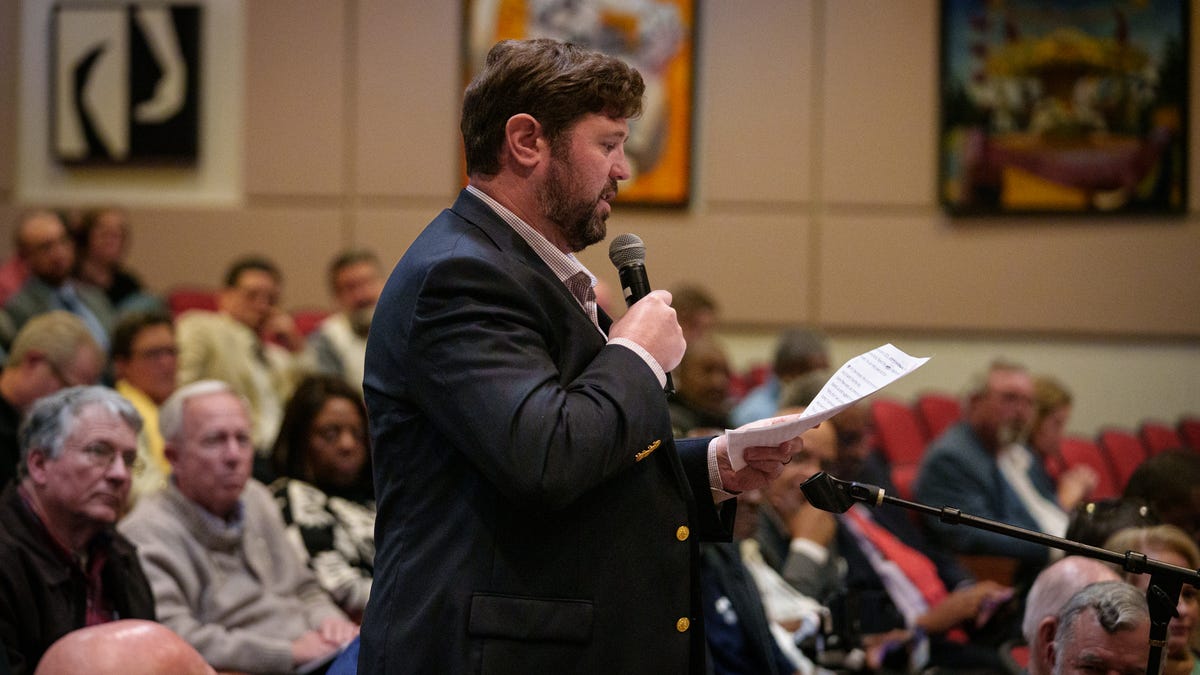
At a Fayetteville hearing on Fuquay-Varina’s request to take water from the Cape Fear River basin, speakers told a packed house why it’s a bad idea.
Nearly 200 public officials and some residents packed the Cumberland Hall Auditorium at Fayetteville Technical Community College on Dec. 4 in the first public hearing on Fuquay-Varina’s request to transfer water from the Cape Fear River basin and return it to the Neuse River basin.
The state Environmental Management Commission, a 15-member appointed committee that oversees departments like water resources within the North Carolina Department of Environmental Quality, is reviewing the request.
EMC member Kevin Tweedy oversaw Thursday’s public hearing in Fayetteville and will make a recommendation to the full EMC board on whether it should grant Fuquay-Varina’s inter-basin transfer certificate, adopt a modified version of the request or take no action.
The EMC is taking into consideration nine facts of finding, which include evaluating the necessity of the request and whether the request will cause any foreseeable detrimental effects, said Maya Holcomb, DEQ’s environmental program coordinator for inter-basin transfers.
According to Fuquay-Varina’s request, the town relies on wholesale water purchased from Raleigh and Johnston County — both in the Neuse River Basin — as well as from Harnett County, which draws from the Cape Fear River Basin.
The request states that the contracted water supply will fall short by 2030, and the town is requesting the transfer to meet future water demands.
Holcomb also presented 12 alternatives to the Cape Fear River Basin for how and where else Fuquay-Varina could get its water.
What local residents said
Of 47 people who spoke during the two-hour meeting in Fayetteville, only one was in favor of Fuquay-Varina’s request.
Most of the speakers said Fuquay-Varina should replace the water it takes out of the Cape Fear River and said that allowing the town to take the water would create a financial burden on Cumberland County, would negatively affect the environment and have impacts on Fort Bragg.
Whitaker Grannis was one of the speakers.
Grannis is president of the Cumberland County Beekeepers Association and chairman of the Fayetteville Stormwater Advisory Board, but said he spoke as a Fayetteville native.
Grannis said Fuquay-Varina’s request is cheaper than if they were to return the water to the Cape Fear River basin.
He estimated that if Fuquay-Varina invested in infrastructure to return the water it uses, it would cost a fifth of a penny per gallon of water used over 50 years.
“Maybe their mothers didn’t tell them to put something back where they got it from, and they expect us to quietly accept that,” Grannis said.
He said every few years, an upstream community wants to grow and take water from the river and dump it elsewhere because it’s cheaper.
“This is a generational defense of our river, our water and our future,” he said.
Fayetteville resident Shelia Cuffee asked the commission to “not rob Peter to pay Paul.”
Elected officials
Cumberland County Board of Commissioners’ Chairman Kirk deViere said he spoke on behalf of more than 358,000 Cumberland County residents.
The inter-basin transfer request, deViere said, “carries serious implications for our regional water supply, public health, economy and security.”
“This is a decision with real consequences for families, businesses, schools, farms, Fort Bragg — the installation that anchors our national defense right here in Cumberland County,” he said.
DeViere said that if water is withdrawn from the river and not returned, downstream communities bear the burden
“Our request is clear: Protect the water that sustains our community today and for generations to come. If you take it out, put it back in the same place,” he said.
Commissioners Glenn Adams, Pavan Patel and Henry Tyson as well as Fayetteville Mayor Mitch Colvin and Hope Mills Mayor Jessie Bellflowers, voiced their opposition to the inter-basin transfer as well.
Al Wheatley, legislative assistant for state Rep. Diane Weatley, said Rep. Wheatley and state Sen. Tom McInnis, who both represent Cumberland County in the state General Assembly, oppose the request.
Rep. Wheatley was unable to attend the meeting because of a prior commitment, Al Wheatley said.
McInnis, who also represents Moore County, provided a letter to The Fayetteville Observer that he sent to John Solomon, chairman of the N.C. Environmental Management Commission. In the letter dated Dec. 4, McInnis says he is opposed to the request because the water would be transferred to another river basin, and it would negatively impact those who rely on the water.
Future economic impact
Robert Van Geons, president and CEO of the Fayetteville Cumberland County Economic Development Corp., said that though Cumberland County is an economically distressed community, investments are being made.
Van Geons said the county is currently in active competition for projects that could generate $40 billion in investment and more than 15,000 jobs.
“Removing the water from the Cape Fear unfairly jeopardizes our ability to compete for these projects and will dramatically limit future opportunities,” he said.
Local business owner and member of the Greater Fayetteville Chamber, Peter Pappas, said the Chamber’s board passed a resolution against the transfer.
“No company is going to invest hundreds of millions of dollars in a community whose water supply is uncertain,” Pappas said. “This raises the cost of doing business for every industry in Cumberland County.”
Angie Hedgepeth, government affairs director for Long Leaf Pine Realtors and co-chair of the Greater Fayetteville Chamber’s Government Relations Committee, said she represented more than 2,500 realtors in a nine-county area.
Long Leaf Pine opposes Fuquay-Varina’s request, Hedgepeth said.
Fishing and boating
Craig Williams, owner of Deep Creek Outfitters situated along the Cape Fear River on Person Street and the Cape Fear River, estimated that about 8.5 feet of water in the river is supplying Fayetteville.
He said that if the request is approved, there will not be enough water for boaters and anglers.
“That’s all these folks want, is just put the water back in the river,” Williams said.
Aaron Sweat, owner of Cumberland Marine in Stedman, said the river has been affected by past hurricanes causing log jams and that the Linden area only has ankle-deep water.
He encouraged officials to look at flow rates when considering Fuquay-Varina’s request.
Public safety
Cumberland County Emergency Services Director Gary Crumpler said rural fire protection depends on water from streams, ponds and the Cape Fear River. He said there is a concern that less water will create a greater burden when a drought hits, drying out vegetation and causing the river’s levels to drop.
“This creates a dangerous combination for our communities and for the firefighters who serve them during large emergencies … Any change that reduces natural storage or water flow increases the burden on emergency services and lengthens response times and effort,” Crumpler said.
Legal points
Fayetteville resident Kristie Allen said North Carolina’s inter-basin transfer law was designed as a basin balance and safeguard.
“IBTs are supposed to be a last resort after reasonable alternatives have been exhausted with explicit protection for the donor basin and careful attention to cumulative impacts,” Allen said. “The Fuquay-Varina petition turns this sequence upside down.”
Former state representative and local attorney Billy Richardson said he helped write the law cited for the transfer request in 1993.
“The reason that law came into effect was because Wake County was taking water out of the Cape Fear long before 1993, in the 1980s, and taking it out of the Cape Fear basin and putting it into the Neuse River basin, already reducing our flow,” Richardson said.
He said that further downstream toward Bald Head Island, sediment is building up because the water flow can’t push it toward the ocean and that ships are hampered from getting to Wilmington because of the flow capacity and sediment.
He said Fuquay-Varina has had years to plan and the General Assembly passed laws requiring this.
“If they wanted water out of the Cape Fear, they should have built a treatment to send it and put it back into the Cape Fear River,” Richardson said.
Environment
Jonelle Kimbrough, executive director of environmental nonprofit Sustainable Sandhills, which serves 11 counties, said an inter-basin transfer will threaten the quality of the region’s water and have impacts on the environment, economy and culture.
“We don’t want to experience the enforcement of water rationing measures, higher utility rates and stymie economic opportunities here while development to our north (goes) unchecked,” Kimbrough said.
She said the Cape Fear River is already polluted by perfluoroalkyl and polyfluoroalkyl substances, called PFAS, which are man-made chemicals used in products like nonstick cookware and firefighting foam.
“This IBT could cause a proliferation of these chemicals across our state and present further challenges as our region attempts to mitigate the harm,” Kimbrough said.
PWC
Richard King, chairman of the Fayetteville Public Works Commission Board, said PWC opposes Fuquay-Varina’s request to pull water from the Cape Fear River basin without returning it.
King said it is PWC’s responsibility to protect 250,000 people who rely on the river for safe, reliable drinking water, and 900,000 people downstream would feel the impact, as well.
“It will also shift the financial burden of treatment upgrades onto communities like ours, who will be forced to spend millions to manage the reduced flows and more concentrated containments,” King said.
Treatment and testing costs will increase, meaning rates will increase, he said.
Misty Manning, chief operations officer for PWC, said if the transfer is approved, PWC will see a 1.1% reduction in available flow.
“This is an unacceptable burden for PWC to accept when a feasible alternative of returning treated wastewater exists,” Manning said.
Cape Fear Valley
Tavarus Gray, corporate director of engineering for Cape Fear Valley Health, said the hospital’s water, power, heating, cooling and sanitization rely on a reliable water flow.
“We can not provide high-quality care on a reduced or unpredictable water supply,” Gray said.
Impact to military
Army veteran Miguel Arroyo spoke about concerns that droughts and flooding already impact the Cape Fear River and also what it would mean for Fort Bragg.
Fayetteville resident Charlie Allen said that Fort Bragg is home to several top Army commands, Special Forces and the nation’s immediate response force, the 82nd Airborne Division — all of which he said depend on reliable water from the basin for aviation, training, maintenance, hospitals and housing.
“If the Cape Fear gets less reliable, that is not just a local headache; that is a national readiness problem,” Allen said.
What’s next?
The next public hearing for Fuquay-Varina’s transfer request is 6 p.m. Dec. 9 in the ground-floor hearing room of the Archdale Building at 512 N. Salisbury St. in Raleigh. Sign-in and speaker registration for the hearing will begin at 5:30 p.m.
Participants who wish to speak must attend in person.
Another meeting is scheduled for 6 p.m. Dec. 11 at the Chatham County Agriculture and Conference Center, 1192 U.S. Hwy 64 West Business in Pittsboro. Sign-in and speaker registration start at 5:30 p.m.
A training session on accessing a virtual hydrological model used to evaluate alternatives for Fuquay-Varina’s request is Dec. 16. Registration is required, and those interested in the training can email maya.holcomb@deq.nc.gov to enroll.
DEQ will also accept written comments on the request until April 1, 2026.
Comments can be mailed to Maya Holcomb, Division of Water Resources, 512 N. Salisbury St., Raleigh, N.C., 27604, or by email to maya.holcomb@deq.nc.gov.
Staff writer Rachael Riley can be reached at rriley@fayobserver.com or 910-486-3528.