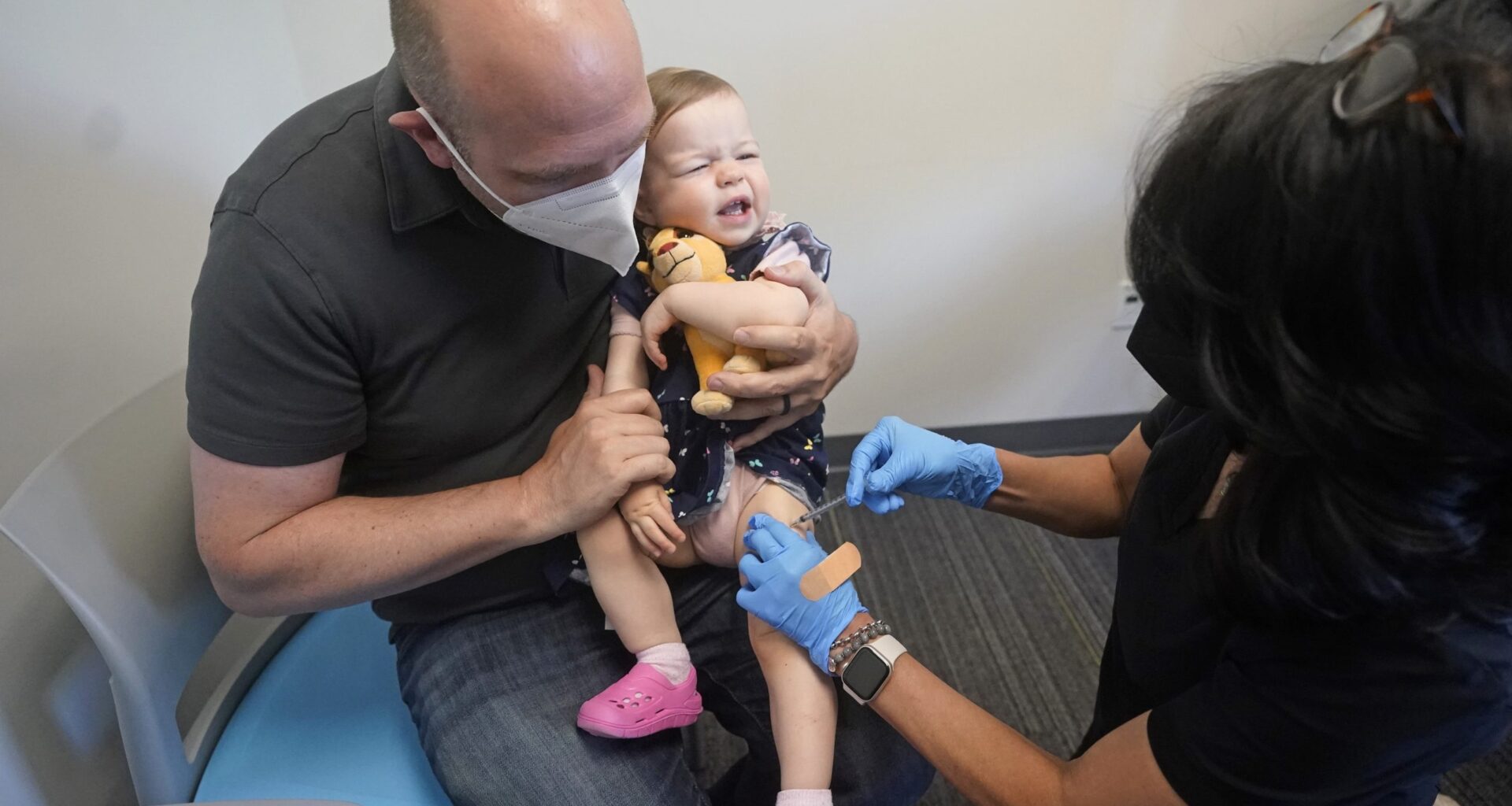
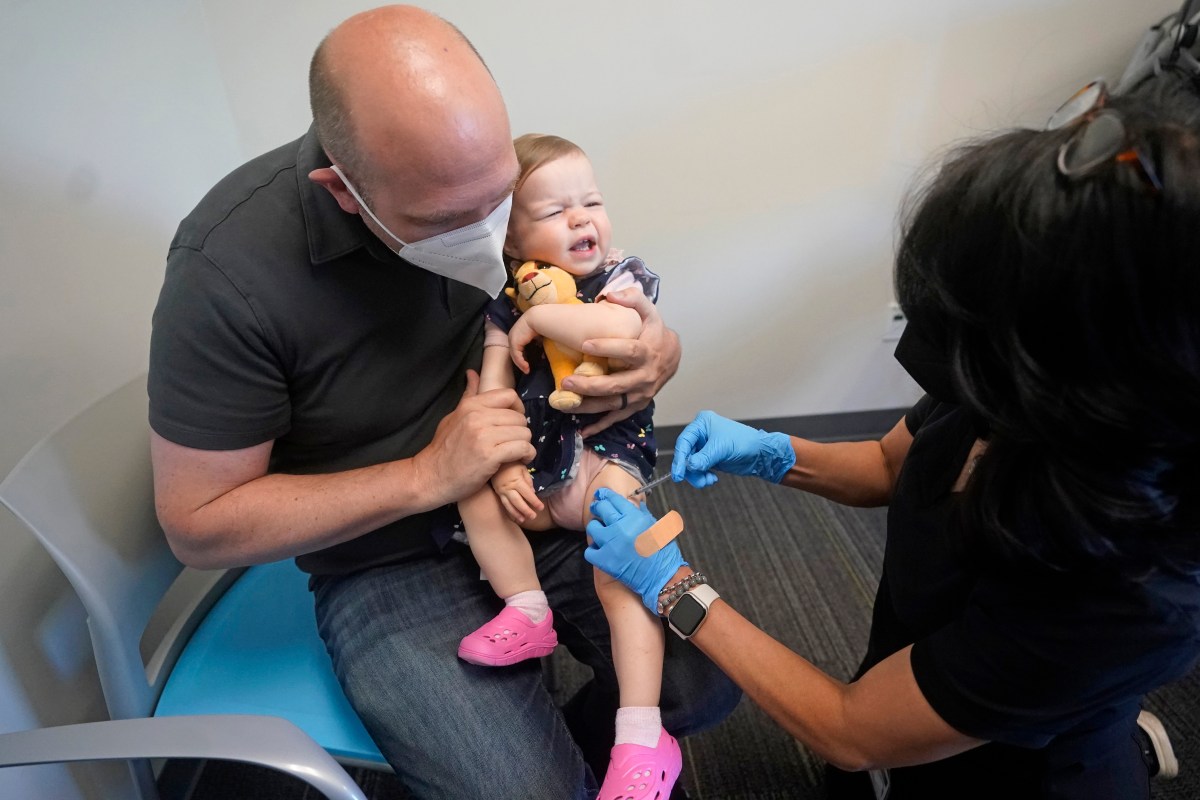
 A parent holds his 16-month-old daughter as she receives the Moderna Covid-19 vaccination in Salt Lake City, Utah, on June 21, 2022. File photo by Rick Bowmer/AP
The federal panel that advises the Centers for Disease Control and Prevention’s vaccine recommendations made one of its biggest moves on vaccine policy to date on Friday, saying that rather than vaccinate all newborns against hepatitis B at birth, parents and caregivers should delay the vaccine series until their child is 2 months old — if they choose to vaccinate them at all.
Vermont state officials are adamant that providers and families do not follow the panel’s recommendation and continue to give infants a dose at birth.
Even before the decision from the federal Advisory Committee on Immunization Practices, called ACIP, the Vermont Department of Health issued a public advisory to maintain its support for infants to be vaccinated within 24 hours of birth.
“I’m concerned,” the state’s health commissioner, Rick Hildebrant, said in light of the federal panel’s decision. “The biggest concern I have is the confusion that this will cause.”
“We sent the press release to make sure Vermonters know what our recommendation is, that it’s backed by science by 30 years of precedent, that it has been effective and safe in preventing chronic liver disease in folks,” Hildebrant said.
The federal panel voted 8-3 for the delayed vaccination. In June, U.S. Health and Human Services Secretary Robert F. Kennedy Jr. gutted the existing lineup of experts on the CDC panel and instead stacked the panel with many outspoken skeptics of vaccines.
The state recommends the birth-dose, followed by a series of vaccines for a child to complete by the time they are 18 months, as essential to prevent hepatitis B infections. The virus targets the liver and can lead to liver failure, cirrhosis and liver cancer. Though adults exposed to the virus are more able to clear it, 90% of infants infected develop chronic conditions.
Typically, the state Health Department buys the vaccines directly from the CDC at a low cost. That allows for easy distribution to the health care providers who administer the vaccines. Since the CDC panel’s recommendation delays, rather than entirely rejects, the vaccine, Hildebrant is not yet sure if or how this decision will alter the state’s ability to buy the vaccines and distribute them.
Kristina Massari, a spokesperson for BlueCross BlueShield of Vermont, said the state’s largest commercial insurer does not expect a significant shortage of vaccines in the coming year, since a recommendation is still partially in place.
ACIP’s recommendation only applies to infants whose parent tested negative for hepatitis B while pregnant. The panel did not change the recommendations for those whose parents test positive, or those who do not test at all for the virus.
“Blue Cross VT is not changing its coverage of Hepatitis B vaccines,” Massari wrote in an email. “Members will have zero cost-share and will not be required to obtain prior authorization to receive this vital vaccination.”
Hildebrant said he and his colleagues are preparing to act, should they need to adjust the procurement and distribution pathways, though he is not sure what that would look like exactly. He worries about the added cost of buying the vaccines directly from the manufacturer and the logistics of needing to take on the distribution of them.
Federal insurers will also continue to cover the vaccine, a policy analyst for the Centers for Medicare and Medicaid, Andrew Johnson, told the ACIP committee, as first reported by STAT, a health care news source.
“Not only do they care immensely about their insured individuals,” Hildebrant said of Vermonters’ insurance companies, “but they also know that this is going to save money. I mean, it’s very costly to not get vaccinated and then end up with a chronic illness. And that’s the least important part of this.”
Since the CDC adopted the recommendation of a birth-dose in 1991, the United States saw a significant decrease in hepatitis B cases, dropping from a total of nearly 18,000 to fewer than 3,000 new diagnoses annually, a 2023 public health report found.
“You don’t get that kind of response rate in medicine with treatment,” Hildebrant said, becoming animated about the vaccine’s efficacy. “That is just remarkable. And the thought of going back to the days where we’re seeing 14,000 to 18,000 kids contracting hepatitis B across the country is not one that we’re excited about. It’s one we’re really, really concerned about.”
Cody Meissner, a professor of pediatrics at Dartmouth’s Geisel School of Medicine at Dartmouth, is one of Kennedy’s recent ACIP appointees. He has a history on the panel, having served under President Barack Obama between 2008 and 2012. He was one of the few dissenters in Friday’s meeting.
“I will just say, we have heard ‘do no harm’ as a moral imperative. We are doing harm by changing this wording,” Meissner said as he cast his no vote during the panel.
The state health department echoed his concerns.
“There’s been a lot of incredible incredulity about this. ‘Why is this happening?’ And I don’t think anyone has a good answer to [the question of] why are people doing this,” Hildebrant said. “All I can say is, it’s clearly not based in science.”
The state Health Department has been coordinating and in frequent communication with counterparts across the region, according to Hildebrant. Following upheaval at the CDC this summer, Vermont joined a regional coalition to solidify more consensus as federal guidance contradicts consensus public health science.
Merideth Plumpton, the department’s Immunization Program manager, authored a Dec. 1 letter with more detailed guidance for providers and parents on the state’s recommended vaccination schedule, in line with that of the American Academy of Pediatrics.
Hildebrant encouraged questions and skepticism of what best protects children from harm, but he encouraged parents to have these conversations with their children’s pediatricians.
“Do not listen to a politician when it comes to health care decisions, please. These are decisions that belong in an exam room, and they are the people who are the best equipped to give you information about this.” he said.