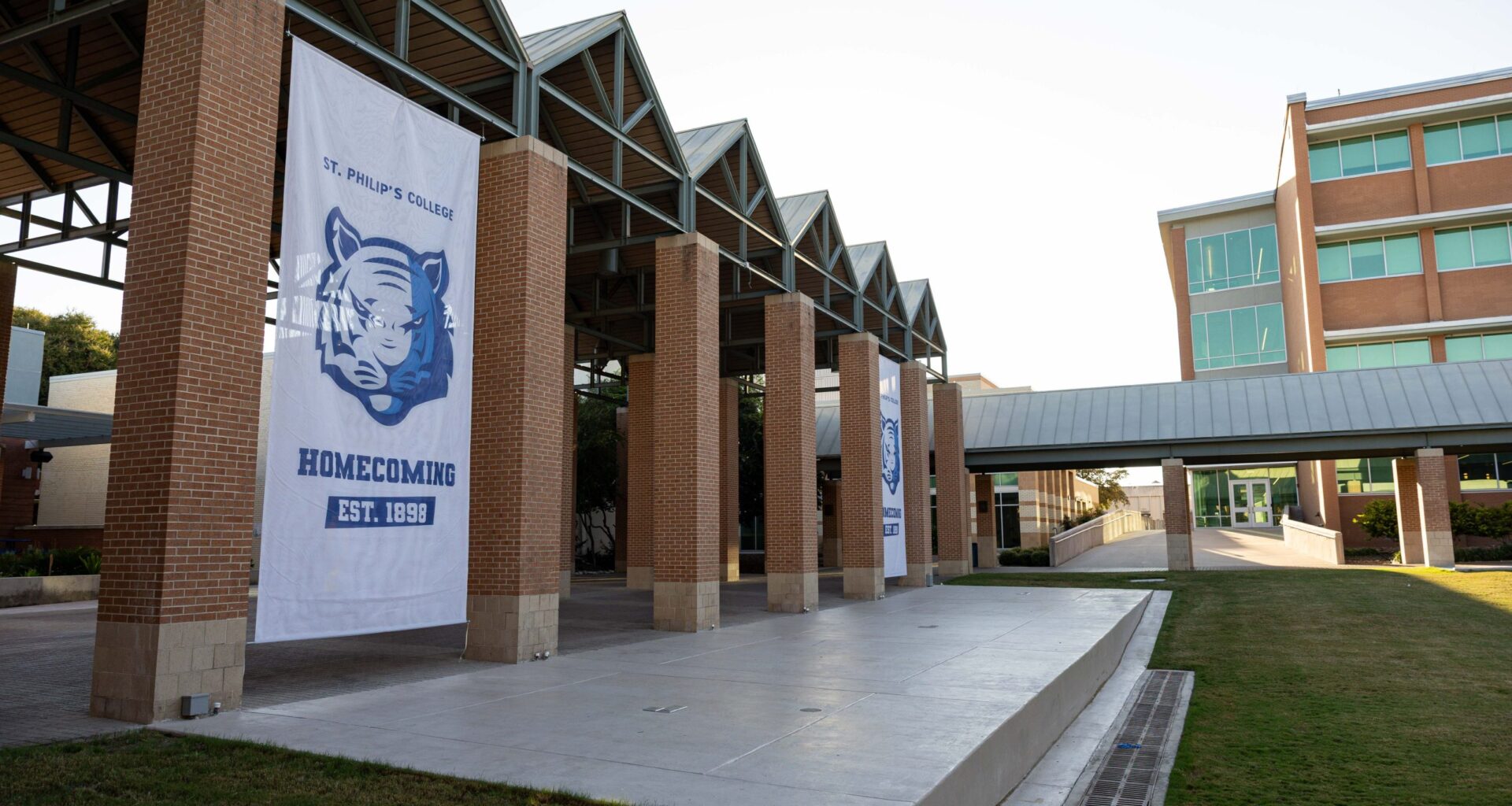
St. Philip’s College, the nearly 130-year-old college on San Antonio’s East Side, is expected to undergo additional renovation projects in 2026, among them the construction of a long-awaited formal main entrance.
This is happening because of the infusion of nearly $15 million in unexpected federal funds aimed to support Historically Black Colleges and Universities.
“Where is the front door for St. Philip’s College, where is the main entrance? That’s right, we don’t have one,” said President Adena Williams Loston as she announced the funds to the Alamo Colleges District board of trustees in November, calling this a “terrific opportunity.”
The college plans to complete four campus expansion projects with this unexpected windfall of cash, an additional $14.6 million that is part of a significant investment for Historically Black Colleges and Universities and Tribally Controlled Colleges and Universities.
Together, HBCUs and tribal colleges will receive $495 million in addition to their existing support from the federal government.
St. Philip’s officials were notified of the additional funds on Sept. 27, and told they have one year to spend the funds, Williams Loston said. The plan is to use these to build a Veterans Hall, additional cafeteria space and make improvements to the Watson Fine Arts Center’s heating and air conditioning system.
The college is one of the oldest in the region, established in 1898, and the only one designated as both a Historically Black College and Hispanic Serving Institution.
Today, St. Philip’s serves nearly 21,000 students out of the nearly 90,000 students enrolled across the five Alamo Colleges District, which also includes San Antonio College, Palo Alto College, Northwest Vista College and Northeast Lakeview College.
“This is an opportunity,” Williams Loston said. “We do not have a center on campus that supports the student veterans… And in addition, because of our phenomenal growth, we now need added cafeteria facilities.”
Earlier this year, the Department of Education announced it would shift dollars formerly allocated to support Hispanic Serving Institutions, a federal designation awarded to degree-granting colleges with at least 25% of Hispanic or Latino students enrolled.
Under the Trump administration officials with the Department of Education deemed these programs “racially discriminatory,” citing the federally mandated quota as the main reason. They also announced these funds would instead go to Historically Black Colleges and Universities, Native American-serving institutions, and others.
While the federal government deems this funding as unfair, Hispanic Serving Institution leaders say the program provides vital investments for more than 600 institutions.
READ MORE: San Antonio’s Hispanic-serving colleges see millions in federal grants stripped away
Funding for Historically Black institutions are not competing, meaning the colleges don’t have to apply to compete for a pot of money, they are instead allocated using a federal formula. Funds allocated to Hispanic Serving Institutions were issued as competitive grants and awarded based on an application process.
Despite having access to these grants due to the designation as Hispanic Serving, these services were accessible to every student enrolled in the institution, not only Hispanic students.
In San Antonio, 12 colleges and universities have carried this designation for decades. Since 2018 there were at least 21 HSI grants issued by the Department of Education totaling more than $57 million.
While it’s still unclear how many grants will be impacted by this decision across San Antonio’s colleges, most of the grants funded since 2018 focused on increasing enrollment, retention and completion of all students.
St. Philip’s reported having about 68% of students who identify as Hispanic or Latino, but the college could not compete for grants linked to the Hispanic Serving designation while also receiving funds as a Historically Black college.
St. Philip’s College officials have already engaged a design team for the latest projects, Williams Loston said, to fully allocate the funds before the Sept. 30, 2026 deadline.
When it comes to completion of the actual construction, the college president is hopeful that these would be at least nearing completion by the end of next year if the design phase moves forward as expected.
So far the plan involves building a main entrance facing Martin Luther King Drive and St. Philip’s Way, formerly Mitman Street, and to divide the old gymnasium into the veterans center and the cafeteria, each with an individual entrance.
“I still recall when I first came on campus for my interview, I said, ‘Take me to your main entrance,’ [they said] ‘We don’t have one.’ And that was in December of 2006,” Williams Loston said. “So we do want to create a front door so that everyone [recognizes] that off of Martin Luther King Drive, this is our main entrance.”
The San Antonio Report partners with Open Campus on higher education coverage.