
Thank goodness for wealthy people and their big houses. I don’t mean all of them, of course, not that share of the 1 percent that overspends recklessly on oversized temples that serve mainly to shelter their car collections, and their egos.
I’m referring to the tasteful, monied minority who see the construction of their homes as a chance to sponsor a piece of quality architecture that contributes to the community as much as it serves their own needs, a landmark structure intended to last the ages.
Without that well-intended set, we wouldn’t have Louis XIV’s Palace of Versailles, or Thomas Jefferson’s Monticello, or Elvis Presley’s Graceland. (OK, Graceland is not for everybody, but it is, no doubt, a world wonder.)
 The indoor pool was fabricated in Italy and shipped to the U.S. in sections. (Provided by Robert and Judi Newman)
Such high ideals surely drove the construction of the Pondbank house in Cherry Hills Village. That is clear from the publication of a new book — also called “Pondbank” — written in large part by its owners, Robert and Judi Newman, together with architect Donald H. Ruggles and former Denver Post reporter Mike McPhee.
The Newmans are well known in Colorado, mostly for their philanthropy, which cuts across numerous causes and includes naming-level support for two of Denver’s most notable pieces of public architecture: the Newman Center for the Arts on the University of Denver campus, and the education-minded Freyer-Newman Center at the Denver Botanic Gardens.
The Newmans completed their 21,500-square-foot home in 2012 but just got around to publishing the coffee table tome this year.
“This house deserves a book,” Judi Newman said, when I asked why she went to the trouble of completing a 172-page diary of the house’s construction.
More than that, she wants people to take from the lessons the Newmans learned when making their personal masterpiece. She hopes readers see the value of supporting high-level craftsmanship; to respect well-considered design; to get involved from the beginning of the building process and keep a close eye on construction; and to be patient enough to make something unique.
And Pondbank is one-of-a-kind, mostly because every wall, floor, ceiling, stairway and railing was custom-crafted for the Newmans’ needs.
The book, full of color photos that document the construction and show off the final product, takes readers on a tour, explaining the design principles developed with architect Ruggles, who produced more than 1,000 drawings for the project, which took four years and eight months to complete.
Ruggles is one of the region’s most prolific architects and known widely as an advocate of classical design. But he also understands how technology-driven structures work today. Both of those skills are on display at Pondbank.
“Pondbank” the book takes readers on a tour, starting with the curved driveway approach from the street created by landscape designer Herb Schaal. Despite its size, the house is modestly scaled in front to fit in with its low-rise neighborhood.
Then it is on to the courtyard, full of potted plants and flowers and centered by an urn-shaped fountain that can be adjusted to spew either water or flames.
The courtyard is circular in shape, surrounded by a curved marble colonnade that supports a series of marble arches. Each arch is fitted perfectly with clear glass, creating an interior, temperature-controlled arcade on the other side that serves as the first exhibition space for the Newmans’ extensive art collection.
The vestibule is next, with its domed ceiling, painted with a blue sky and white clouds. Alcoves hold large bronze sculptures; in the center is a large table that the family decorates to complement the season.
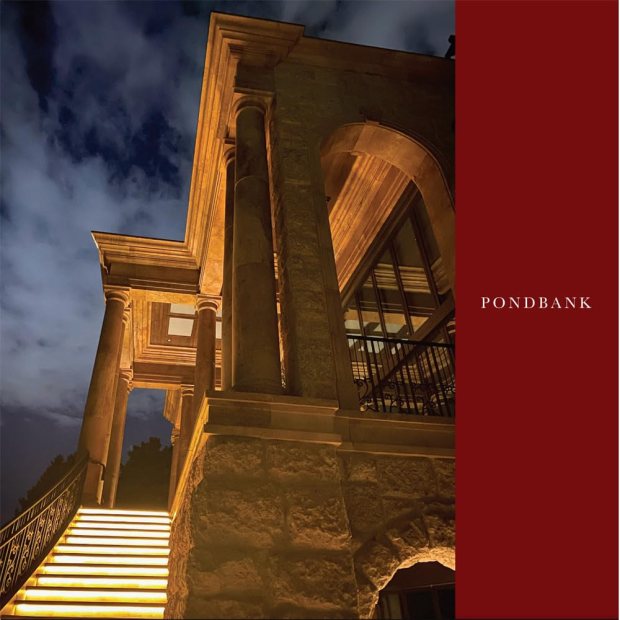 Pondbank: The Residence of Robert and Judi Newman, by Donald H. Ruggles and Mike McPhee (Fibonacci)
Eventually, the book passes through the second art gallery, with a barrel-vaulted ceiling, inspired by the Queen’s Gallery at Buckingham Palace.
There are other stops on the tour: the great room, which also features marble columns and marble entablatures, enhanced by wooden moldings and ceilings. Most of the wood in the house was hand-crafted specially for the space.
The great room is Pondbank’s star attraction. It rises two levels, starting from a floor covered with stone that the Newmans imported from Europe. The room is large enough to fit multiple fireplaces, a grand piano, numerous sofas and chairs and a large and flexible dining space. It is spacious, but the details — like the mantles and the window frames — are scaled down to a human level.
The Newmans wanted this space to be intimate yet airy, so that it could host benefits and luncheons for local charitable causes. Over the years, they have invited many people there, turning over their personal space to raise money and support various nonprofit organizations that serve the region.
More grand is Pondbank’s loggia, which has more columns, of course, and enough space to hold four seating areas and an outdoor dining space. The view looks out to the backyard, through a garden, across a pond (that inspired the name) and off to the Colorado mountains.
The house takes on its most classical personality, to an extreme, perhaps, with the towering, south facade, which resembles something out of ancient Europe. It features a checklist of elements of traditional, symmetrical design, including matching sets of stairs on either side that lead to the outdoor pool deck below.
“Pondbank,” which also gives book design and writing credit to John Boak, offers a lot more info to readers, plenty about the structure and engineering and the mechanical workings of the house, about the gardens, the hand-hewn stone, stained glass and railings, the large kitchen, the home theater, the bridge connecting the upstairs bedrooms and the second, indoor pool lined with a glass mosaic that depicts various constellations and planets. The mosaic was designed by Judi Newman and the project’s other key architect Melissa Mabe, and then fabricated in Ravenna, Italy, before being shipped back for installation.
All along, the book hands out credit to the designers and artists who did the work, especially to interior designer Paula Berg and the tireless contractor Jeff Barnett of JKB construction who oversaw every detail for his very involved clients. There are a lot of names on the book’s pages, and the Newmans, in their generous way, make sure everyone gets their due.
The book is also a tribute to classical architecture, which for better and worse, is back in fashion, thanks (or no thanks) to its very public push by the current conservative administration in Washington, D.C.
Pondbank, to its benefit, shows its flexibility of this old form, and what is possible when it is employed thoughtfully. Classical houses like this can be grand in their way, elegant enough to host the Newmans’ holiday parties and large enough to shelter their own car collection. But they can also be engineered to accommodate contemporary living, in this case with a geo-thermal energy setup, tight security, and tech-advanced mechanisms that control everything from the lighting to the music systems.
Is Pondbank a landmark, like those historic houses that go down in history? It is hard to say. But it is model for home-building in the 21st century, at least for those who care about design, technology, the environment, their neighbors and the wider community — even if they make their own homes on more modest means. Both the house, and the book, are inspirational.