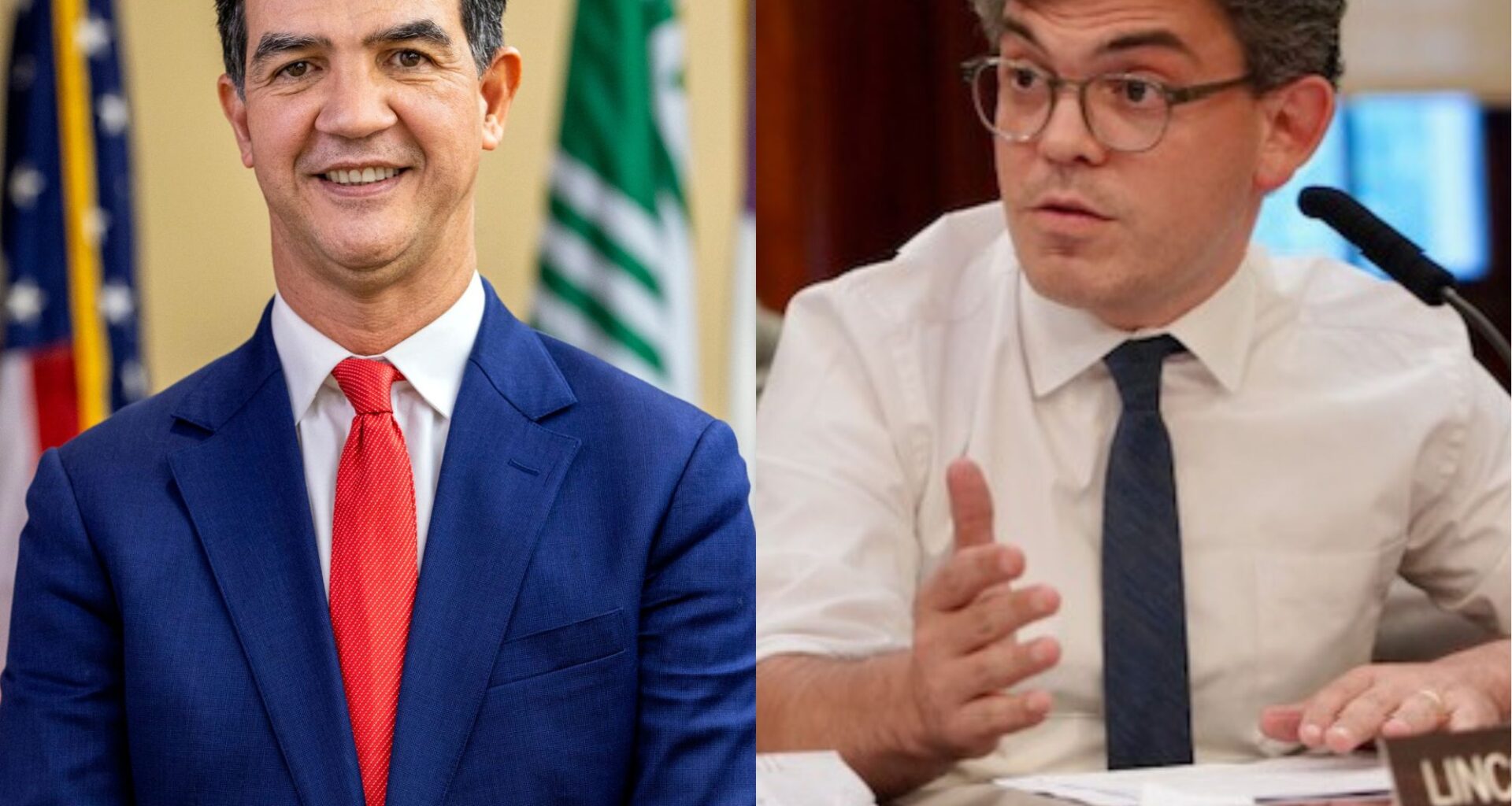
Ydanis Rodriguez (left) and Lincoln Restler. Photos courtesy of NYC DOT and Lincoln Restler
EDITORS’ NOTE: There is no doubt that the New York City Department of Transportation created huge community engagement, seeking suggestions for improvements of ‘BQE Central.’ But at no point did DOT ever deny their basic role in seeking to (a) give out huge contracts to remove the triple cantilever, destroying the landmarked Brooklyn Heights Promenade and impinging on the beloved Brooklyn Bridge Park, and (b) providing untrammeled support, whether stated or not, to the trucking lobby, despite city mandates to reduce truck traffic. We understand one of their primary roles in the city is the awarding of massive contracts to build, rebuild and maintain. The role of good government is vital as a watchdog over this inevitable commercial power. These observations are the core of ‘facts on the ground,’ a phrase used by the current DOT Commissioner in the following guest editorial.
NYC DOT: What Is Actually Happening Around the BQE
By Ydanis Rodriguez, NYC DOT Commissioner
Two recent Brooklyn Eagle articles (an 11/13 news article as well as a prior op-ed) addressed the New York City Department of Transportation’s (NYC DOT) plans around the section of the Brooklyn Queens Expressway (BQE) that we have termed “BQE Central.” Unfortunately, these pieces misrepresent both our position and the facts on the ground. My team has been laser-focused on a project that prioritizes expert engineering and is responsive to conversations with hundreds of stakeholders. This project has languished for decades — but in the past three years, NYC DOT advanced the BQE Central project further than ever before. While previous administrations cobbled together patchwork fixes, we pivoted by scrapping temporary band-aids and launching a once-in-a-generation planning process for long-term reconstruction.
NYC DOT undertook an extensive two-year visioning process, inviting residents, community groups, and local organizations to define priorities for the BQE corridor in Brooklyn. Through workshops, surveys, and neighborhood walk-throughs, Brooklynites identified goals such as improved safety, better connectivity, reduced traffic impacts, and enhanced public spaces. The community feedback informed the design concepts we shared with the public from 2022-2024 and that we further developed this year with our co-lead state and federal agencies. This feedback also informed a variety of upgrades for pedestrians and cyclists in the surrounding communities. Now we have reached the next step in the project: the City and State provided U.S. DOT with notice that it is prepared to enter the federally-mandated environmental review process.
Perhaps the most misunderstood and misrepresented part of our work is what we have been doing for the past year — namely, working with state and federal partners to complete the engineering, traffic modeling, and documentation required to enter environmental review. We developed a framework of needs and objectives, engineered detailed concepts, and completed extensive traffic studies. The environmental review process, by design, is very public. The process will explore a wide range of preliminary concepts, assess potential environmental and community effects, evaluate tradeoffs, and identify mitigation and remediation measures. We will solicit broad community feedback throughout.
This administration is not attempting to railroad a preferred option. Instead, we laid the groundwork for the public to weigh in on a range of different design options before anything can be locked in. The public will have the chance to comment on a range of concepts that include structural rehabilitation of the highway and replacement of the structures, as well as options such as a boulevard or tunnel. A total of thirteen options will be considered during the environmental review process. And, whether the environmental review begins now or next year, its purpose remains the same: it will allow New York City to evaluate a range of designs and ultimately narrow them down into a final, workable design for BQE Central.
It is critical that we move forward. Preparation for environmental review included the most comprehensive engineering evaluation of BQE Central since it opened in 1954. After seventy years of heavy use, the findings are clear: the structure has remained safe due to NYC DOT’s continuous interventions, but it is now experiencing deterioration and cannot be addressed through rigorous maintenance alone. If we do not undertake a major replacement or rehabilitation project in the near future, we will need to undertake disruptive, large-scale, and expensive annual repairs and face potential operational changes to the highway.
While moving forward this planning process, NYC DOT has also been a responsible steward of the existing BQE Central structures. In 2021, NYC DOT successfully worked with Albany to grant our agency the authority to use roadway weight sensors to issue violations to overweight trucks on this section of the highway. This resulted in a more than 60 percent reduction in overweight trucks on the Queens-bound roadway.
As we successfully implemented this technology, NYC DOT has expertly managed necessary repairs to deteriorating sections of the cantilever. Combined with a complete repaving of the structure, these efforts reflect our commitment to ensure that the entire BQE Central structure remains safe, while considering local quality of life.
However, in the end, we need to do far more than just maintain BQE Central. Over the last three years, we have been trying to transform an aging, dividing highway into something safer and more connective— and NYC DOT is ready to work with the community through a transparent and collaborative environmental review process to achieve shared goals.

Ydanis Rodriguez has served as Commissioner of the NYC Department of Transportation since January 1, 2022. As NYC DOT Commissioner, Rodriguez oversees more than 5,500 employees, an annual operating budget of $1.4 billion, and a 10-year capital budget of $33 billion. Rodriguez is the first Latino and only the second person of color to serve in the position.
Commissioner Rodriguez is delivering on the agency’s commitment to reimagine public space, including making New York City the most walkable and bikeable city in the nation. Under his leadership, NYC DOT is focused on equity and bringing government, local communities, the private sector, and academia together to build a better and fairer transportation future.
Prior to leading NYC DOT, Commissioner Rodriguez served in the New York City Council, where he chaired the Transportation Committee from 2014 to 2021. Before serving in elected office, Commissioner Rodriguez taught in New York City public schools for more than fifteen years.
A proud immigrant from the Dominican Republic, Commissioner Rodriguez arrived in New York City at the age of 18. He worked tirelessly — including as a livery cab driver — to put himself through City College, where he earned both bachelor’s and master’s degrees.
Restler: After four lost years on BQE under Adams, BQE fix must be priority in 2026
By Lincoln Restler, Councilmember
When the Adams administration came into City Hall four years ago, they were handed a gift-wrapped plan to extend the lifespan of the Brooklyn-Queens Expressway’s Triple Cantilever by 15 to 20 years while a longer-term vision for the whole BQE corridor could be developed. This rehabilitation plan stretched from Atlantic Avenue to Sands Street and was crafted by then Department of Transportation Commissioner Hank Gutman. It was fully accounted for in the city’s budget and had broad support from local elected officials, community groups like the Brooklyn Heights Association, and neighbors. So, of course, the Adams administration decided to throw it out the window and start from scratch.
Fixing the Triple Cantilever section of the BQE has left a string of Mayors and Governors stumped for decades. Nevertheless, conditions have continued to deteriorate and the senior leadership of the Adams administration promised to make a long term fix for the BQE one of their signature priorities. Unfortunately, even granting them the benefit of being well-intentioned, they accomplished practically nothing and cost the city and its taxpayers millions in consulting fees and endless hours of wasted time.
Shortly after taking office in 2022, the Adams administration reallocated $180 million dollars intended for immediate repairs to the BQE and decided instead to design their own plan. They claimed the Biden Administration would not fund the rehabilitation plan that had been crafted by the de Blasio administration and were not interested in heeding the calls from experts and communities alike for something more sustainable and climate-responsive. Instead they decided to pursue a 100-year solution that would essentially preserve the status quo.
While longevity is a worthy goal, fixing the Triple Cantilever is one of the most expensive and complex engineering projects ever undertaken by the City of New York. Navigating a multi-billion dollar highway reconstruction project that carries 130,000 cars and trucks every day nestled tightly between the world class public spaces of Brooklyn Bridge Park and the Brooklyn Heights Promenade is no easy feat.
The local elected officials who represent the Triple Cantilever have worked in close coordination for years to advocate for our community. Assembly Member Jo Anne Simon, State Senator Andrew Gounardes, Congress Members Dan Goldman and Nydia Velazquez and Borough President Antonio Reynoso and I jointly meet each month to strategize on the BQE and also participate in a monthly meeting with City Hall to try to chart a path forward.
But despite our regular communication, the Adams administration has failed to recognize that local elected officials are critical partners on this project who will have to sign off on any long-term BQE solution. There are approvals required by the City Council and the State Legislature, which would need to be shepherded through those bodies by the local elected officials before construction can begin. And this multi-billion dollar project inevitably requires meaningful federal investment, which is significantly harder to secure without the support of the local Members of Congress.
We have been clear and consistent that we will not support the reinstatement of a third lane of traffic on the BQE Triple Cantilever — which would add 6 million car and truck trips annually, polluting our community and undermining our critical climate goals. We will not support a project that destroys the beloved Brooklyn Heights Promenade or impedes on the magnificent Brooklyn Bridge Park. We recognize that there will be disruptions for adjacent residents, but we must ensure that any project that generates five to ten years of construction leaves our community in better shape than before. And we want to think more broadly about how we can reimagine the entire 10-mile BQE corridor to reconnect our neighborhoods, reduce air and noise pollution, and improve public health outcomes.
While there have been a number of ambitious and inspiring proposals over the years that would reduce the negative health and climate impacts of the BQE — such as enclosing the highway, expanding green space, and reducing noise and vibrations that shake the homes of neighbors — the Adams administration refused to consider bolder proposals due to potential cost.
Unsurprisingly, the go-it-alone strategy of the Adams administration has produced no progress. Instead, they’ve only managed to complete emergency interim repairs to maintain the safety of the structure until 2029.
After four lost years, I am eager and committed to partner with Mayor-elect Zohran Mamdani and his team along with the communities most impacted by the BQE to advance viable solutions. This infrastructure is at risk of imminent failure, and we must take decisive action before there is a crisis. Robert Moses’ disastrous decision 80 years ago to run a superhighway through our dense communities does not have to be our destiny. I aspire to the days when the BQE is no longer, but in the immediate future we must come together to advance pragmatic solutions that safely and sustainably move people and freight through our communities — without committing ourselves to the current BQE for yet another 80 years.
Lincoln Restler is a New York City Councilmember representing Council District 33 in Brooklyn.
December 5 |
Charles J. Russo and Lydia Artz, The Conversation
✰PREMIUM
‘Yes’ to God, but ‘no’ to church: What religious change looks like for many Latin Americans
December 5 |
Matthew Blanton, The Conversation
December 5 |
David Higgins, The Conversation

✰PREMIUM
People who talk with their hands seem more clear and persuasive — new research
December 4 |
Giovanni Luca Cascio Rizzo, The Conversation
Leave a Comment