
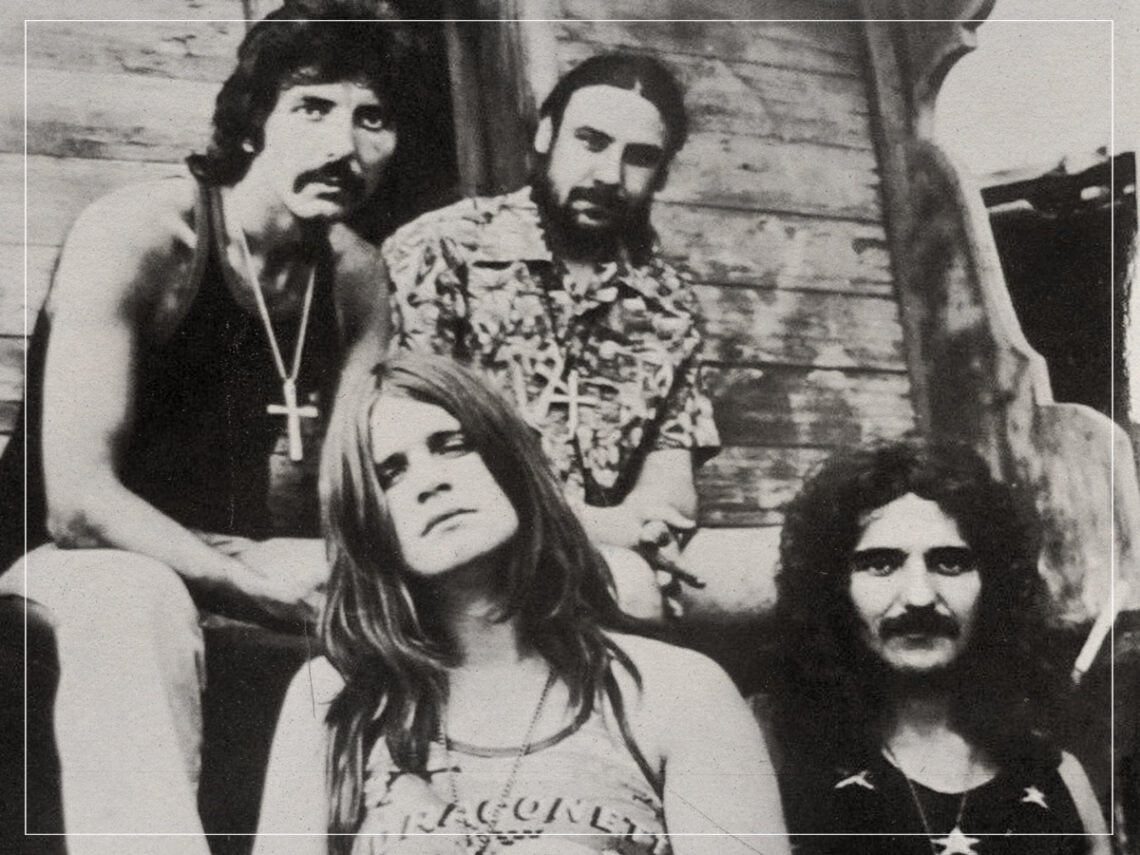
(Credits: Far Out / Warner Bros. Records)
Mon 8 December 2025 3:00, UK
In the summer of 1976, Black Sabbath were on the verge of rupturing.
Reality had been looking grim for heavy metal’s forefathers for some time: they had just finished a legal battle with their former manager, its costs merging with tax bills that seemingly never ended, their unmatched desire for drug and booze-fueled chaos was finally taking its toll, and their record sales dwindled to a modest point. Their then-latest album, 1975’s Sabotage, became a cult-like fan favourite, boasting classics such as ‘Hole in the Sky’ and ‘Symptom of the Universe’, but was marred with misfortune.
The album peaked at number 20 on both the UK and US charts, the band’s first not to reach platinum status in the latter country. Further, the touring in support of Sabotage was cut short after frontman Ozzy Osbourne suffered a motorcycle accident, rupturing a muscle in his back. Thus, Sabbath entered the studio the following year, battered and bruised, the once cathartic sense of impending doom becoming a bit too heavy to bear.
Camping out at Criteria Studios in Miami, Florida, Osbourne’s investment in Sabbath began to lessen. The intensity between him and his bandmates – guitarist Tony Iommi, bassist Geezer Butler and drummer Bill Ward – only worsened, and by the album’s completion, he ended up in Stafford County Asylum in Britain. Osbourne emphasised the overwhelm in his 2009 autobiography, I Am Ozzy. “I’d had enough,” he wrote. “There didn’t seem to be any point any more. None of us was getting on,” citing the ongoing legal issues, nonstop touring and the aftermath of drugs and alcohol.
The resulting album, Technical Ecstasy, reflected the strange realm in which Sabbath found themselves inhabiting, venturing into unfamiliar pop and soft rock territory. Debuting with even less success than its predecessor, Butler described the album to Guitar World in 2001 as “the beginning of the end… And obviously, the music was suffering; you could just feel the whole thing falling apart”.
 Ozzy Osbourne, biting a bat. (Credits: Far Out / Alamy)
The following year, in late 1977, when it came time for Sabbath to rehearse their follow-up and just before studio time was to begin, Osbourne decided he was done, abruptly walking out of a rehearsal one day and not returning.
Left to find someone who could fill Osbourne’s shoes (or, at least, attempt to), Iommi placed his faith in someone familiar, of whom he was a fan: Dave Walker. The vocalist had been a longtime friend of Sabbath’s, and a seasoned musician in his own right, having been a member of The Redcaps in the 1960s and serving subsequent tenures in The Idle Race (previously fronted by Jeff Lynne), Fleetwood Mac and Savoy Brown. After receiving a call from Iommi telling him of Osbourne’s departure, Walker left his then-band, Mistress, and flew from Birmingham to California to join Sabbath’s writing sessions.
Sabbath’s rehearsals commenced in an old mill near Rockfield Studios in Monmouth, California. “Right away they let me hear the tracks they’d been working on and told me they needed lyrics,” Walker says, in conversation with Classic Rock in 2014. “There wasn’t what I’d call one complete song, just reels of tape with little ideas on them. I wrote a shitload of lyrics, but I had no idea that Geezer was their main lyricist.” The sessions proved fruitful and, on January 8th, 1978, Walker made his live debut with Sabbath, when they appeared on the BBC West Midlands programme Look! Hear!, performing the intro to ‘War Pigs’ and a new song, ‘Junior’s Eyes’.
Yet, the show would prove to be Walker’s only with the band, who had not cut ties with their former frontman. Speaking to Classic Rock, Walker recounted a chance meeting he had with Osbourne at a pub, where the singer showed up dishevelled and shaking. “I’ve been around the block with drugs, but when I saw poor Ozzy I thought, ‘God almighty,’” he recalls. While there was no clear discussion of Osbourne’s return, Walker could feel the implications of the meeting. Worsening his stance in Sabbath was the fact that musically, they had not found their footing with the new frontman; to top it all off, Walker’s and Bill Ward’s wives did not get along.
Still, Walker’s dismissal came as somewhat of a shock. “One day I turned up where they were rehearsing near Evesham, and they were having a meeting, after which Bill told me, ‘We’re in, you’re out,” he reveals. “No warning. I still don’t even know if Ozzy had agreed to come back then.” In just a few short months, Walker went from the helm of heavy metal’s biggest band back to square one. Osbourne returned, as did Sabbath with Never Say Die!, which featured a reworked version of ‘Junior’s Eyes’. Walker continued with his eponymous band and eventually reunited with Savoy Brown, looking back on his short time with Sabbath as “kind of cool, but there was a lot left to be desired”.
As for Sabbath, Walker’s tenure was a footnote in a long, strange, heavy metal haze.
Related Topics