The year in politics ended as it began: “the bloc” domination.
During Scottsdale City Council’s last scheduled meeting of 2025, another controversial move was crammed through by council members Barry Graham, Kathy Littlefield, Jan Dubauskas and Adam Kwasman.
Veteran Councilwoman Solange Whitehead previously called those four “the bloc,” sneering at what she called bullying tactics to push through their agenda.
During the meeting that concluded a turbulent year, Whitehead took it a step further, accusing the power-wielding majority of “mucking around.”
“I am embarrassed by this council,” Whitehead proclaimed.
Whitehead and Graham will be stepping up reelection campaigns in the coming months.
At the Dec. 2 meeting, Graham laughed off suggestions of a conspiracy in proposed changes to council rules, notably revising the city’s long-standing public comments policy.
Kwasman sarcastically stated, “I made a huge mistake in admitting to the news I participated in the process – I’m not the only one, the charter officers asked us all for input.”
A laughing Graham chimed in to his colleague, “So you weren’t the mastermind behind this?”
With a shrug, Graham then downplayed the changes: “We are not here to take away public comment.”
Indeed, in comparison with Fountain Hills, which chopped down the flaming bush of non-agendized public comments, Scottsdale City Council’s actions are more of a “pruning.”
Even so, the changes were answered by prune faces of disgust, both from elected officials on the losing end of the vote and several public commenters.
The change that drew the most scrutiny, both before and after being passed by a 4-3 vote – “the bloc” for, Borowsky, Whitehead and Maryann McAllen opposed:
Instead of two “open” public comment periods, at the beginning and end of meetings, “there will be only one public comment period (non-agendized public comment) which takes place towards the end of a regular meeting instead of towards the beginning.”
Former Councilwoman Tammy Caputi, who is expected to run for reelection next year, did not speak at the Dec. 2 meeting.
However, two days later she sent out a mass email titled “Council Bloc Censors Residents.”
“Tuesday night Councilors Graham, Dubauskas, Kwasman and Littlefield censored the residents,” Caputi insisted.
Public comments
The Dec. 2 meeting began, as hundreds of Scottsdale City Council meetings before it have, with public comment “on non-agendized items that are within the Council’s jurisdiction.”
A few people reminded Council that, one year earlier, Scottsdale’s first “Sustainability Plan” was passed – only to be overturned a month later, when Kwasman and Dubauskas took office, swinging the political landscape from “liberal-leaning” to “conservative-heavy.”
In keeping with Arizona law, Scottsdale elections are “nonpartisan,” but Kwasman and Dubauskas received strong Republican support – as did Mayor Lisa Borowsky.
Following the sustainability plan repeal protestors, former Councilwoman Linda Milhaven, who failed in a 2024 run for mayor, congratulated those who approved the Nov. 18 Axon deal.
She accused Littlefield, Graham and Dubauskas — who opposed the deal — of twisting the truth.
“You completely misrepresent what’s going on here,” Milhaven said. “You took away the people’s vote, you forced Axon to go to the Legislature.”
Yvonne Cahill, who briefly was on Borowsky’s staff, also offered non-agendized public comment. She slammed the bloc-led change of a North Scottsdale intersection from a state-funded roundabout to a signalized intersection with undetermined funding.
Millions of dollars in ncreased costs, she claimed, “were deliberately hidden.”
“I hope in the new year,” Cahill concluded, “the council will be more transparent.”
In all, a half dozen citizens spoke at the beginning of the meeting.
Starting in January, those desiring to express general opinions on items not on the agenda will have to wait until the end of the meeting.
Running time of the Dec. 2 meeting: Five hours.
Changes
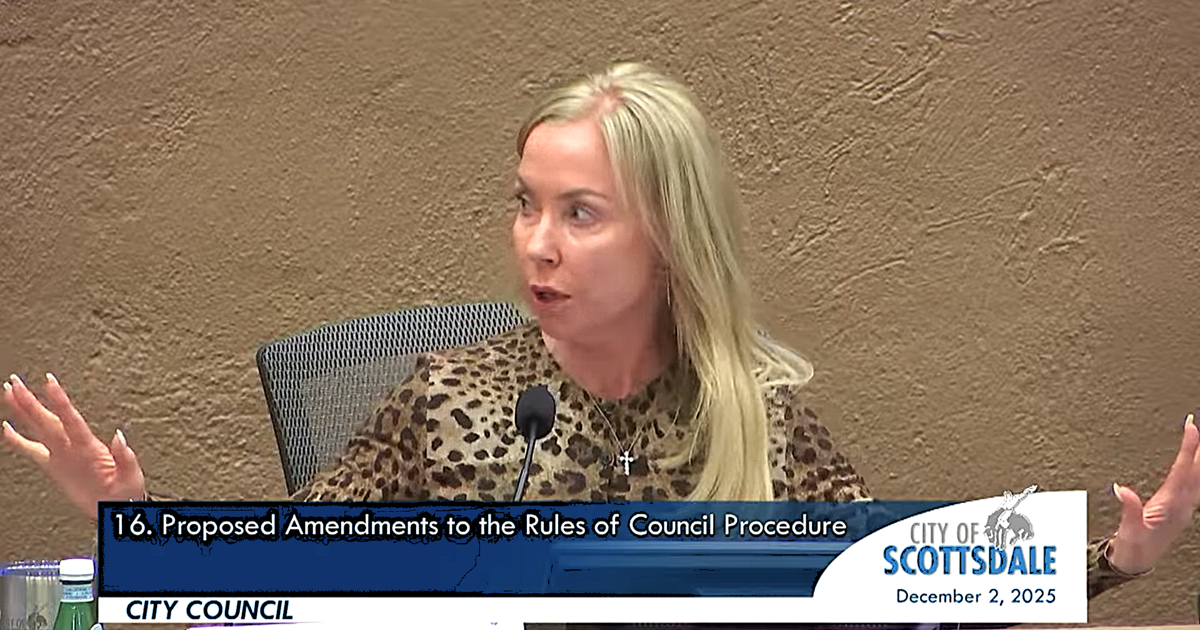
Following the public comment period and consent agenda items, which were considered as a whole without individual discussion, Borowsky moved on to agenda item 16, “Proposed Amendments to the Rules of Council Procedure.”
Before the vote, more public comment was taken, this time on the “agendized item.”
Steve Sutton, who offers critique at nearly every meeting, called the moves to change public comment procedure “rhetorical political suicide one council member has constructed that could blow up the council.”
He called out Kwasman for “deliberately lying to manipulate Scottsdale residents.”
Up next was Raoul Zubia, who plans a run for council next year. He said the proposed moves “create more distance between residents and council.”
Milhaven and Cahill returned to the microphone, echoing criticism of the proposed changes to public comment.
Milhaven was not gentle in her criticism, though her conclusion was politely framed: “Please do not limit public participation.”
Some might find irony in the idea that, in an effort to “streamline” meetings, council members then spent two and a half hours hashing out what changes would be made.
“This is getting to be a comedy of errors,” Whitehead said, late in the long meeting.
According to a memo from Luis Santaella, the interim city attorney, the proposed changes were to “Improve transparency, civility, decorum and public participation” and “streamline council operations and agenda management.
“These updates,” Santaella added, “are based on feedback from councilmembers and city staff and are intended to make our meetings more efficient, civil, and legally sound.”
At one point in the lengthy, sidetracking debate, Graham said, “residents already tell us … they don’t feel respected by many decisions that have been made by council.”
Whitehead would say for good reason – she decried the idea of getting rid of the beginning-of-meetings public comment period.
“We have tonight eliminated the ability for most people in the city of Scottsdale to come to City Council meetings and speak,” Whitehead cried out, facing – again – the losing end of a key vote.
“This is a city that has been driven by resident priorities. Putting them last and all this mucking around is simply an effort to shut down people that oppose some of the actions of this council.”
Kwasman said he was “eyerolling” Whitehead’s comments.
“You can tell who’s running for office,” Kwasman added, “when you make these dramatic statements about ‘democracy.’”
Borowsky blast
Hours after the Dec. 2 meeting that changed City Council’s public comment procedure, Mayor Lisa Borowsky sent out an email blast titled “Bait-and-Switch: How the Scottsdale City Council majority betrayed the public trust.”
Before the meeting, she said, “My office received an overwhelming number of emails from our constituents demanding public comment at council meetings not be infringed upon.”
She said council members Barry Graham, Kathy Littlefield and Jan Dubauskas “all swore not to reduce public comment … they are hoping you will swallow their ‘bait-and-switch’ that they actually expanded public comment time.”
The mayor called out a “game of adding two public comment speakers while depriving all speakers of a reasonable and predictable opportunity to speak.”
The three representatives named above and Adam Kwasman voted to put non-agendized public comment at the end of meetings.
If that policy was in place Dec. 2, Borowsky noted, “those wishing to address the council would have had to wait until 10 p.m.”