In an editorial, Harvard University’s Graduate School of Design urban design student Drew Noorily gives his take on Hoboken’s flood resiliency efforts.
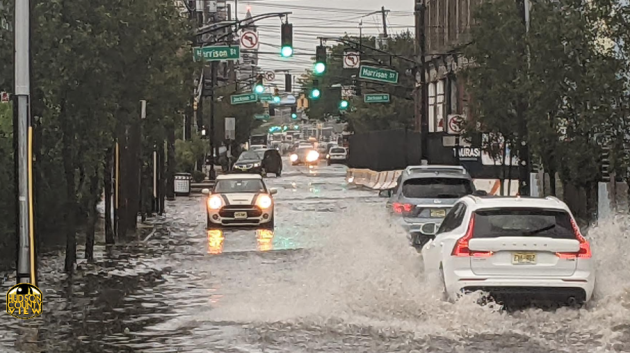
The storm this past October did not look dramatic at first. A steady gray curtain moved across Hoboken and people did what they always do. They pulled up their hoods, walked faster down Washington Street, and checked the radar every few blocks.
The first puddles formed at Third and Willow then spread across the crosswalks until the painted stripes disappeared.
Cars slowed into cautious arcs and people stepped off curbs into water that crept up their shoes. Everyone recognized the moment. The streets were becoming the marsh they once were.
Hoboken’s flooding is not a surprise. It is geography. The city sits like a shallow bowl, higher along the riverfront and lower toward its center. Stormwater moves downhill and gathers where it always has.
Built on reclaimed wetlands, Hoboken remembers its origins whenever it rains. The flooding is not a glitch. It is the base condition.
After Hurricane Sandy submerged most of the city, Hoboken became a national test site for climate resilience. Through the Rebuild by Design competition the globally renowned firm OMA proposed a system to let Hoboken live with water.
Their plan, titled Resist-Delay-Store-Discharge, treated the city as a hydrological landscape. The project was awarded about $230 million in federal funds.
While some sources cite additional private/state contributions and higher overall cost estimates (between $200–$300 million) the core funding number remains well established.
What made OMA’s proposal different was that it treated resilience as part of the city’s lived space rather than hidden machinery. Waterfront berms were designed as promenades, parks became temporary reservoirs, and streets slowed rather than accelerated runoff.
The approach echoed SCAPE’s founder and landscape architect Kate Orff’s belief that “we cannot retreat from nature. We must embed ourselves within it.”
OMA’s vision asked Hoboken to meet water in public space instead of burying it in pipes, because resilience is something people must live with, not simply engineer out of sight.
As the plan moved into local politics, it fractured. Lawsuits challenged waterfront elevations. Budget changes cut or delayed key segments. Funding came in phases. Every compromise reduced the system’s coherence.
Today Hoboken has components of the plan: detention tanks in parks, upgraded valves and pumps. But heavy storms still flood the same streets. Residents do not care whether a block is part of “planned detention.” It’s water in the wrong place.
And increasingly the issue is not just on the surface. In September 2025 the city issued a city-wide boiling water advisory after the main water breaks caused pressure loss and raised concerns of contamination.
The advisory was lifted two days later once tests confirmed the water safe. Even so, the message sent chills: a city that cannot fully control the water outside now could not guarantee the water inside. The boundary between climate risk and daily life vanished.
Urbanist Jane Jacobs believed cities serve everyone only when they are created by everyone. Hoboken’s residents, officials, and developers must face that resilience is not an add-on.
The city cannot keep marketing river views, ground floor retail, and mid-rise density while ignoring what safety requires.
Hoboken needs a continuous waterfront edge built as civic infrastructure, new buildings rising above flood elevations, and low lots converted into real green space.
Residents already adapt. They know which intersections fail first, which basements flood deepest. Hoboken promised resilience more than a decade ago.
To honor that promise the city must stop stitching fragments and build the complete system its geography has been demanding. The storms will continue to arrive.
The question is whether Hoboken keeps reacting to each one as a surprise or finally builds the city its geography has been quietly demanding all along.
Drew Noorily is a New Jersey native, licensed architect, and urban design student at Harvard University’s Graduate School of Design. His interests explore how cities can adapt to climate challenges and create fairer futures, placing design at the center of meaningful change.