We’re all familiar with La Jolla’s sea lions, harbor seals, orcas, garibaldi and seabirds. But in this series of stories called Species of the Month, the Light sheds light on other, lesser-known marine creatures in local waters, their role in the ecosystem and more.
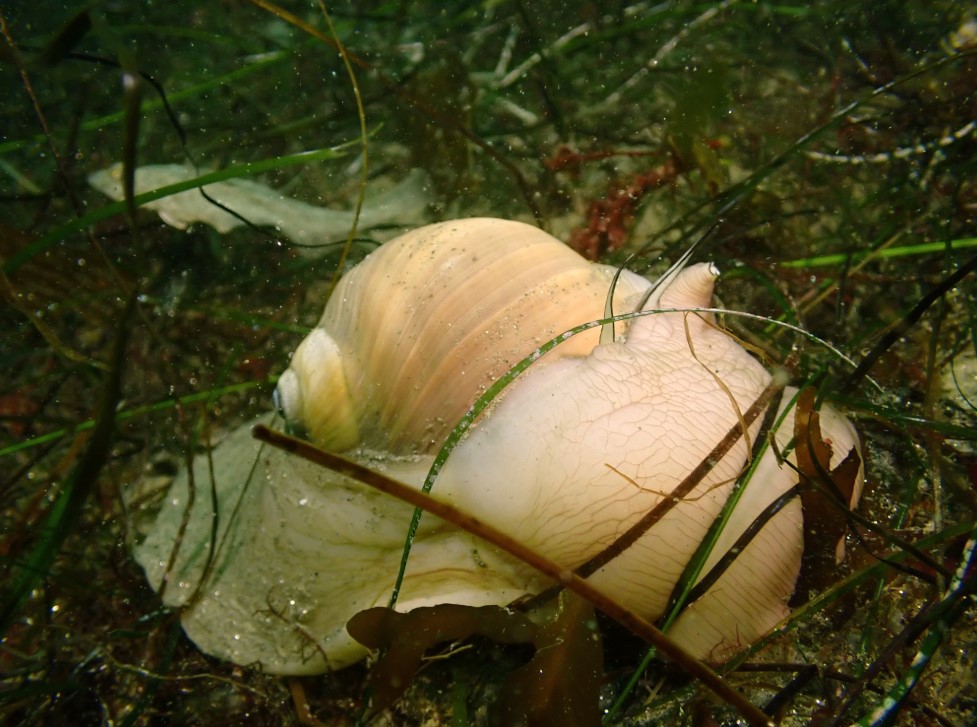
With a shell that looks like a full moon, egg cases that look like broken pottery on the seafloor, a unique predatory style and even a feature comparable belly button, the moon snail that frequents La Jolla waters has been described by researchers as “impressive” and “distinctive” within the local ecosystem.
“The snails themselves can get huge, like grapefruit sized,” said Charlotte Seid, manager of the Benthic Invertebrate Collection at UC San Diego’s Scripps Institution of Oceanography in La Jolla. “They have a very thick round shell. They are distinctive and look like a full moon. The rest of the animal is fleshy…has a huge muscular foot and can propel itself to glide along the sea floor.”
While hunting on the seafloor, she added, “It has a special structure on the front that acts like a snow plow. But the moon snail is a sand plow, so you’ll see it push sand out of the way and sniff out chemical cues from their food.”
While not harmful to humans, Seid said the moon snail is a predator that uses slow and methodical processes to consume clams and other snails.
“They eat their prey very slowly and very creatively,” Seid said. “Moon snails have a tongue that is raspy like a cat tongue. They don’t have fangs or anything scary, but it is a slow way to drill a hole into another shelled creature. They are very patient. They will lick and lick and lick until it makes a hole in the shell,”
Next, they’ll extract the animal out of its shell.
“Sometimes you see shells with holes in them,” she continued. “That’s the work of the moon snail.”
While a predator for smaller creatures, the moon snail is also prey for other snails and possibly rays and octopuses. Thus, Seid said they bury themselves in the sand as a way to hide.
Moon snails have tentacles on their heads with small black tips used to sense predators, so when the snail is buried in the sand, only those tentacles are visible. They are also capable of closing their whole body into its shell if needed.
“The shell is really big, but they are just really good at squishing themselves,” Seid said. “Like a sponge, they can take on water and then squeeze it out when they need to fit into the shell. The shell also has a trap door structure to close the opening to seal the deal.”
However, Seid notes that when moon snails get large enough, they don’t have many natural predators. With a lifespan of at least 14 years, the snails reproduce with egg sacks that look like broken pottery on the seafloor.
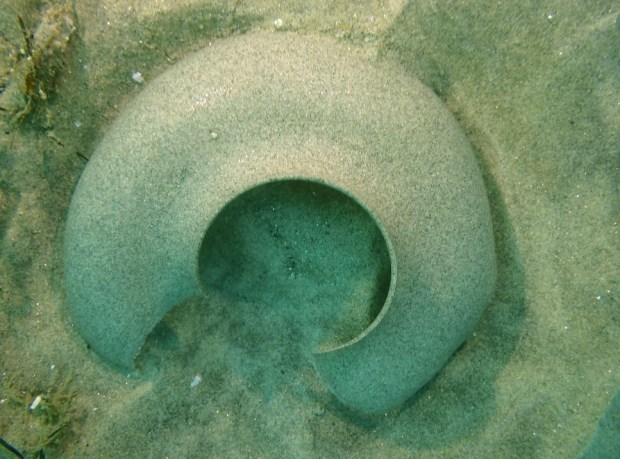 An egg case from the moon snail, as documented near La Jolla. (Charlotte Seid)
“The egg cases don’t go in a perfect circle and while they look broken, [they] are not,” Seid said, adding that each egg case can hold thousands of eggs, each one microscopic in size. When the eggs hatch, the larvae drift in the ocean like plankton until they reach a certain size, and then fall back down to the seafloor.
Because these egg cases can also float to the surface, should one be found on the beach, Seid advises throwing it gently back into the ocean.
“They have a rubbery, flexible texture, so they won’t fall apart if you are gentle,” she said. “They are used to surges and wave action, so they can go into the surf or even deeper.”
While there are different types of moon snails, the ones found off La Jolla are considered distinguishable because of a feature comparable to a belly button.
“If you see a moon snail or the shell, you can find in the middle of the coil there is an inward pointing belly button,” Seid said. “Some species don’t have that or it is covered up or it is partially closed.”
The local moon snails are also one of the largest of their species.
“I think they are stately and impressive when I encounter them as a diver,” Seid said. “Having the largest moon snail is a point of pride in California.”