
A few hours before this column was to run Friday morning, I received an email. Charlie Brown, the man with whom I’d spent Wednesday afternoon in the storm tunnels beneath Harry Hines Boulevard, was nowhere to be found.
That missive came from Garrett Boone, the 82-year-old co-founder of the Container Store who has spent years cleaning up and greening up a part of Dallas into which the city has shoved every sin and shame it hopes to hide. Brown, who until recently had lived for five years in those storm tunnels, hadn’t shown up at his North Dallas apartment for an important Thursday morning meeting with Boone and a disability case manager.
Charlie gets around by bicycle despite his worsening glaucoma. And he’d “gone completely missing,” Boone wrote early Friday morning. “Apparently he didn’t make it home after he talked to you.” His cellphone went straight to voicemail.
Boone feared the worst for his friend, so we spent Friday and Saturday searching every drainage tunnel and tent-filled, trash-strewn encampment spread across northwest Dallas, two grown men shouting into the cold and the dark, “Charlie Brown! Charlie Brown!”
Boone had introduced me to Charlie Brown — his real name — as the man he charged in 2023 with collecting the refuse of the unsheltered living in the city just beneath the city. Boone found Brown living in the tunnels beneath Harry Hines near Walnut Hill Lane and offered him cash to clean up the canals and creeks where refuse fouls the water and the shores of the Elm Fork of the Trinity River.
Opinion
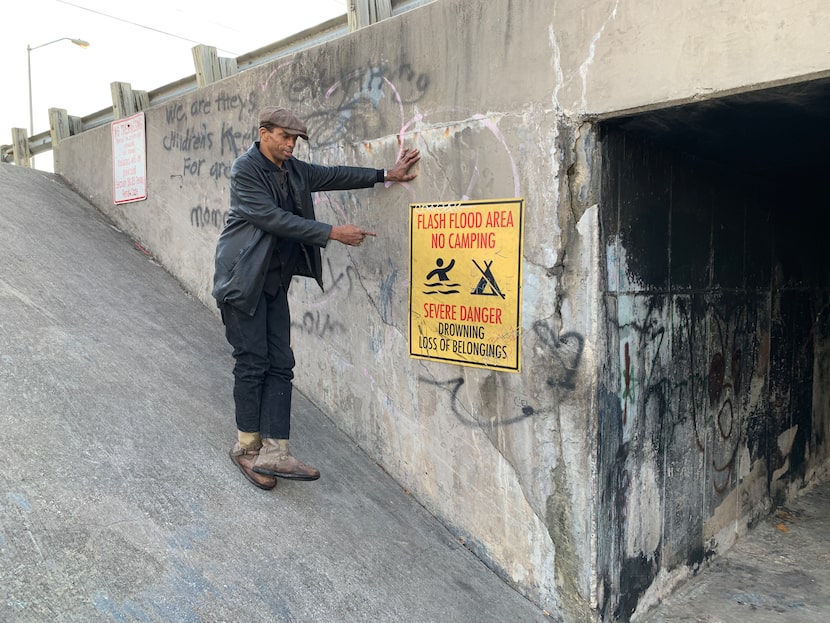
Charlie Brown and the sign Garrett Boone had made to warn people of the dangers that come with living in the Harry Hines tunnels.
Robert Wilonsky
Everyone knows Boone down here, the beloved “Mister Garrett” who, for years, has begged City Hall to mend the waterways and mind those living among them. “I got involved because I saw my city needed help,” Boone said. And in northwest Dallas, Boone reminded, the environment and the homeless are inextricably intertwined.
“Charlie’s just so good with people,” Boone had told me before I met Brown last week for what was to have been a profile of a man who’d escaped the tunnels. “Charlie’s respected. And he’s a kind man. He did what I wanted him to do. I love him like a brother. But he also drives me crazy like a brother.”
Boone also pays Brown to warn the unsheltered in the tunnels and along the creeks whenever rain approaches. The 52-year-old Brown calls himself a “prevention specialist.”
How he landed here is a story that begins behind a 7-Eleven in Oklahoma City, where his mother abandoned him in a cardboard box, Boone told me. Brown said he sold meth at 10 and went to prison, then got his associate’s degree in psychology from a community college outside Oklahoma City. He moved to Dallas to work in the cold-storage unit at Garland warehouse, where he said he caught the sniffles at a bad time — just as COVID hit.
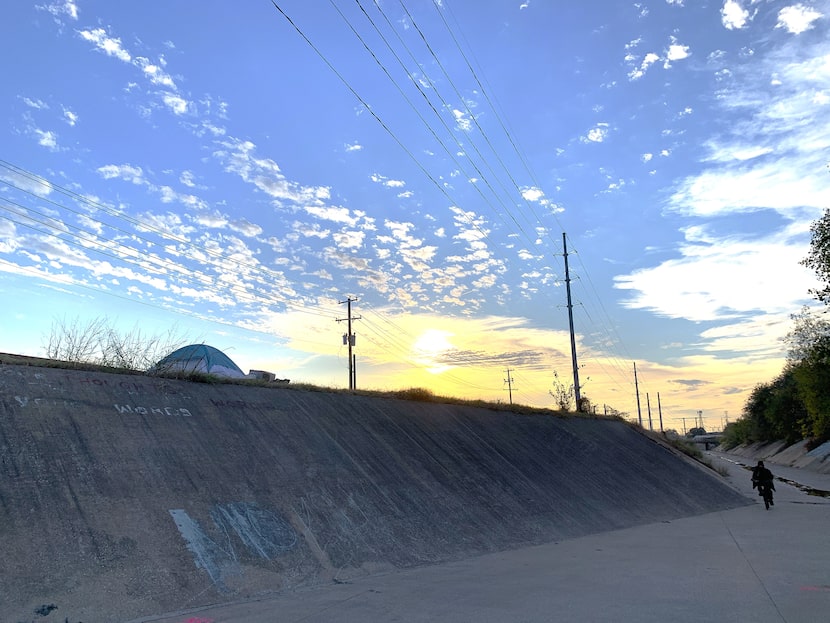
Doug’s tent, perched above the tunnels that run beneath Harry Hines Boulevard near Walnut Hill lane.
Robert Wilonsky
He was sent home, he said, and told not to come back. When he was no longer able to pay rent, a friend told him of a place to stay.
“I thought he meant another house or something, but he meant these tunnels,” Brown said last week. “And if it hadn’t been for guys named Mike and Billy, I would’ve never made it. They taught me where to go for food, where to go get clothes, stuff like that. And they brought me a box. I slept in a box for the first two weeks I was out here.”
He now has an apartment near Spring Valley Road and North Central Expressway, which he said has been broken into five times. And, yeah, it’s horrible, but not as horrible as having to rebuild your life every time it rains hard.
There are six square stormwater tunnels beneath Harry Hines near Walnut Hill, each numbered by the longtimers, beginning with the southernmost Tunnel One, its graffiti-covered insides charred by fires lit on cold nights. Lucky Brown, no relation, and his girlfriend, who goes by Chocolate, have lived in Tunnel Two for almost nine years and are awaiting promised placement in housing, though when, they do not know.

Charlie Brown surveyed the belongings left in Tunnel One beneath Harry Hines Boulevard.
Robert Wilonsky
I asked how they could live down here for so long. Lucky shrugged.
“After a certain period of time,” he said, “I guess I got content with the situation.”
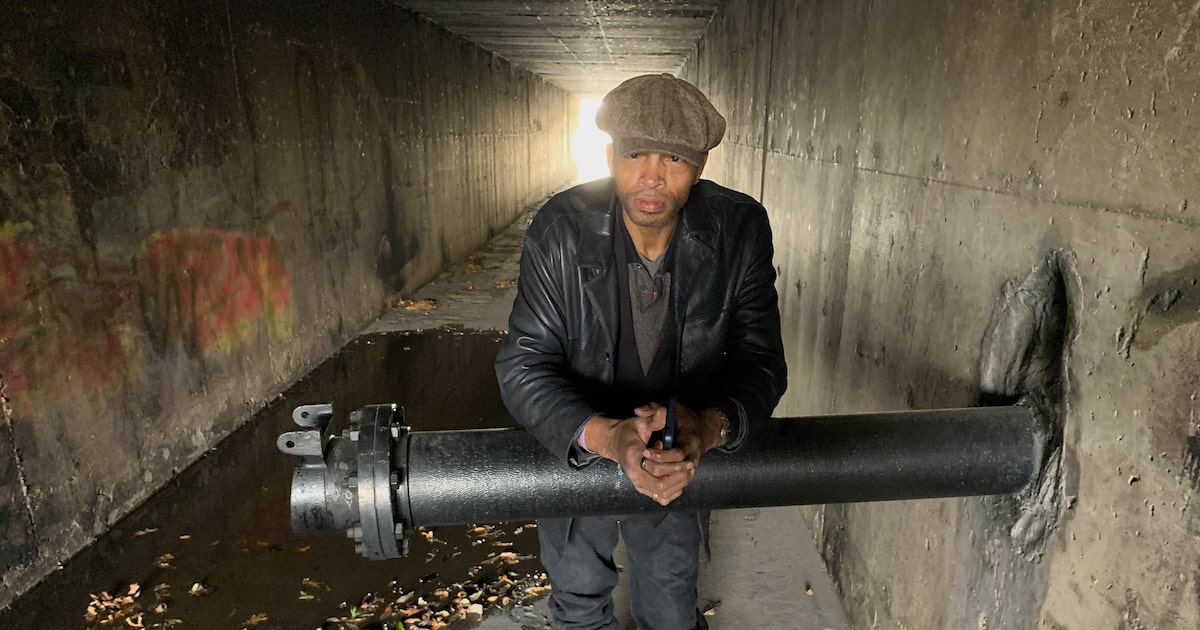
Charlie Brown lived in Tunnel Six, where a black pipe juts out of the wall.
“I can’t count how many times this saved my life,” Brown said, patting it as one might an old friend. He wore a leather blazer and flat ivy cap, picked out by a woman named China who lives elsewhere in these canals.
“When the water came, I would chain my shopping cart to this pipe,” Brown said. “I would sleep on it, too. It was crazy and dangerous. But, look, man, when I came down here, I thought I was bulletproof. I was a pretty egotistical, narcissistic type of guy. I sold a lot of drugs. I mean, I was at the top of the trash heap.”
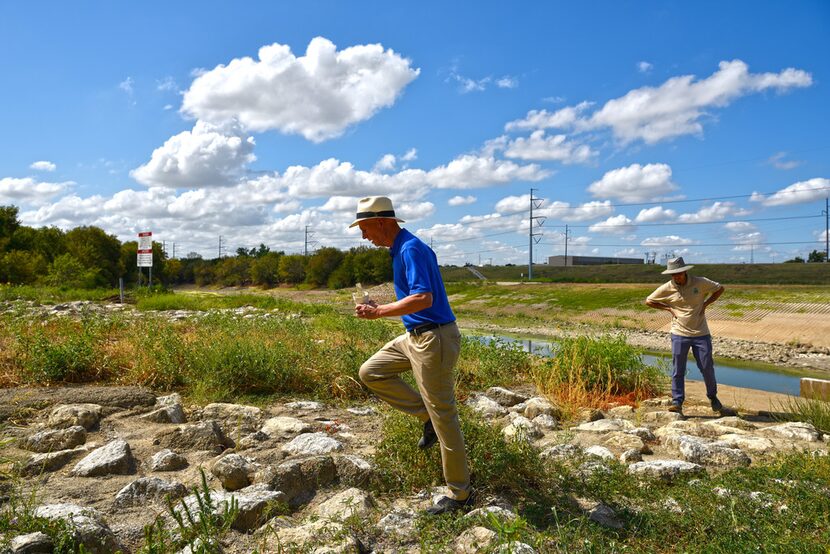
Garrett Boone carries litter he calls a “Trinity River cocktail” collected during his walk along the Frasier Dam, which he spent year cleaning up.
Ben Torres / Special Contributor
He pointed with pride to the yellow “No Camping” signs, which Boone made to warn residents of the flash flooding. I asked Brown when he found out who Boone was.
“When I Googled him,” he said. Brown smiled, sort of, hiding the fact he’d lost most of his teeth to meth.
“And I’m like, what is he doing down here? He’s doing something he finally wanted to do instead of something he had to do, you know what I mean? And he gave me something I can believe in, man, something I can feel good about. It’s called self-worth for a reason. You can’t give yourself that. I was like, well, man, somebody believed in me.”
Brown has gone radio silent plenty of times. But his disappearance Thursday troubled Boone, who had repeatedly stressed to Charlie how important the meeting with the caseworker was. Brown told him, repeatedly, he’d be there.
Boone and I spent Friday morning walking the tunnels and driving the canals from Harry Hines to Stemmons. A man named Doug, living in a blue tent perched just above the tunnels, said he hadn’t seen him since Wednesday evening. Doug also does work for Boone. He said he’s lived here for more than six years and was waiting for an apartment for which he’d been short-listed long ago.
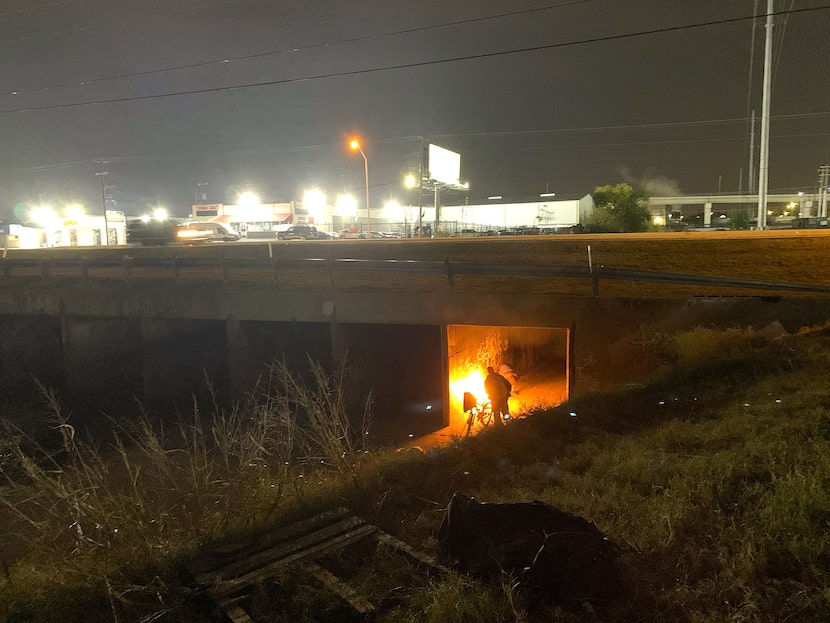
Late Friday night, a woman living beneath Harry Hines Boulevard lit a fire beneath Tunnel One to keep warm.
Robert Wilonsky
Doug’s buddy Brian said he’d seen Charlie around 3 Friday morning. They suggested we try Ernest and China, who live in the tents above the tunnels where Southwell Road dead-ends into Stemmons. Or maybe Leann, who has one of the tents in the increasingly crowded, fetid field — which Dallas Central Appraisal District says is owned by the Million Dollar Saloon — behind a Shell station and liquor store on Walnut Hill west of Stemmons. Or maybe Jennifer, who’s tucked away somewhere near Parker College. And had we tried The Slab?
Everyone we saw knew Charlie Brown, because everybody knows everybody in the city under the city. But they hadn’t seen him.
I retraced our route Friday afternoon then again later that night, when the cold landscape was illuminated by campfires. The woman called China, so named because she is Chinese, said she’d seen Brown behind the Shell station a few hours earlier. As we spoke above the Southwell tunnels, a man on a bicycle pulled up looking for weed. He wore a hoodie. His right eye was missing its iris. I asked if he’d seen Charlie Brown.
“Yeah,” he said, “in Terry’s trailer, way back behind the Shell station along the creek.”
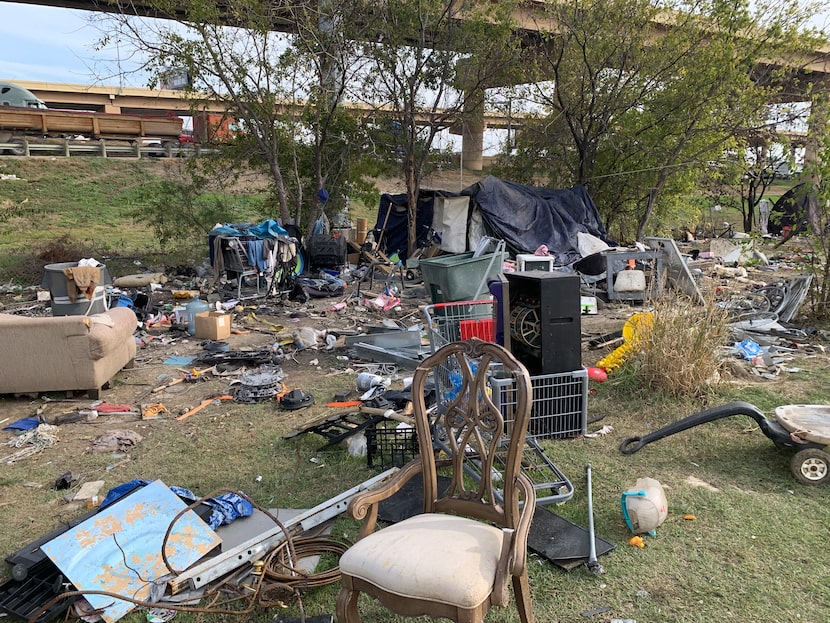
Behind the Shell station off Walnut Hill Lane, along North Stemmons Freeway, a tent city grows, and the trash along with it.
Robert Wilonsky
I headed home around 2:30 Saturday morning. Six hours later, Boone said Charlie just texted, claiming to have been kidnapped and just turned loose. Boone was skeptical, more so when Brown didn’t arrive at the tunnels by 11 a.m.
We went back to the field, which sits in the shadow of the Target Sortation Center on Goodnight Lane, where, Boone said, the population has exploded in recent months. A man said Charlie Brown was in Terry’s trailer.
“Yeah, he’s asleep on the couch,” said a young woman named Lindsey, wearing a Lilo & Stitch long-sleeved T-shirt. Brown’s bike leaned against the trailer. Lindsey’s a new arrival from Irving who, like so many others, said someone from the city had promised her an apartment, too. She rousted Brown, who now wore a fireman’s coat and Lindsey’s replica leather football helmet.
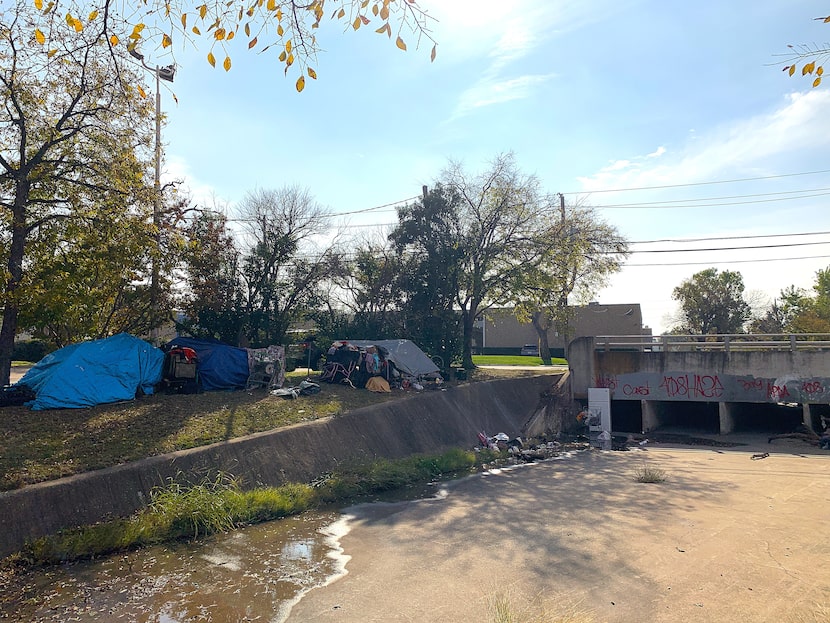
When Charlie went missing last week, Garrett Boone was told to ask a woman named China and a man named Ernest living in the tents above the Southwell Road tunnels.
Robert Wilonsky
Boone was angry Charlie had missed the meeting; Brown insisted he’d tried to make it until he was abducted. They argued like brothers who’d grown frustrated with and weary of each other. Brown told Boone, look, he appreciated his concern, but he doesn’t know, not really, what happens out here.
“You don’t see any kids around here,” Brown shouted as we stood in the field. “This isn’t a place for children. This is a grown man’s place where grown man s— happens.”
Boone finally relented, then handed Brown some cash and told him to get home, find a photo ID and sign that paperwork. Brown said he would, and went to fetch his bike. By Monday morning, Boone said, Charlie seemed to be back on track, for now. But Boone said he was spent, too, from trying to help one man among the more than 3,000 unsheltered in Dallas County.
As we turned to leave the field, Boone and I walked past two large threadbare candy canes made of tinsel, propped against a green sign displayed amid the tents and the trash. It read, “Merry Christmas.”

A sign of the coming holiday in the field behind the Shell station off Walnut Hill Lane in the shadow of North Stemmons Freeway
Robert Wilonsky