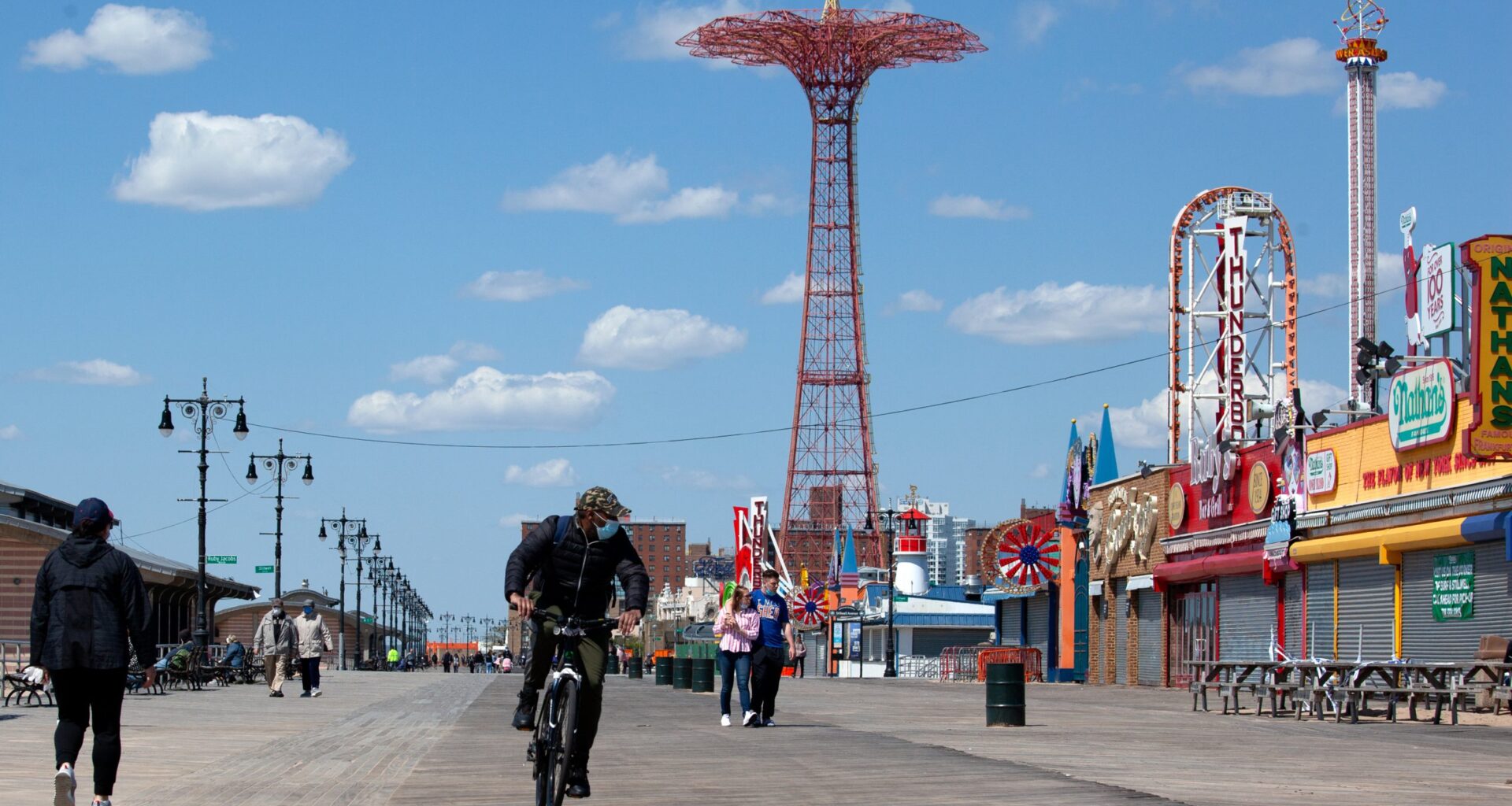
The Riegelmann Boardwalk in Coney Island will get a $1 billion makeover.
As part of the full reconstruction of the nearly three-mile-long boardwalk, the Parks Department will partner with the Economic Development Corporation to replace the utilities and structural piles and elevate the walkway in some places.
The complete project also includes improving adjacent access points to the boardwalk with ramps and plazas, and renovating more than a dozen adjacent buildings that house lifeguard stations and public restrooms.
“This is really our opportunity to look at the whole 2.5 miles together as one piece,” said Grace Tang, a Parks program director, at a Brooklyn Community Board 13 meeting Monday night.
The Mayor’s Office of Management and Budget in September earmarked the capital funds for the project through 2032. Mayor Eric Adams in February noted the boardwalk’s reconstruction as part of a larger initiative to redevelop the neighborhood, with plans for 1,500 new apartments, and the renovation of the Abe Stark Sports Center.
Construction is many years away with design for the new boardwalk yet to begin. The EDC plans to issue a request for proposals for the project early next year.
The work will take place in phases, across years, to allow the public access to the beach, said Brooklyn Parks Commissioner Marty Maher. He estimated that community input sessions would start in two years.
Coney Island, famous for its rollercoasters and ferris wheel, has been the site of much new development in recent years — though it missed becoming the home of a proposed casino. But the 102-year-old boardwalk has long been in need of repairs.
Its support beams and concrete piles have cracked; the wood rotted in some areas. Locals have long called for upgrades, decrying the boardwalk’s loose screws, gaping holes and uneven planks.
The team of Parks Department carpenters that makes ongoing repairs to the boardwalk and replaces deteriorating boards has tackled just about 1% of the boardwalk, said Maher.
Parks has taken a couple bigger swings at more significant chunks of the boardwalk. Following 2012’s Hurricane Sandy, which badly damaged the boardwalk, Parks reconstructed a five-block section of the boardwalk almost a decade ago, replacing the wooden stretch with plastic and concrete much to the dismay of some locals. (The material for the new boardwalk hasn’t been decided on yet.)
In the meantime, Parks is continuing a project to reconstruct another three blocks of the boardwalk.
“That particular section of the boardwalk is likely the worst,” Maher said.
The reconstructed boardwalk will also enhance the flood resilience of Brighton Beach and Coney Island. Certain parts of the boardwalk — already on the highest point of the Coney Island peninsula — could be raised higher.
The Parks Department floated an idea to create upper and lower tiers of the boardwalk in the reconstruction. That would involve keeping some parts of the boardwalk on lower tiers, with steps or ramps as much as 30 inches up to connect to higher tiers.
Parks officials said the elevation would not block views of the beach and would be in alignment with possible future coastal flood protection plans from the federal Army Corps of Engineers.
One area resident, Abby Jordan, said she would like to see flood resilience elements for the boardwalk resemble those in the Rockaways, with beach grass to fortify sand dunes along with an elevated boardwalk.
“It would be a dream that would hopefully see something that is hybrid, holistic, meets the points of being able to work with nature-based solutions, but then also meets the points of maintaining a historic amusement district,” Jordan said.
Several locals expressed concerns that the earmarked money could go away as mayoral administrations change.
“If at all the contingency comes where that money starts to disappear partially, the Coney Island community would stand up and say no,” said Daniel Murphy, executive director of the Alliance for Coney Island. “I don’t know how we’re gonna spend it, but I know we’re gonna spend it.”
Related