The ever-evolving identity of the Fort Worth Convention Center took on its newest dimension Monday morning with yet more overhauls planned.
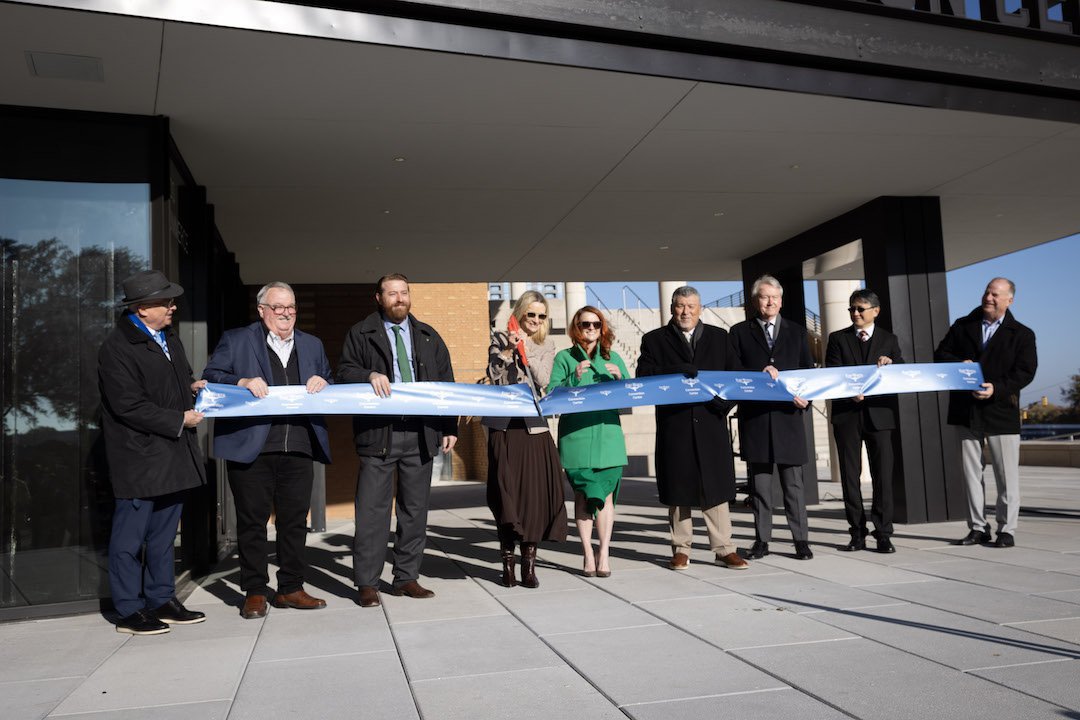
Civic leaders cut the ribbon on the first phase of the convention center renovation project, part of the city’s wider economic development strategy to attract meetings from across the state and country.
“Fort Worth provides the Texas experience that meeting planners want, and the Phase I convention center expansion and modernization exceed those expectations,” said Mayor Mattie Parker. “This milestone, along with Phase II construction, will increase capacity to host conferences from across the nation, bolstering our already impressive convention and tourism industry.”
In addition to Parker, speakers included District 9 City Councilmember Elizabeth Beck, the city’s Public Events Director Mike Crum, and Bob Jameson, Visit Fort Worth president and CEO.
The expansion is taking place in two phases, and the facility is remaining operational during both. Totaling 76,794 square feet, the $95 million Phase I includes a grand southeast entrance and terrace, state-of-the-art food and beverage facilities, a retail coffee bar for casual networking, 11 new loading docks (up from seven), and the realignment of Commerce Street to create a site pad for a future convention hotel and additional retail or restaurants.
The project emphasizes pedestrian access and improving the area’s walkability and connection to the surrounding neighborhood, which includes the Water Gardens, Trinity Metro Central Station, the new Texas A&M Fort Worth campus, and surrounding hotels.
Thompson, Ventulett, Stainback & Associates Inc. teamed with local firm Bennett Partners to deliver design and construction administration services. AECOM Hunt, Byrne Construction Services, and E.J. Smith Construction served as construction manager at risk.
Phase I was backed by $52 million in federal pandemic-era stimulus funds and another $43 million in debt. Revenue generated by the city’s voter-approved hotel tax rate, passed in May 2024, will cover the debt service and help fund Phase II.
The complex opened as the Tarrant County Convention Center in 1968 at a cost of $18 million ($168 million today), covering 12 city blocks, with an extra 3½ blocks to the west for surface parking. It was a win-win proposition, considering the first order of business was the demolition of 16 blocks of blight in this section of “lower downtown.” It was a “perpetual headache” for police, fire, building, and public health officials.
The all-purpose floor, with pipes built beneath it, could be converted into an 85-by-200-foot ice rink. The Ice Capades was the first show in the arena.
The complex’s identity went through a couple of complicated iterations. Sometime in the 1980s, the county leased the facility to the city for $1, and it became the Tarrant County–Fort Worth Convention Center. A judge later ruled that arrangement unconstitutional, saying the lease amounted to an improper gift from the county to the city.
Another arrangement was worked out until the city ultimately purchased the complex from the county for $16 million in 1997. That set the stage for a major makeover in the aughts, which included demolishing the theater to add convention space.
Tourism today is a $3.5 billion industry for Fort Worth and one of its largest employers, with more than 30,000 jobs, according to Visit Fort Worth. In 2024, Fort Worth welcomed 11.5 million visitors, generating $251 million in state and local taxes. The convention center expansion is part of the city’s larger economic development strategy to attract meetings from across the state and nation.
“This is only the first step in a bolder future for Fort Worth as a convention destination,” said Crum. “We’ve delivered Phase 1 on budget and on time, and design is almost complete for the second phase of expansion and modernization. We will have floor plans and renderings to share within the next few months that will illustrate big horizons ahead for Fort Worth’s meeting business.”
Phase II construction, estimated at $606 million, is anticipated to begin in late 2026 and run through early 2030.
It will include a scheduled appointment for the arena — with a wrecking ball. It will be a sad but fully necessary event, progress being what it is.
Lots of life has been lived in that arena.