
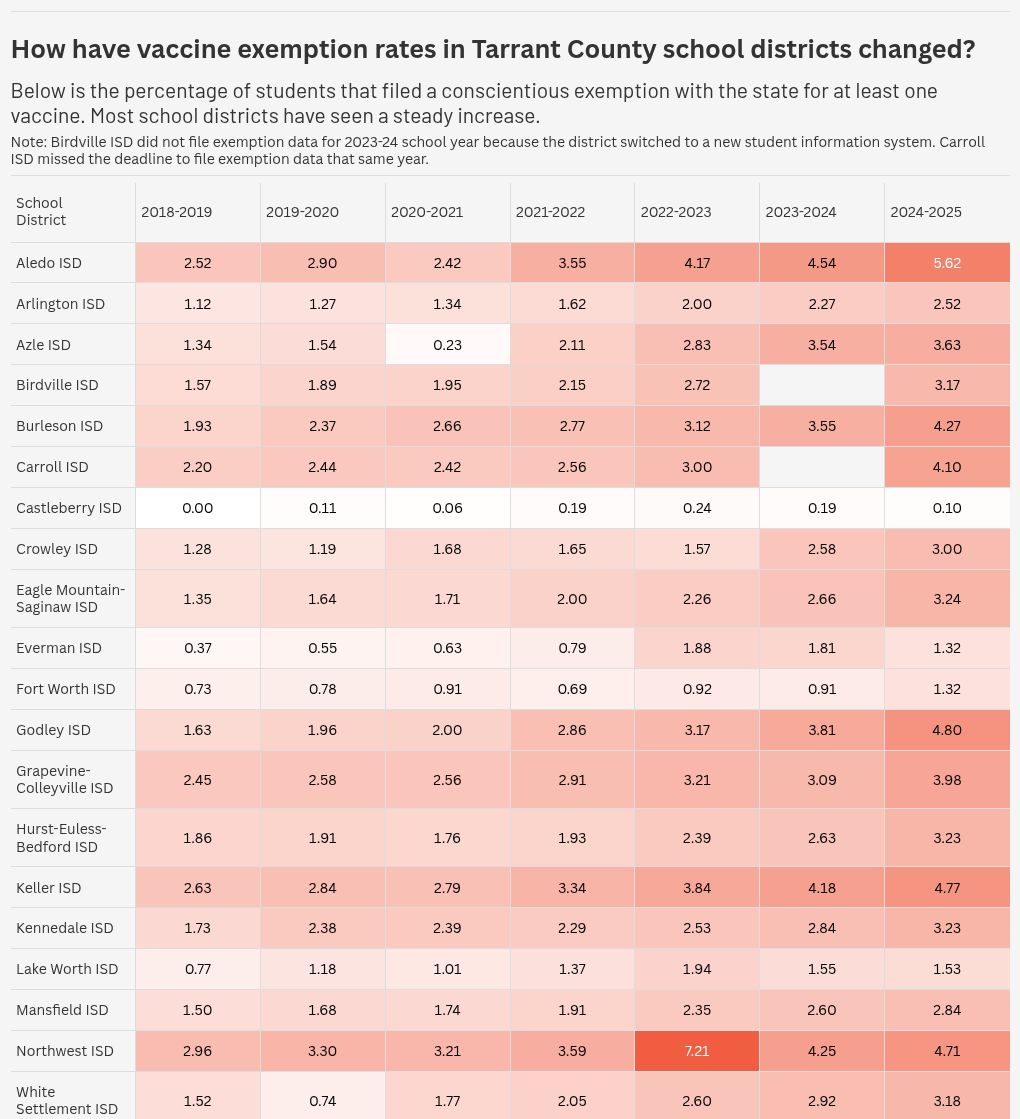
All school districts in Tarrant County saw an increase in students filing vaccine exemptions during the past seven years. Now a new Texas law makes it easier for families to seek such exemptions from state vaccination mandates.
In the 2024-25 school year, 14 of the 20 school districts in Tarrant County had a vaccine exemption rate of 3% or higher for all students, according to data from the Texas Health and Human Services agency. However, the relatively low percentage reflects a significant difference from 2018, when no district in the county had a rate higher than 3%.
Rekha Lakshmanan, executive director of the Houston-based Immunization Partnership, said the continued increase in the exemption rate places children at risk.
“The more kids that are not fully protected, the higher the risk of a vaccine-preventable outbreak happening,” Lakshmanan said.
Texas is one of 19 states in the country that allow students to file vaccine exemptions for medical, religious and personal reasons as of May 2024, according to Immunize.org.
State law does not define what personal beliefs, phrased as “reasons of conscience,” constitute.
What reasons qualify a Texas student for a vaccine exemption?
- If the vaccine is not safe for the student.
- If the student is in the military.
- If the student has a religious or personal belief causing them to object to vaccinations.
Increasing exemption rates are not exclusive to Tarrant County. Lakshmanan said the Immunization Project, a national advocacy nonprofit pushing for increased awareness of the health benefits of vaccines, has tracked a steady increase in exemption rates in Texas over the last 20 years.
Lakshmanan said the increase in unvaccinated students is likely to continue with a resulting “big spike” in the 2025-26 school year data, which will be published next year.
Dr. Brian Byrd, health director for Tarrant County, said it’s “too early to say” whether or not the new law will lead to an increase in vaccine exemptions.
Previously, the process for parents to file a conscientious exemption form with the school district was more complex. Parents had to ask the Texas Department of State Health Services to mail them the form.
On Sept. 1, a new Texas law went into effect that allows parents to download the form directly from the state agency’s website. Families can fill it out, have the form notarized and then submit it to the school nurse. The exemption is valid for two years.
The process that previously took about a month can now be completed within a week, said Dr. Laura Romano, a physician at Cook Children’s Health Care System.
Texas requires students starting kindergarten — in both private and public schools — to receive vaccinations for diphtheria, tetanus, pertussis, polio, measles, mumps, rubella, chickenpox, hepatitis A and hepatitis B. Seventh graders must receive the meningococcal vaccine.
The state of Texas requires those vaccinations for children because the diseases are extremely contagious and potentially life-threatening, Romano said.
“We know that measles, chickenpox, pertussis, all those can be potentially fatal if a nonimmunized person is exposed,” Romano said.
Tarrant County vaccination rates among kindergarteners decreased from the 2023 to the 2024 school year with the exception of the measles-mumps-rubella vaccine. MMR vaccine rates increased from 91.52% to 93.64%. Byrd attributed the increase to the surge of demand the county saw at vaccine clinics after the West Texas measles outbreak.
The school district perspective
School district health directors across the county also expect an increase in vaccine exemption rates.
Northwest ISD, which had the fourth- highest exemption rate in the county, is currently completing vaccine data collection. Health services coordinator Rebekkah Dellaccio-Bazley noted there is a concern about the percentage of unvaccinated students increasing past the point of herd immunity, meaning enough people have immunity to or protection from a disease that it no longer spreads easily.
“We’re starting to approach that level where we’re not safe,” Dellaccio-Bazley said.
Suburban school districts are where most of the vaccine exemption increases have happened in Texas, Lakshmanan said.
Although these increases can partially be attributed to vaccine misinformation, parents in suburban areas sometimes have less access to certain medical care as doctor offices tend to be in city centers, said Hollie Smith, health services coordinator for Eagle Mountain-Saginaw ISD.
Smith said campuses in the district host immunization clinics before the school year.
“Our parents really depend on these vaccine clinics to get vaccines because the primary pediatric health care is really scarce up here,” Smith said.
The lack of vaccine access is further concerning because of the state law, Lakshmanan said.
“It’s not proper to say that all of those exemptions are based on parents who oppose vaccines. We could take a stab and say that a lot of them are, but we also know that it is, oftentimes, not easy for parents to get access to vaccines,” Lakshmanan said. “It’s easier for them to go get an exemption than it is to go take their kid to the doctor’s office.”
Both Smith and Dellaccio-Bazley reiterated the concerns for their schools.
“There’s an important conversation that needs to happen between them and their health care provider,” Smith said, concerning the reality of vaccine exemptions. “Being able to just print a form, there’s no one line for that. You don’t have to wait for that.”
“We do have a lot of people who say, ‘I’ll get it later on. I’m just doing this as a bridge until I get to the doctor’s appointment,’ and then they forget,” Dellaccio-Bazley added. “Then two or three years later, the kid is still not immunized.”
School districts are able to submit vaccination data until Dec. 12.
Private school numbers
Lakshmanan noted several pockets in suburban Tarrant and Dallas counties with high vaccine exemption rates, particularly among private schools and religious communities.
Preventable virus outbreaks become more possible in these communities when exemption rates increase, Lakshmanan said. She pointed to the 2013 measles outbreak at Eagle Mountain International Church, where 21 people of the congregation got the disease.
Of the 20 private schools with the highest vaccine exemption rate in Texas for the 2024-25 school year, three are in Tarrant County.
Mercy Culture Preparatory, a private K-12 school connected with the Mercy Culture Church in Fort Worth, reports the highest exemption rate in the state, with over 51% of students filing at least one vaccine exemption.
Alliance Christian Academy of north Fort Worth and Covenant Classical School of west Fort Worth have 39.23% and 30.31%, respectively, of students not having received at least one vaccine.
Spokespeople for all three private schools did not respond to requests for comment.
When it was reported earlier this year that Mercy Culture Preperatory had the lowest vaccination rates for measles in the state, the school pastor posted a video celebrating the announcement.
“There are pockets in the county surrounding Fort Worth, the suburbs of Dallas that have high exemption rates,” Lakshmanan said. “It’s only a matter of time when we experience another outbreak in the area.”
The only school district with similar exemption rates to the private schools is Loop ISD, which is one of three school districts in Gaines County. The school district had an exemption rate of 46.36% last year.
Gaines County was the epicenter of last year’s measles outbreak, which resulted in 762 Texans contracting the disease and two children dying.
Importance of vaccinations
While emphasizing a parent’s right to choose, Byrd noted that vaccinations are incredibly important.
“We’re concerned about seeing awful diseases, such as polio, come into our community,” Byrd said. “It’s my opinion as a physician — I’ve looked at the data very closely over the years — vaccinations are remarkably successful and incredibly safe.”
Alongside protecting the individual, wide vaccine coverage allows for a school to have herd immunity, Romano said.
“Herd immunity is what protects our babies who can’t get vaccinated against measles or flu. It’s what protects people who have compromised immune systems, who we know don’t respond well to vaccines,” Romano said. “It’s literally what protects us all against the spread of extremely communicable viruses and bacteria.”
Each virus and bacteria has a different threshold needed for herd immunity. For diseases that are extremely communicable, the herd immunity rate is high — measles is 95% and pertussis is 92%-94%.
Three Tarrant County school districts, Azle, Aledo and Carroll ISDs, do not have immunity for pertussis. For measles, 12 out of the 20 school districts do not have herd immunity.
As witnessed in Gaines County, where the recent measles outbreak began, the consequences are dire, Lakshmanan said.
“All you need is someone who traveled somewhere either in the U.S. or abroad — they’ve taken a family vacation, and they’ve gone someplace where they’ve been exposed to a preventable and infectious disease, and they bring it back home — and you have a community that has low vaccination rates potentially have an explosion of measles or pertussis,” Lakshmanan said.
Ismael M. Belkoura is the health reporter for the Fort Worth Report. Contact him at ismael.belkoura@fortworthreport.org.
At the Fort Worth Report, news decisions are made independently of our board members and financial supporters. Read more about our editorial independence policy here.
This <a target=”_blank” href=”https://fortworthreport.org/2025/12/09/what-fewer-vaccinated-students-could-mean-for-tarrant-county-as-exemptions-rise/”>article</a> first appeared on <a target=”_blank” href=”https://fortworthreport.org”>Fort Worth Report</a> and is republished here under a <a target=”_blank” href=”https://creativecommons.org/licenses/by-nd/4.0/”>Creative Commons Attribution-NoDerivatives 4.0 International License</a>.<img src=”https://i0.wp.com/fortworthreport.org/wp-content/uploads/2021/04/cropped-favicon.png?resize=150%2C150&quality=80&ssl=1″ style=”width:1em;height:1em;margin-left:10px;”>
<img id=”republication-tracker-tool-source” src=”https://fortworthreport.org/?republication-pixel=true&post=320906&ga4=2820184429″ style=”width:1px;height:1px;”><script> PARSELY = { autotrack: false, onload: function() { PARSELY.beacon.trackPageView({ url: “https://fortworthreport.org/2025/12/09/what-fewer-vaccinated-students-could-mean-for-tarrant-county-as-exemptions-rise/”, urlref: window.location.href }); } } </script> <script id=”parsely-cfg” src=”//cdn.parsely.com/keys/fortworthreport.org/p.js”></script>