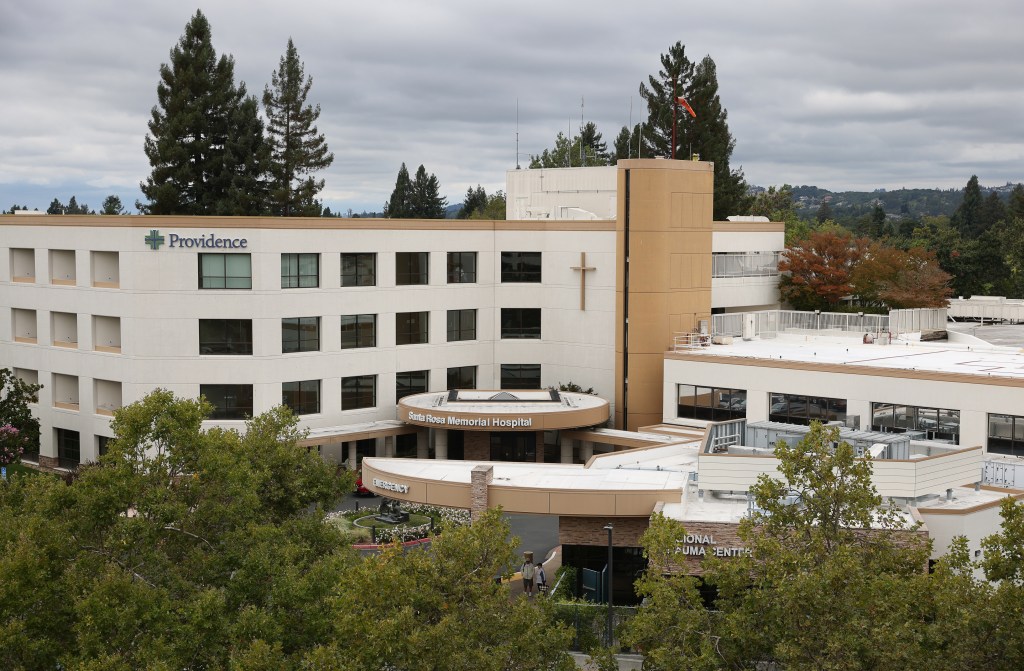
A Sonoma County pediatrics advisory panel has levied its strongest criticism to date of Providence’s recent decision to close the inpatient pediatric ward at Santa Rosa Memorial Hospital.
Members of the Maternal, Child and Adolescent Advisory Board, speaking at the Sonoma County Board of Supervisors’ meeting Tuesday, called on county officials to take more aggressive actions to mitigate the potential impact of the closure, which will leave the county without a hospital unit specializing in overnight, non-emergency care with the exception of Kaiser Permanente, a closed, members-only system.
Michael Perry, a member of the advisory panel, said he was frustrated with the lack of county action in pushing Providence to engage with local pediatrics professionals in crafting plan to address fallout from that void.
“Communications to date have stated that unfortunately this is a state-of-California issue,” Perry said, adding that Providence’s transition plan for closure remains “unacceptably opaque to the public.”
Pediatricians with Providence’s affiliated medical group estimate the inpatient unit treats about 500 patients each year. Without it, roughly 300 children annually would need to be transferred — via helicopter or ambulance —to hospitals outside Sonoma County, predominantly to facilities in Oakland and San Francisco.
About 85% of those pediatric patients are covered by Medi-Cal, the state’s version of the Medicaid insurance program for low-income households. Medi-Cal reimburses hospitals for only about 75% of care costs, among the lowest rates in the nation.
Providence Sonoma County, the local arm of the health care giant that operates more than 50 hospitals across seven western U.S. states — including Santa Rosa Memorial, Petaluma Valley and Healdsburg hospitals — announced in late October that it would shutter the ward, citing financial pressures and low patient volume.
Of Santa Rosa’s other two hospitals, Sutter Health does not have an inpatient pediatric unit, and Kaiser Permanente serves a much smaller share of Medi-Cal patients locally. That leaves families on public insurance with few options close to home if Memorial Hospital stops admitting pediatric patients.
Perry criticized Nolan Sullivan, the county’s health services director, for taking the position that the county has “very little leverage” to make Providence change course. He said the advisory panel has reached out to all the supervisors urging them to “take actions.”
“In my way of thinking, this is not a legal but an ethical issue,” Perry said. “We are all responsible for adequate health care for underserved children, full stop. If a disaster occurs with one child, we’ll have wished we had done more.”
Sullivan, in an email, said he appreciated “the passion, activism and commitment” from local pediatricians and other medical providers concerned about Providence’s decision.
“The sad reality is that, despite the fact that the expected closure of this unit will significantly impact children, especially low-income children needing local access, the county has no tools to compel or influence Providence or any other provider’s lines of service,” Sullivan said in his email.
He said county staff have been in contact with Providence officials over the past months, and that “while we don’t support their decision, we understand it.”
Supervisor Rebecca Hermosillo, whose district includes the Memorial Hospital campus, in an email sent after the supervisors meeting, echoed Sullivan’s position that there was very little the county could do to make Providence change course.
She said that any repurposing of pediatric beds at Memorial Hospital must go through regulatory review by state Department of Public Health and the federal Centers for Medicare and Medicaid Services.
“I am engaged with Providence to ensure that if it closes their pediatric unit, that there are safety nets put in place to mitigate the impacts of the closure,” she said.
Sullivan said county health staff “continue to work behind the scenes to mitigate the impact of this proposed closure, work with other providers in the region to create additional pediatric service lines and support low-income families with children in accessing the medical care they need.”
Providence insists it is working with its physicians and clinical teams on what “our post inpatient pediatric care will look like,” the provider said in a statement. The company said it is also working with UCSF Benioff Children’s Hospital in Oakland to ensure its current patient transfer agreement is “optimized” with the closure plans.
Providence is one of many hospital systems to close pediatric inpatient units in recent years, citing financial pressures and declining patient numbers. A study published last year in the journal JAMA Pediatrics found that hospitals in the United States shut down nearly 30% of pediatric inpatient units between 2008 and 2022, while adult inpatient beds fell by just 4.4% over the same period.
During the supervisors meeting, Dr. Deborah Britt, a pediatrician with Providence Medical Group, said pediatricians in the community “have spoken with a unified voice of the importance of the ward.” Providence, she said, has sought to “minimize the risks of closure” and has misrepresented the “extent of their post pediatric ward planning, which we feel is insufficient.”
Britt urged the supervisors to heed the MCAH advisory board’s recommendations and insist that Providence engage in a “robust, creative effort with relevant stakeholders to arrive at a solution that does not shortchange our children.”
Memorial Hospital’s inpatient pediatric ward is a specialized wing for children requiring overnight hospital care. Separate from the neonatal intensive care unit, the wing is underused, averaging only two pediatric patients per day, according to hospital officials.
Once the unit is closed, hospital sources say Providence plans to keep infants younger than 28 days in the NICU, while some patients older than 14 will be placed in the adult medical-surgical unit. Children needing very short stays — eight to 12 hours — will be kept in the emergency department.
“Providence will decline to do that unless you, elected leaders, provide oversight the public, your constituents, from all indications, want you to do this,” Britt said.
Perry, the MCAH advisory board member, in a phone interview following the supervisors’ meeting, said he has accepted the inevitability of the ward’s closure.
“I accept that the transition is going to occur,” he said. “I don’t accept that that should be done behind the scenes. We have lots of smart concerned people who want to do the right thing for children and they need to be at the table and help develop a (transition) plan.”
You can reach Staff Writer Martin Espinoza at 707-521-5213 or martin.espinoza@pressdemocrat.com. On Twitter @pressreno.