
Up to 98% of Fort Worth’s residential land could be off limits as home addresses for registered sex offenders under an ordinance being considered by City Council.
Council members debated how restrictive they want to be with a new ordinance that could bar sex offenders with child victims from living within either 1,000, 1,500 or 2,000 feet of child safety zones, according to proposals discussed during the Dec. 2 work session.
Texas law defines child safety zones as schools, playgrounds, public pools, youth centers and other such places.
However, some critics of the plan said limiting housing options could drive another public safety concern: homelessness.
Most council members said stricter regulation could keep more neighborhoods safe. However, it also could open the door to affected sex offenders suing Fort Worth, as the city isn’t legally allowed to “banish” people from living within its limits, said Jerris Mapes, senior assistant city attorney.
City staff previously recommended a 1,000-foot restriction, saying it creates the least risk for lawsuits. But a majority of council members expressed concern that such a limit could unintentionally lead to certain neighborhoods becoming hot spots for sex offenders to live in.
“That’s less risk for the city but more risk for the residents that live in these districts where we will encourage sex offenders to move,” said council member Deborah Peoples, whose eastside district would be about 11% open for sex offenders — the fourth most open — to live in if a 1,000-foot restriction is approved.
Of the 3,201 registered sex offenders who live in Fort Worth, 2,454 had victims under 17 years old. Of those, 1,577 have no residency restrictions.
When registered sex offenders are on parole or supervised release, Texas law mandates where they can live on a case-by-case basis. Once they’ve cleared those temporary restrictions, no statewide law mandates where they live.
Such a city ordinance could not be applied retroactively, meaning sex offenders already living close to a child safety zone could not be forced to move.
How much of Fort Worth could be restricted?
These maps, broken down by council district, show how much of Fort Worth’s residential-zoned land would be off limits to registered sex offenders if City Council approved an ordinance.
Percentages reflect the entire district, not just residentially zoned areas. Areas highlighted would be off limits.
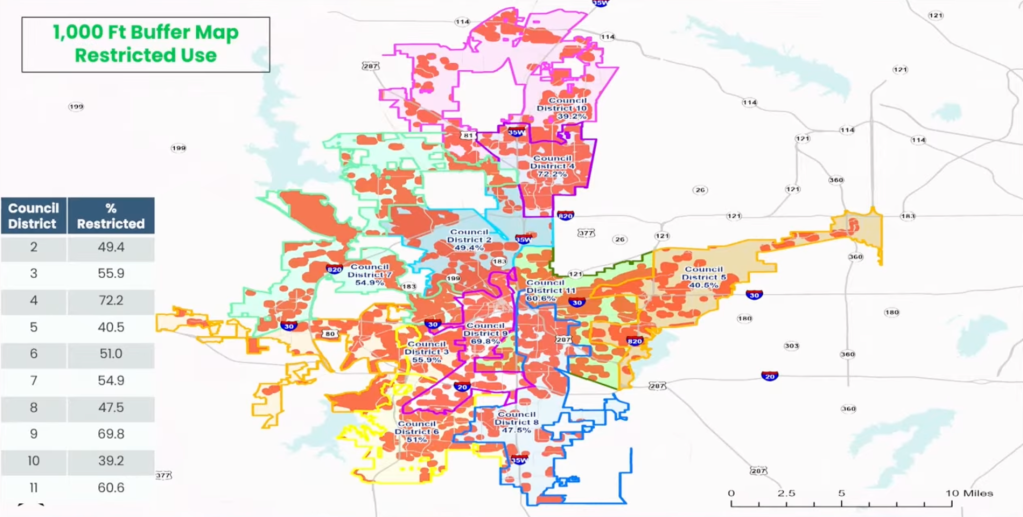
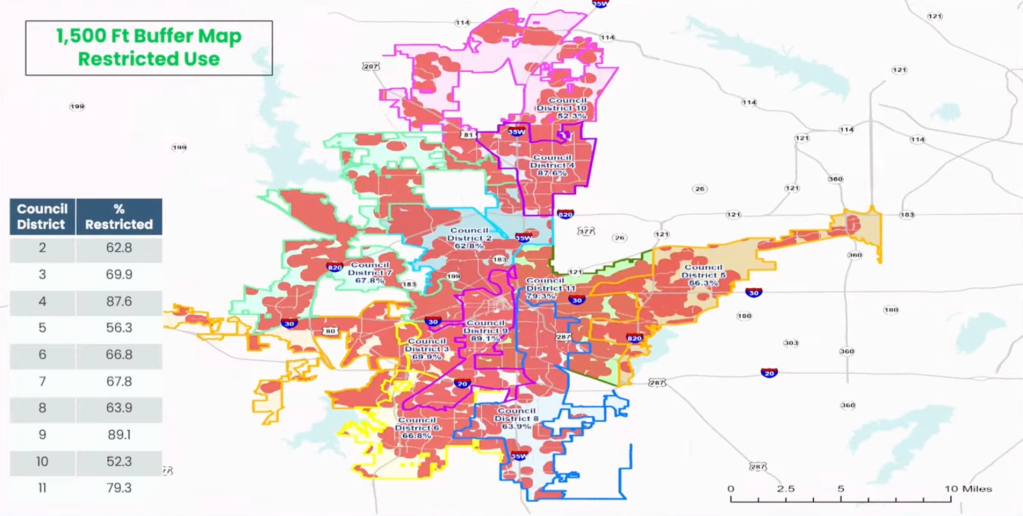
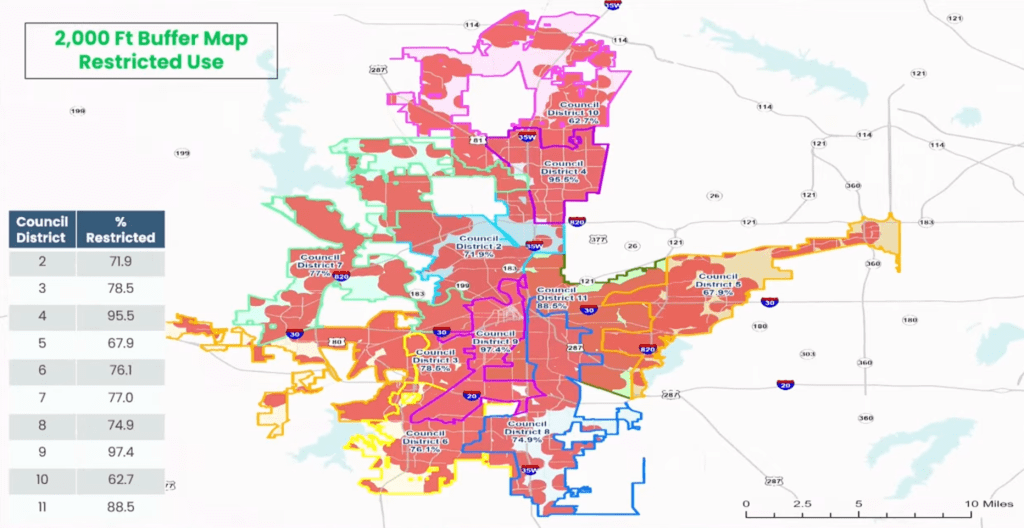 (Courtesy renderings | City of Fort Worth)
The discussion to roll out a policy comes three years after Keller created its 2,000-foot restriction. Both Fort Worth staff and council members said they wanted to prioritize a similar rule for Fort Worth to avoid attracting sex offenders to the city.
Council members said they can work to restrict more areas of Fort Worth after an initial ordinance is passed.
For example, Chris Nettles, who represents a swath of southeast Fort Worth, suggested the council “get creative with zoning” to make more land off limits. Charles Lauersdorf, who represents a northern portion of the city, said Fort Worth could create more parks.
“If there are parks or other areas where our children can safely come together and play, and that just so happens to put a restriction on somebody, they made that bed, and they can sleep in it,” Lauersdorf said.
The effectiveness of such restrictions is debatable, said Jerry Puckett, who with his wife founded and operates Under The SON Outreach, a Christian nonprofit providing transitional living and rehabilitation services to men who are registered sex offenders.
Puckett, a registered sex offender for an offense committed in 1992, went through years of healing and rehab, he said. He said he’s since been open about his experiences and tries to help other men on the road to recovery.
While Puckett would not be directly affected by the restrictions, he said such restrictions do more harm than good. Recently released registered sex offenders already have limitations on where they can live, and those whose state restrictions have expired rarely recommit offenses, he said.
“When someone lives in structured housing, they have curfews, we’ve got drug testing, treatment, employment, daily oversight,” Puckett said. “But when you ban that housing, they don’t disappear. They become homeless. Homelessness is the worst possible condition for public safety.”
Puckett knows his opposition to the restrictions isn’t popular, as it makes him appear to be soft on crime and protecting people who have caused harm in the past. He maintained that rehab programs like his have strict rules.
He cited data suggesting that registered sex offenders’ proximity to schools isn’t correlated to increased risk for children attending them. He noted an estimated 93% of juvenile victims were abused by someone they knew, not a stranger, according to a 2000 study by the U.S. Department of Justice.
At a previous meeting on Oct. 14, council members were hesitant to roll out a one-size-fits-all ordinance.
Carlos Flores said in October that as a parent he wants the maximum distance possible. However, he was concerned about how such an ordinance could affect offenders’ access to jobs and stretch law enforcement resources.
At the same meeting, city staff said any cities have exceptions to their ordinances, including for those who committed crimes as a minor and have since become good members of society.
At the Dec. 2 meeting, Mapes told council members that they can decide how the ordinance is written — including its exceptions and definitions.
Council member Mia Hall, who was also wary of a one-size-fits-all approach, said that she was hesitant to implement an ordinance that could make her district more open to registered sex offenders. Hall’s District 6 would be 10.7% open to sex offenders under the 1,000-foot restriction.
“I don’t want to be punitive to any group of people, and I do believe in rehabilitation and all types of things, but I feel like this does marginalize some of our communities, or impacts them, much more inequitably than it does others,” Hall said.
Council members requested that city staff research the legality of a 1,500- or 2,000-foot restriction — and how they’ve fared in court in other Texas cities — before bringing it to a vote.
What ordinances do other cities enforce?
Dallas: Does not allow offenders whose victims were under 17 to “remain at or near” child safety zones.
San Antonio: Does not allow any offender to live within 1,000 feet of a park, or loiter within 300 feet of a park.
Arlington: Does not allow “habitual offenders” to live within 1,000 feet of specified zones.
Everman: Does not allow offenders whose victims were under 17 to live or rent within 1,000 feet of specified zones.
Keller: Does not allow offenders whose victim was under 17 to live or rent within 2,000 feet of specified zones.
Mansfield: Does not allow any offender to live or rent within 1,000 feet of specified zones, and this year added restrictions to multiple offenders living at the same dwelling.
Drew Shaw is a government accountability reporter for the Fort Worth Report. Contact him at drew.shaw@fortworthreport.org or @shawlings601.
At the Fort Worth Report, news decisions are made independently of our board members and financial supporters. Read more about our editorial independence policy here.
This <a target=”_blank” href=”https://fortworthreport.org/2025/12/09/sex-offenders-couldnt-live-in-most-fort-worth-neighborhoods-under-proposed-ordinance/”>article</a> first appeared on <a target=”_blank” href=”https://fortworthreport.org”>Fort Worth Report</a> and is republished here under a <a target=”_blank” href=”https://creativecommons.org/licenses/by-nd/4.0/”>Creative Commons Attribution-NoDerivatives 4.0 International License</a>.<img src=”https://i0.wp.com/fortworthreport.org/wp-content/uploads/2021/04/cropped-favicon.png?resize=150%2C150&quality=80&ssl=1″ style=”width:1em;height:1em;margin-left:10px;”>
<img id=”republication-tracker-tool-source” src=”https://fortworthreport.org/?republication-pixel=true&post=321231&ga4=2820184429″ style=”width:1px;height:1px;”><script> PARSELY = { autotrack: false, onload: function() { PARSELY.beacon.trackPageView({ url: “https://fortworthreport.org/2025/12/09/sex-offenders-couldnt-live-in-most-fort-worth-neighborhoods-under-proposed-ordinance/”, urlref: window.location.href }); } } </script> <script id=”parsely-cfg” src=”//cdn.parsely.com/keys/fortworthreport.org/p.js”></script>