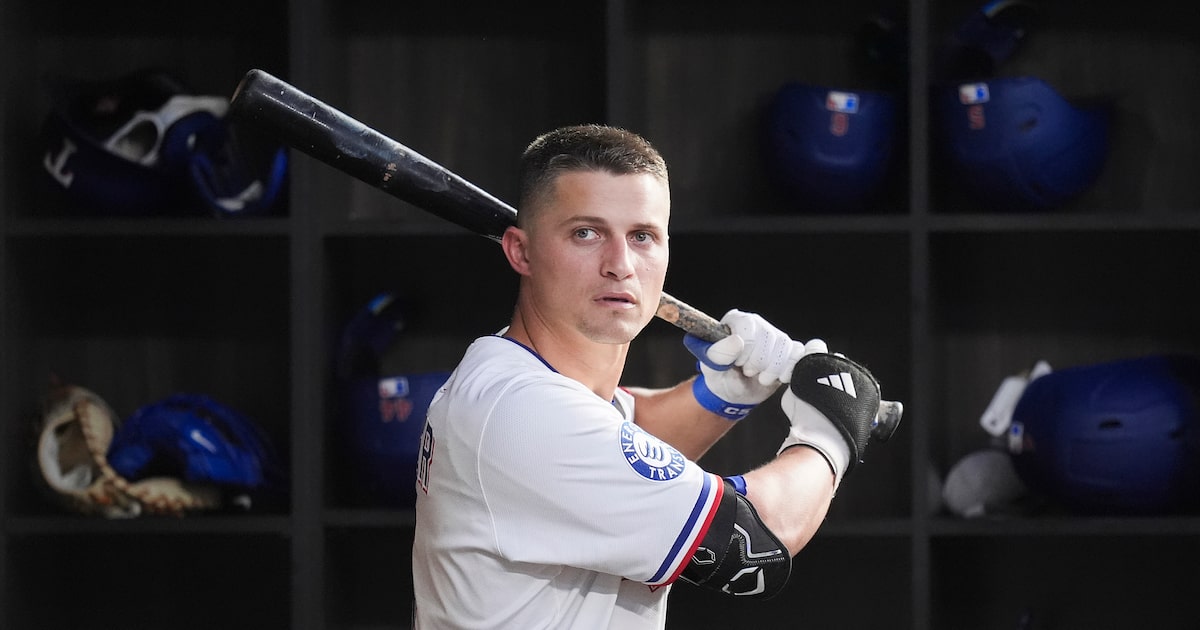
LAKE BUENA VISTA, Fla. – As the Rangers prepare to pack up at winter meetings, stow their mostly meager resources and return home to continue trying to fill multiple roster needs, they’ve found that they have at least one potentially valuable trade chip.
Related

The question is whether the club has any interest in furthering discussions. According to two people with knowledge of the conversations, several deep-pocketed teams, including the Boston Red Sox, have noted the Rangers’ financial approach to the winter and have expressed interest in Seager this offseason. While the Rangers have noted the interest and haven’t explicitly said he’s unavailable, they haven’t engaged in deeper discussions.
Rangers
Other teams that have inquired include Atlanta and the New York Yankees.
The takeaway is that the Rangers are not motivated to move Seager, but haven’t flatly dismissed overtures from teams that are interested. There do not appear to be ongoing conversations, either.
Boston, according to a report in The Boston Globe, has conversed with at least four teams this winter about premier middle infielders – the Rangers about Seager, Arizona about Ketel Marte, St. Louis about Brendan Donovan and Houston about Isaac Paredes. The Red Sox have also been linked to free agent shortstop Bo Bichette.
Boston, at least, has the wherewithal to potentially entice the Rangers to listen a little more. The Red Sox have a host of young, controllable major leaguers such as shortstop Marcelo Mayer and left-handed Payton Tolle, just to name two.
Seager, who turns 32 in April, has six years and $189 million remaining on his 10-year, $325 million contract. Based on the market and his position, there is reason to believe that if he were a free agent, he could still get more than that. So teams could view him as something of a free agent “bargain.”
It also means that from the Rangers’ perspective, even as motivated as they are to trim payroll, there would be no reason to “buy down” any of the contract by sending some cash to another club.
It would take premier young players to acquire a premier veteran. And, given the stance of President of Baseball Operations Chris Young, who bristled earlier this offseason at the suggestion that cutting payroll was akin to rebuilding, the players would need to be major league ready to give the Rangers at least a fighting chance to compete.
But there is also reason to at least listen. If the Rangers are ever going to consider trading Seager, the window likely closes after this season. He will reach 10 years of service, including five with the Rangers, in 2026, thus giving him the right to block any trade. While not an absolute deal-killer, it changes the market and reduces leverage.
Though Seager’s last three seasons have all had significant injury-related interruptions limiting him to an average of 114 games per year, he remains an elite contributor. He’s averaged 6.1 WAR per season – Superstar/MVP-candidate-worth, according to FanGraphs calculations – and posted a .916 OPS. When he starts, the Rangers are a winning team (180-163, .525 winning percentage); a 59-64 team when he doesn’t.
Related

On the other hand, if the Rangers moved Seager for a host of young, pre-arbitration players, it would give them a larger pool of young talent to help fill multiple holes and a much more significant pot of money to spend to further strengthen the team.
All it would take is being willing to bid adieu to the World Series MVP of their only win who remains one of baseball’s best.
Find more Rangers coverage from The Dallas Morning News here.
Click or tap here to sign up for our Rangers newsletter.