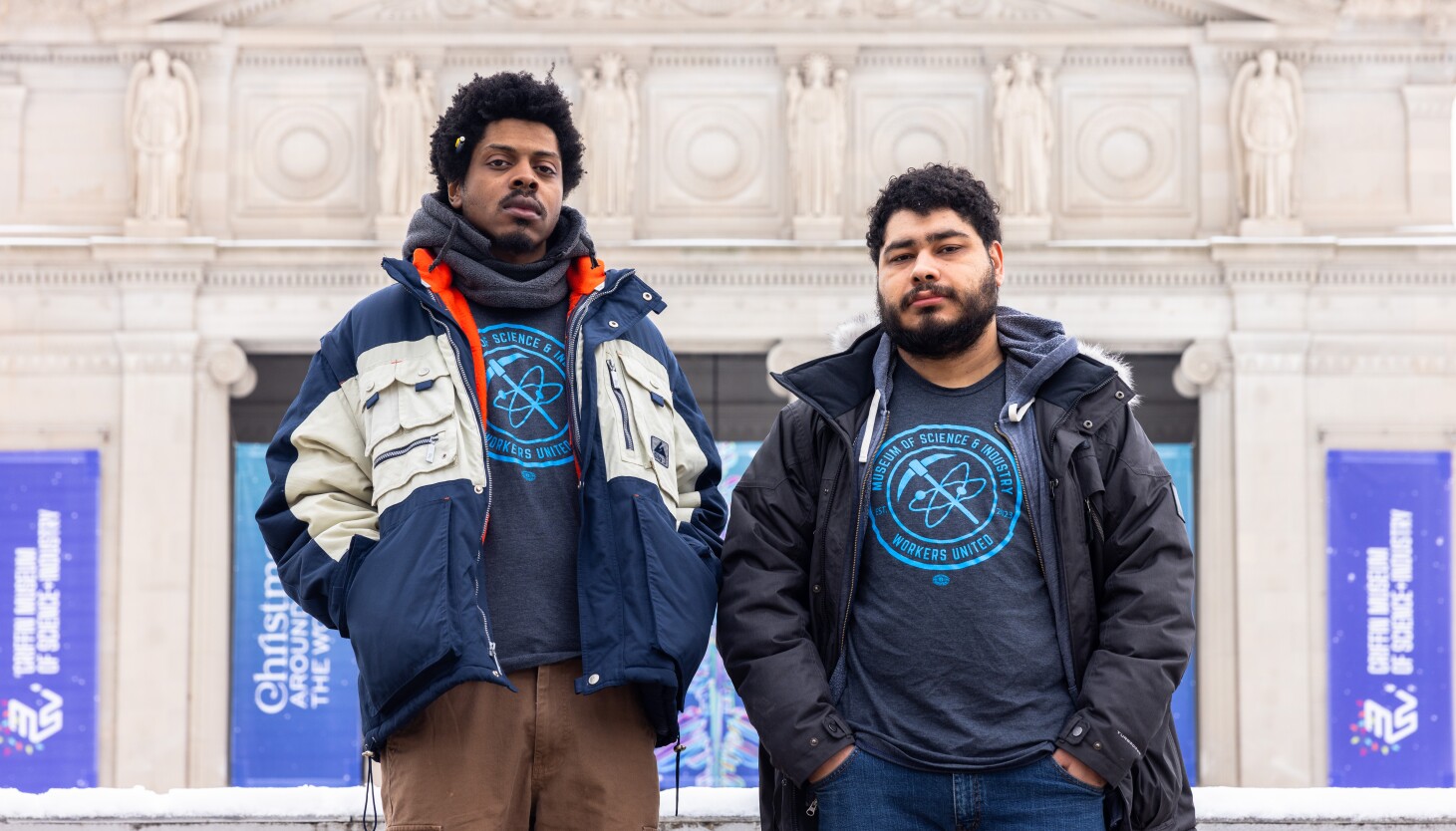
As a former guest engagement employee at the Griffin Museum of Science and Industry, David Dowd was on the “front line.”
Greeting customers and giving tours was fun, he said, but it was also challenging. He had to navigate different personalities, moods and perspectives on divisive scientific topics such as climate change.
Seeing his colleagues juggle demanding roles while feeling undervalued by management motivated him to join the union bargaining committee at the museum.
“They are constantly thinking of ways that they can have a meaningful impact on the world,” he said of his peers. “To see them give so much of themselves for so little in return probably inspired me more than anything.”
Dowd, 31, of Hyde Park, helped his fellow workers successfully unionize before leaving the museum for personal reasons. Earlier this month, the museum ratified its first union contract, which includes an average 8% pay increase and new workplace protections. The cohort of more than 120 employees in guest-facing roles and the education department is represented by the American Federation of State, County and Municipal Employees Council 31.
The victory is the latest in a wave of unionization at Chicago’s cultural institutions. Launched in 2020, AFSCME’s Cultural Workers United organizing campaign now represents 50,000 cultural workers nationwide. In the past four years, it has helped 2,500 Illinois cultural workers form unions at such sites as the Art Institute of Chicago, Field Museum, Museum of Contemporary Art, Shedd Aquarium and Newberry Library.

David Dowd, a former guest engagement employee at the Griffin Museum of Science and Industry, said seeing his colleagues juggle demanding roles while feeling undervalued motivated him to join the union bargaining committee at the organization.
Candace Dane Chambers/Sun-Times
Employees at the Adler Planetarium could soon join them after a vote on Thursday. Separately, staffers at the Chicago Botanic Garden are organizing under the Chicago and Midwest Regional Joint Board of Workers United.
But such votes are happening at what museums say is a perilous time, as about a third of U.S. museums have lost government grants or contracts. More than half of U.S. museums reported fewer visitors in 2025 than in 2019, according to a November report by the American Alliance of Museums. As a result, financial performance has stalled or declined for about half.
During tough economic times, unions should be viewed as partners instead of adversaries, said Anders Lindall, a spokesperson for AFSCME Council 31. He pointed out that AFSCME joined the American Library Association in filing a lawsuit blocking President Donald Trump’s attempt to dismantle the Institute of Museum and Library Services. (The lawsuit is ongoing, but the IMLS has since reinstated its previously terminated grants in response to a separate lawsuit filed by the attorneys general of 21 states.)
“We should absolutely be fighting together,” Lindall said.
Cultural workers are more vocal than ever
Workers say rising inflation and other economic challenges have moved them to demand better pay and benefits. And though nonprofit museums and cultural sites may struggle to meet such demands, employees are continuing to push back, feeling they’ve long been taken for granted.
Lindall said there used to be a sense that, “You are lucky to work here and there is a line of people down the block to take your job, so don’t be the squeaky wheel.”
But then the COVID-19 pandemic happened. “You had museums getting a lot of public funding to maintain their workforces and stay afloat,” Lindall said. “But workers were still being furloughed, laid off or taking pay cuts, and top management was not.”
A local tipping point was the unionization effort at the Art Institute of Chicago, the city’s largest cultural destination by revenue, according to ProPublica’s Nonprofit Explorer database. The organization’s first-ever union contract was ratified in 2023.
“Certainly throughout our fight, having the Art Institute be ahead of us made an enormous difference in our morale,” said Melissa Anderson, a library collection specialist who has worked at the Field Museum for more than 20 years.

Anders Lindall, spokesman for the Council 31 of the American Federation of State, County and Municipal Employees, is shown at a 2021 rally at the Art Institute of Chicago. The organization’s unionization was a local tipping point, inspiring workers at other cultural institutions to organize.
Jason Beeferman/Sun-Times
In May, the Field Museum ratified its first union contract, which offered pay increases from nearly 14% to more than 17%, a new grievance procedure and stronger disciplinary rights. Previously, employees had been demoralized by low pay, according to Anderson, 44, who moved to the south suburbs because she could no longer afford rent in the city.
“What we do is very niche,” she said. “If I wanted to be a librarian at a different national history museum, I’d have to pick up my life and move to another major city. They take advantage of that. They know that you are loyal to this place.”
Path to union not always smooth
One factor that may be weighing in workers’ favor is that many museums are reporting difficulty filling both paid and volunteer roles, according to the American Alliance of Museums.
“Inflation’s been on the rise,” said American Alliance of Museums President and CEO Marilyn Jackson. “When people are looking at what they can get paid in the nonprofit environment, they’re rethinking that and maybe looking for opportunities that may help them balance their household budget.”
In an unstable economic moment, Jackson said museums are trying to adapt by bolstering membership programs, increasing the number of facility rentals, reducing utility bills and closing one or more days per week.
Economic uncertainty will only strengthen unionization efforts, especially if organizations decide to reduce staff or decrease pay, said Robert Bruno, a professor of labor and employment relations at the University of Illinois Urbana-Champaign.
“It’s going to increase dissatisfaction among workers,” he said. “And, as a result, they’ll look to organizations to represent them and help protect them.”
Bruno said he expects that employees will continue to see success in obtaining raises through collective bargaining. City leaders, donors and patrons do not want to see a diminished cultural industry, he said.
“It’s critical to how a city feels and how it looks, and it really does tie into its economic success,” he said. “These institutions are going to have to recognize these workers. They are going to have to at least agree to compensation levels that enable people to live in this city.”
Still, the process of unionization may not be smooth at every site. At Chicago Botanic Garden, there’s currently a disagreement between workers and management with what steps should be required to establish a union. Employees who are advocating for better pay, health care and safety on the job and are represented by CMRJB Workers United say they are asking employees to sign union cards.
However, Chicago Botanic Garden leadership opposes that approach in favor of a secret ballot election to vote on the union.
“To skip that step would really be disenfranchising those eligible employees,” Chicago Botanic Garden President and CEO Jean Franczyk told the Sun-Times. “The process has multiple steps and options that you can pursue. But the one that we think protects individual eligible workers’ rights is that supervised election.”
CMRJB Workers United Organizing Director Matt Muchowski said the union card-signing process is supported by the U.S. Department of Labor and called management’s election request is a “delay tactic so that they can continue to intimidate workers.”

Represented by CMRJB Workers United, some Chicago Botanic Garden employees are currently advocating for better pay, health care and safety on the job.
Courtesy Chicago Botanic Garden, file
Muchowski claims that Chicago Botanic Garden has retaliated against workers by sharing anti-union propaganda. And former employee Kai Shin, 32, of Pilsen, told the Sun-Times he was fired in October after raising concerns about layoffs and speaking out in favor of the union.
Franczyk said the organization does not comment publicly about personnel matters.
“I have every confidence that the Garden would never terminate an employee because they were pro-union or anti-union,” she said.
Franczyk, who will retire next March, acknowledged that the nonprofit has been impacted by the precarious economic environment, but wouldn’t say whether it was impacting hiring or employee pay.
“The landscape has changed, and so now it’s on us to find a way to raise that money in other ways,” she said.
Chicago Botanic Garden assistant horticulturist Lorilin Meyer, 45, of Wilmette, said she and her colleagues are underpaid.
“I think that workers in the country are feeling the pinch and feeling unheard,” said Meyer, who received a pay increase of just 19 cents following a promotion. “To have this huge gap between people who have and people who have less is extremely frustrating.”
At Griffin Museum of Science and Industry, the union agreement ratified last week includes immediate pay increases for every union member and holiday pay for part-time workers. The contract also establishes a committee to study paid parental leave, which is not currently offered at the museum.
In a statement attributed to the Griffin Museum of Science and Industry, a spokesperson said the organization appreciated the “dedicated work” of the bargaining teams.
“Our employees play an essential role in delivering meaningful experiences for our visitors and communities, and we are pleased to move forward together.”