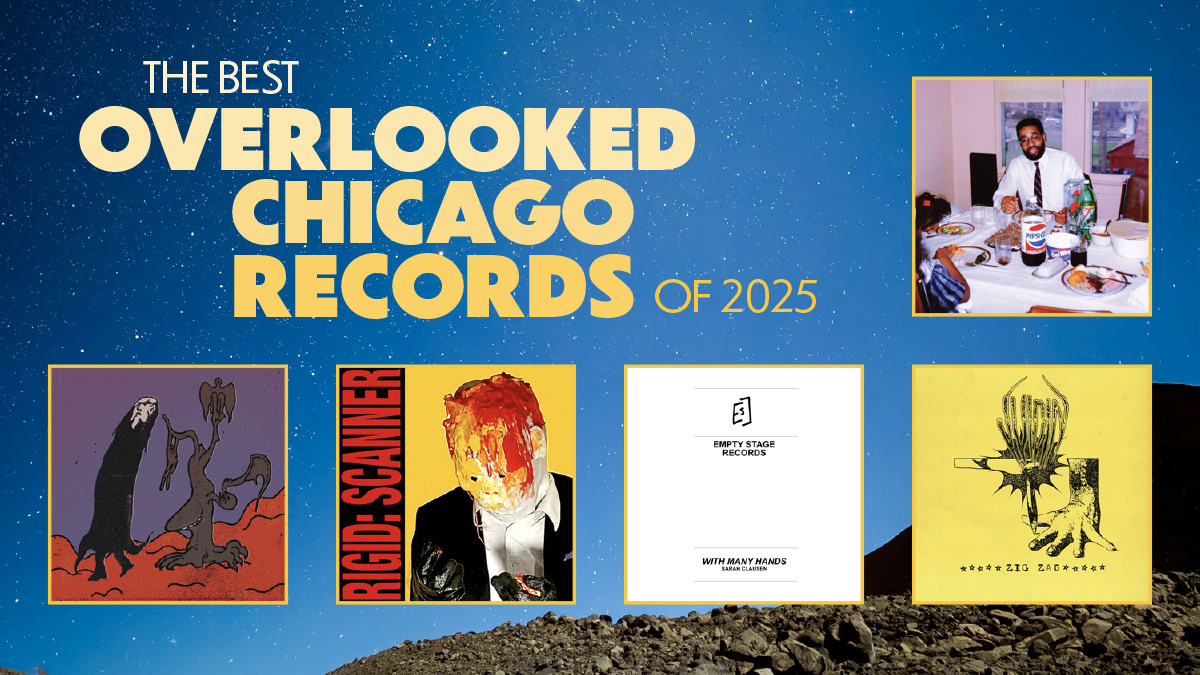
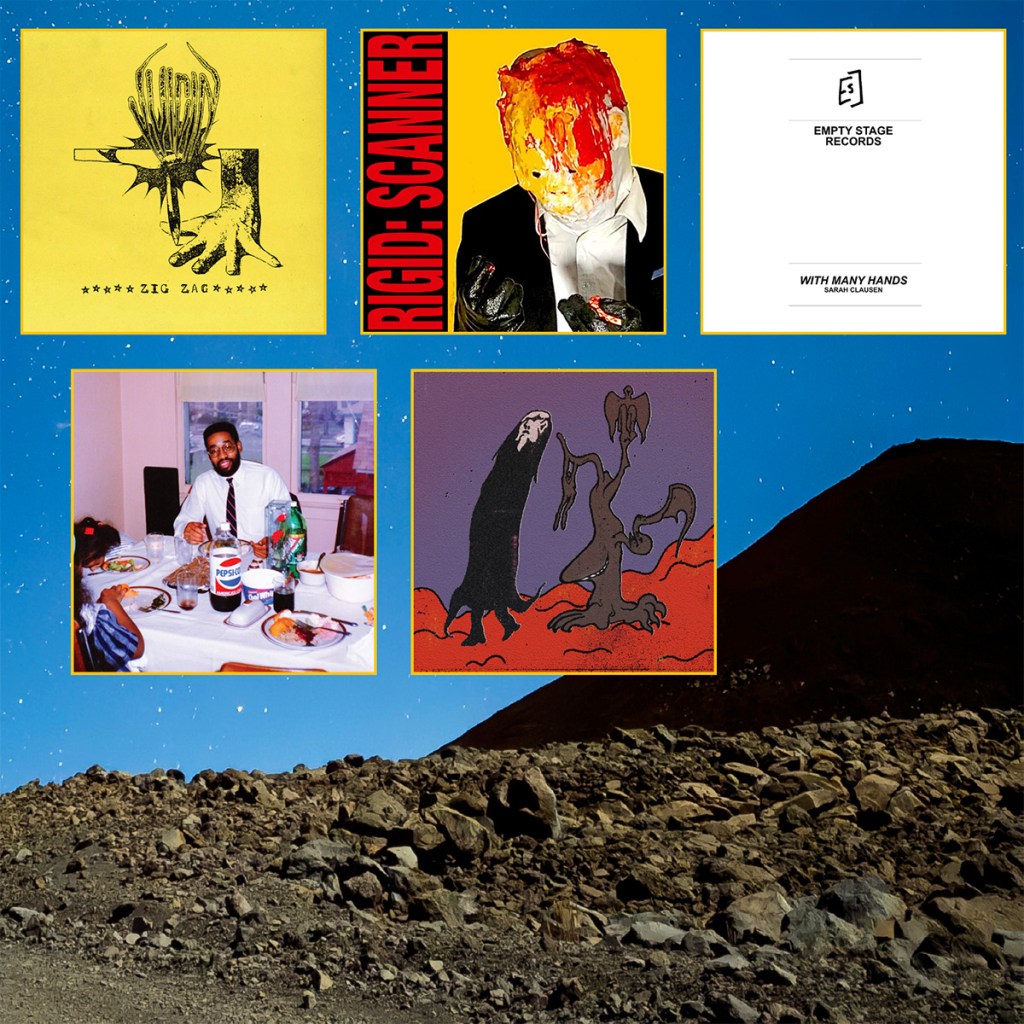
 Credit: Collage by Kirk Williamson
In July, the Atlantic ran a story about a vanishing resource that was once commonplace in publications covering arts and culture: event listings. The story’s author, career musician Gabriel Kahane, had moved to New York City fresh out of college in 2003, and he focused his attention on the New Yorker, the New York Times, Time Out New York, and the Village Voice. His paean and obituary pointed out not only that listings showed him everything he could do each night but also that the pithy blurbs alongside the concert listings in Time Out gave him a crucial early boost as an emerging artist.
Kahane treated these critics’ picks as interchangeable with listings, which caused me some confusion. To me, critical writing about an upcoming concert is fundamentally different from a listing, which is typically just the basic details of the event, sorted by venue or date or some other principle. A listing doesn’t have opinions. A critic’s pick, by contrast, offers a concise argument as to why a specific show matters.
The Reader still runs several such concert previews weekly, though they’re much longer than the old Time Out picks. (My preview of Chance the Rapper’s headlining show in October, for example, was nearly 1,000 words.) Kahane and I agree about many of the reasons concert previews are important—for one thing, they allow critics to use their knowledge and insight to advocate for artists their readers may never have heard of. Kahane mentions several famous musicians he found through listings before they became stars, which feels a little self-defeating. If it’s important to write about folks who aren’t household names, why focus on celebrities? I suppose he’s trying to explain the value of listings to boomer readers of the Atlantic.
Kahane’s Atlantic piece also gets into the emergence of poptimism in the 2000s and connects it to the death of listings. Poptimism, loosely speaking, is a school of thought that encourages critics to bring intellectual rigor to pop music that’s been maligned (or ignored) by older generations of writers. (That said, two decades after the widespread adoption of the term, two critics might come up with three different definitions of it.)
Kahane argues that poptimist critics enriched the culture but couldn’t have imagined “the extent to which their goal would collide with the economic imperatives of internet-based journalism.” No longer was coverage of genuinely popular artists discouraged by snobbery, sexism, or racism—the drive for clicks eventually made it “the status quo in mainstream music journalism.”
This trend reached its “apotheosis,” as Kahane puts it, “in 2023 with USA Today‘s hiring of a full-time Taylor Swift reporter, Bryan West, who would go on to file—you may want to sit down—501 articles about Swift during her Eras Tour.”
In fairness to West, he’s not a music critic. He spent almost a decade as a broadcast news reporter and producer, and he has experience in investigative journalism. Of course, broadcast reporting, investigative journalism, and arts criticism aren’t mutually exclusive. But USA Today didn’t hire West to write criticism about Taylor Swift. They wanted him to produce a lot of copy with her name in it to draw in as many readers as possible. If that sounds cheap or cynical, so is what West does.
What has West written about Swift lately? A piece about Travis Kelce allegedly never arguing with Swift, with quotes sourced mostly from Kelce’s New Heights podcast. A report on a new trailer for a second Eras Tour movie, which quotes from the trailer and a fan’s TikTok explainer. Three separate stories about a Naperville family with an elaborate “viral” Swift-themed Christmas display: a reported story, a photo gallery, and a short-form video. I’ll argue that traditional reporting can function as an act of criticism (and vice versa), but this kind of low-calorie content mining is barely as useful as a press release.
It’s more fun to use this space to convince people to give, say, Heet Deth’s Bad Reading a try than it is to be the umpteenth person to put Geese’s Getting Killed on a top ten.
Last month, USA Today’s parent entity, Gannett, changed its name to USA Today Company. It’s the largest newspaper company in the country, and it operates more than 200 papers. In 2019, the year it merged with the country’s second-largest newspaper business, GateHouse Media, Gannett ran 563 papers. At the time, the newly combined company, loaded with more than $1 billion in debt, employed about 24,000 people in the States; by the end of 2022, that number had fallen to 11,200.
Among the surviving newspapers under the USA Today Company banner is the Burlington Free Press in Vermont. The Free Press website lists six editorial employees. As USA Today Company has hacked away at the Free Press over the years, several staffers have moved over to Seven Days, a Vermont alt-weekly. Seven Days has the largest circulation of any newspaper in Vermont, and its editorial department employs 32 people. It also still publishes concert and event listings.
Seven Days is an exception. As former Reader staffer Aimee Levitt detailed in a Columbia Journalism Review story in June, Seven Days has survived the decline of local news and the extinction-level crisis of the COVID-19 pandemic because it serves a niche community. I’m more familiar with Seven Days than the other extant alt-weeklies Levitt mentions (my in-laws are Vermonters), but I can’t imagine they’re still thriving by prioritizing celebrity runoff over local arts coverage.
I cover local music year-round. For more than a decade, I’ve been wrapping up the year with some version of this list of overlooked Chicago releases. It’s an opportunity to reflect on the past year, address my blind spots, and dream of how I might improve my work. I also get the chance to introduce lesser-known acts (or complete unknowns) to a larger audience.
People seem to like year-end listicles (they definitely like skimming them, at least), so you’ll still see plenty of them out there, despite the general dwindling of arts and culture journalism. But few of these lists focus explicitly on smaller acts, like this one does. And frankly, it’s more fun to use this space to convince people to give, say, Heet Deth’s Bad Reading a try than it is to be the umpteenth person to put Geese’s Getting Killed on a top ten.
Bad Reading isn’t on this list. I’ve covered Heet Deth in the past, which is a strike against the band in this context—when I think about Chicago music that’s been overlooked, I try to confine myself to music that I personally have also overlooked. With any luck, that means you’re about to learn about something you’ve never heard before. I hope you love it as much as I do.
The top five
In alphabetical order
I’m breaking one of my own rules by including With Many Hands. I mentioned it in passing in October as part of a Gossip Wolf item on Hannah Frances; Clausen is musical director of Frances’s band, in which she plays alto saxophone and bass clarinet. With Many Hands is outstanding enough to warrant the exception. Its slow-moving, almost ambient songs, built largely from reeds, electronics, and voice, span a kaleidoscopic range of moods and textures. On “Cry,” Clausen uses an effects pedal to stretch out a resonant woodwind note like a fitted bedsheet, providing a canvas for her somber singing to move across the song in a dramatic, elegant sweep.
This is easily the most “known” release on this list, thanks to Coleman’s long relationship with Scottish archival label Athens of the North, which has already reissued music by two of his other projects: 70s funk band Rasputin’s Stash and 80s soul combo Crystal Winds. In the early 90s, Coleman recorded a collection of background tracks for the Weather Channel, which Athens of the North compiled for this album. (Coleman says they were only played on the air a few times.) For most of its history, smooth jazz has had a pretty lousy reputation—it’s been maligned as a marketing-driven musical equivalent to a weighted blanket. But the genre has been rehabilitated over the past 15 years or so via remixes by vaporwave artists and the efforts of reissue labels who heard something distinctive in it. So it’s a fine time for The Weather Man, which showcases Coleman’s sophisticated touch as an arranger and performer.
The debut album from cheeky alt-rock band Crisis Actress thrashes, lunges, and stomps in inexplicable directions. The knuckle-dragging opening track, “For Gary,” plays like a no-wave take on Krautrock. The rhythm section digs into hypnosis on the psychedelic opus “Sniff,” which piles on backmasked recordings, electric vibraphone, synths, and swirling vocals.
Ryan Davis drums in noise-pop group Astrobrite and leads heavy shoegaze group Sleepwalk, and he also makes dreamy, hard-hitting alt-rock with guitarist and bassist Tyler Gargula under the name Juicin. Their quick-hit debut EP, where Davis plays guitar, bass, and drums, goes out to Deftones fans who fiend for lush, concise, no-nonsense rippers with serene, slow-motion vocal melodies.
South-side industrial group Rigid are well suited to update the Wax Trax! vibe for Gen Z. The trash-can clang of their electro percussion aims to bruise, and the big, honking riffs on Scanner won’t just rattle your rib cage—they’ll stick to your bones.
Honorable mentions
Seth Beck, Soft Heaven
Damen Silos, Far From God
Huxeti, This Summer Was Like Saline Rinse
The Ineffectuals, The Serious One
Toddo, No Room for the Blues
- Leor Galil has been making year-end lists of undeservedly overlooked Chicago records for years, and all the music he’s recommended is still worth hearing. If you’d like to keep exploring, you can start with his lists from 2024, 2023, and 2022.
Reader Recommends: CONCERTS
Upcoming shows to have on your radar.