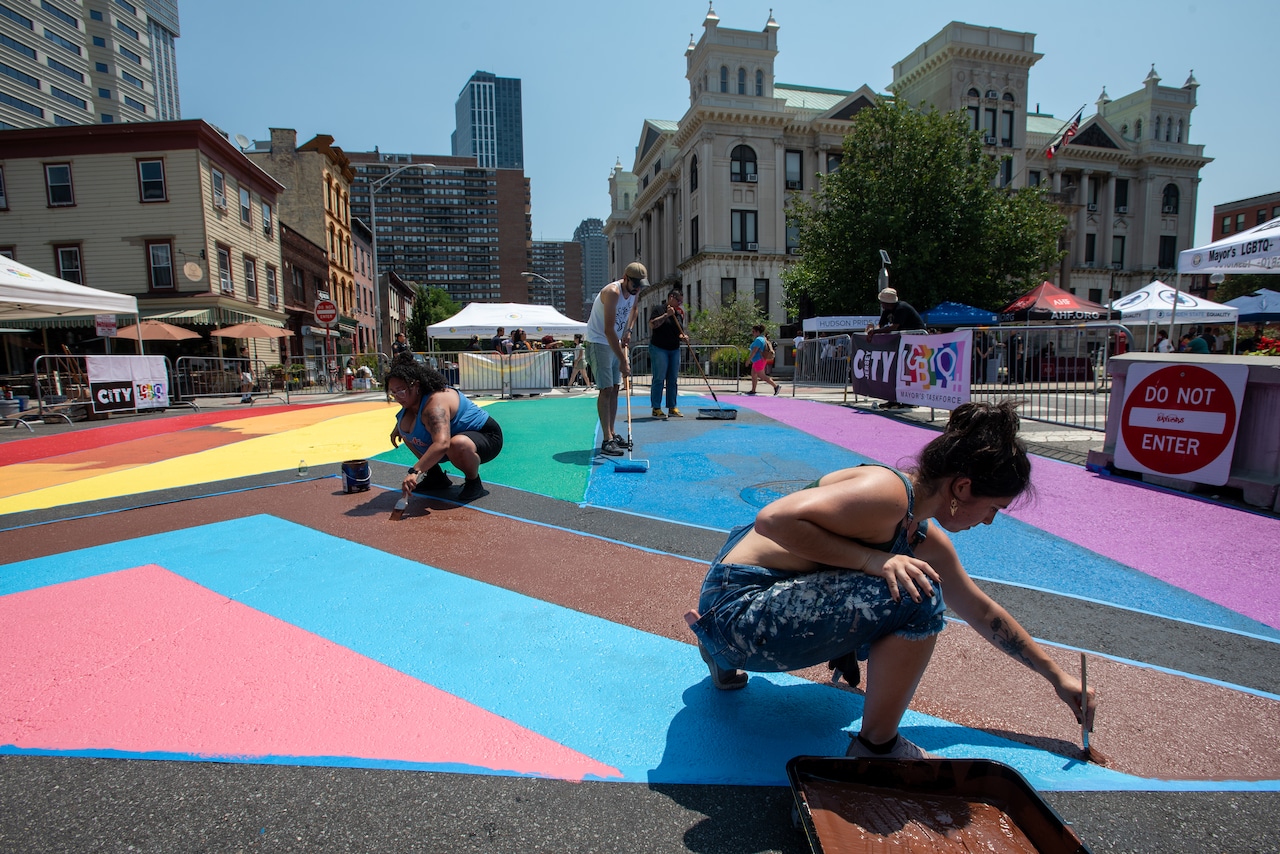
 Volunteers, from left, Layla Orlando, Patrick Byrne, Sonia Marte-Dublin and Larissa Garcia help paint the Pride crosswalk in Jersey City.Reena Rose Sibayan | The Jersey Journal
Five New Jersey cities have been ranked among the best for their inclusive policies and practices that affect LGBTQ+ residents and employees, according to a new study.
The study was conducted in November by the Human Rights Campaign Foundation, the charitable arm of the Human Rights Campaign (HRC), which works for policy and other changes to protect members of the LGBTQ community.
In its 14th consecutive Municipal Equality Index (MEI), the HRCF ranked Hoboken, Jersey City, Asbury Park, Princeton and Montclair among the best of the best, awarding each a perfect score of 100.
“With the federal government and many states leaving LGBTQ+ people behind, cities and towns, including across New Jersey, are stepping up to embrace inclusion and equality,” said Kelley Robinson, president of the Human Rights Campaign.
The MEI evaluates how inclusive municipal laws, policies and services are for LGBTQ+ residents and employees. This year’s study assessed 506 cities from every state on 49 different criteria, including hiring practices, public accommodations and healthcare access. The report looked at 13 cities in New Jersey. The full 2025 MEI report, including detailed scorecards for every city and a searchable score database, is available here.
According to the MEI report, LGBTQ+ protections are strengthening nationwide at the local level, with a record 132 cities — more than one-quarter of those evaluated — earning perfect scores.
The HRC noted that the rise in anti-LGBTQ+ legislation and rhetoric at every level of government has created a chilling effect in cities nationwide.
Robinson said that is why the HRC is prioritizing the Equality Act, a federal bill that would ban discrimination based on sexual orientation or gender identity in employment, housing, education, public services and other key areas of life.
“In these challenging times, our work with the Municipal Equality Index and the leadership of these municipalities has never been more critical,” Robinson said.
Hoboken Mayor, Ravi S. Bhalla was pleased with the city’s ranking, saying the score reflects its values and its resolve at a time of heightened national debate over LGBTQ+ rights.
“As gender affirming care, same sex marriage, and workplace protections continue to be attacked on the federal level, it has never been more critical to continue to stand firm in our beliefs to uplift and protect our LGBTQ+ community members,” Bhalla said.
Hoboken’s LGBTQ+ Community Liaison Laura Knittel noted that the city has been intentional about building a supportive environment over many years.
“For over a decade, Hoboken has built a community rooted in inclusivity, where respect and understanding grow,” she said, adding that Hoboken has become a refuge for families seeking safety and affirmation, particularly those with transgender children.
Officials in neighboring Jersey City were pleased with its ranking as well, noting that it has expanded its LGBTQ+ programming with new employee training and business recognition.
“We provide sensitivity training for city employees and the public,” said Jeana Abuan, who helps lead the city’s LGBTQ+ programming. “We’ve worked to ensure LGBTQ-owned businesses are recognized as an important part of Jersey City’s DEI efforts. We also honor days of significance, like Transgender Day of Visibility, and host events such as flag-raisings and community programs.”
Abuan said the city is especially proud of its efforts to uplift local leaders.
“This year, we highlighted key individuals who have made meaningful contributions to the LGBTQ community and presented them with certificates recognizing their impact,” she said.
Asbury Park Deputy Mayor Amy Quinn said the community’s LGBTQ+ ties stretch back generations.
“Asbury Park has a very long history with the LGBTQ community, going all the way back to the 1960s,” Quinn said. “We performed the first same-sex marriages in 2000, and again in 2005, even though they weren’t yet legal. Then, in 2015, I became one of the first people to legally marry here — I’m a lesbian, and I got married right on the Asbury Park boardwalk.”
Quinn said the city’s character and culture continue to reinforce its reputation as a welcoming place. LGBTQ-owned businesses remain a cornerstone of Asbury Park’s identity, including the dance club Paradise and Georgies bar, remain a cornerstone of Asbury Park’s identity, including the dance club Paradise and Georgies bar.
“All of it reflects our ongoing commitment to ensuring that LGBTQ people feel welcome,” she said, “not just when they work for Asbury Park, but anytime they step foot in our city.”
Garden State Equality, an organization dedicated to LGBTQ+ advocacy and education, is headquartered in Asbury Park and stands as an example of the city’s long-standing inclusivity.
“As a statewide organization, Garden State Equality (GSE) travels the whole of our beautiful, diverse state, and we have chosen our headquarters location very carefully,” said Lauren Albrecht, senior director of Advocacy at Garden State Equality.
“While no place on this planet has proven to be failsafe for queer people, we have given our confidence to the community and leadership here in Asbury Park, and we do not offer that lightly. Congratulations to the whole of Asbury Park — the residents, the businesses, and the government, for earning this score.”
Quinn and Albrecht’s local affirmations echo a broader message resonating across the country.
“There are still more of us who support equality than those who do not,” Robinson said. “I commend each and every city that fought against tall odds to show their continued support of our community.”